

| Select IC Type: | LPD6803 (Base), WS2811 (Base) |
|---|---|
| Availability | In Stock |
| Condition | Brand New |
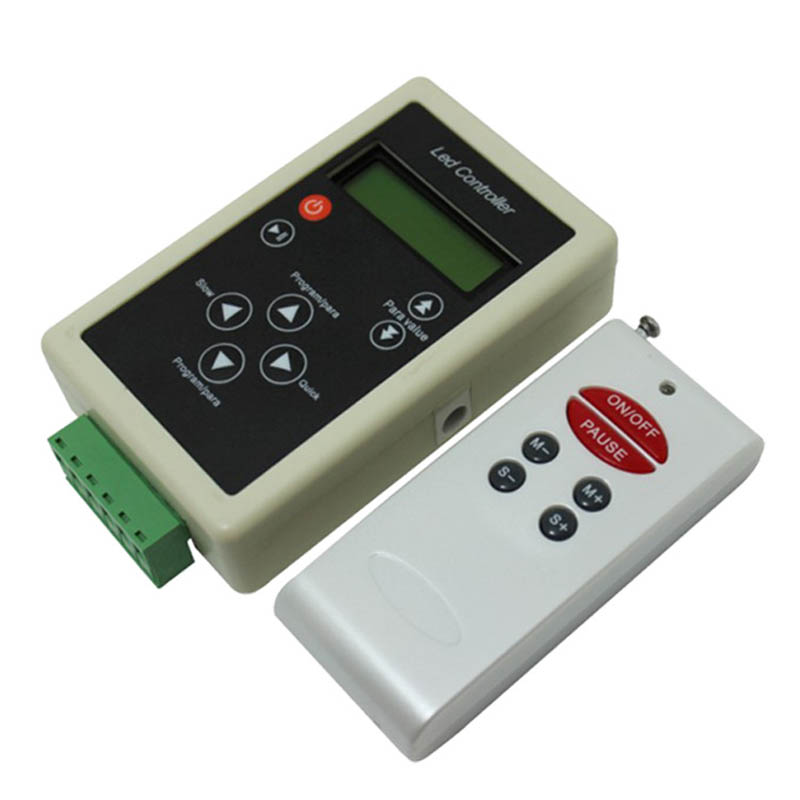
Symphony controller is suitable for SPI signal directly driving LED applications; with 256*256*256 gray level, length setting function and power-down memory function, built-in multiple modes to choose from, at the same time can be used by RF remote control The adjustment of a dynamic light change effect. It can be used in lightbox advertising, stage setting, home decoration, etc. The controller is an upgraded version, which can support more than ten different IC light strips, support light strip line sequence switching function, and supports a maximum of 2048 pixels.


Technical Parameters
● Working Temperature: -20-60℃
● Power Supply Voltage: DC5-24V
● Dimensions: L94*W59*H25mm
● Packing Size: L122*W86*H42mm
● Net Weight: 121g
● Gross Weight: 170g
● Rated Power: 2.2W
● Support Maximum Pixel: 2048
● Output: a group of SPI signals
Specifications Download 
Dimensions

Interface description


The standard change function is shown in the following table:
|
Mode |
Mode description |
Mode |
Mode description |
|
1 |
Static red |
43 |
Blue, yellow and green three-way overlap running forward
|
|
2 |
Static green |
44 |
Green-blue curtain |
|
3 |
Static blue |
45 |
Blue-yellow closing
|
|
4 |
Static yellow |
46 |
Forward seven colors |
|
5 |
Static purple |
47 |
Reverse seven-color flutter |
|
6 |
Static cyan |
48 |
Blue tail |
|
7 |
Static white |
49 |
Red positive tail |
|
8 |
Red right horse race |
50 |
Red reverse tail |
|
9 |
Red left horse |
51 |
Green positive tail |
|
10 |
Green right horse race |
52 |
Green reverse tail |
|
11 |
Green left horse |
53 |
Blue positive tail |
|
12 |
Blue right horse race |
54 |
Yellow positive tail |
|
13 |
Blue left horse |
55 |
Cyan positive tail |
|
14 |
Red horse race closing |
56 |
Purple tail |
|
15 |
Green running horse curtain |
57 |
White positive tail |
|
16 |
Positive three primary colors |
58 |
White reverse tail |
|
17 |
Tri-color race horse brush color |
59 |
Seven colors running backward |
|
18 |
Tri-color horse race brushing screen |
60 |
Seven-color forward running tail |
|
19 |
Closing of the tri-color racehorse color |
61 |
Positive cyan-red-cyan gradient transition |
|
20 |
Positive seven-color horse racing color |
62 |
Positive purple-red-purple gradient transition |
|
21 |
Reverse seven-color horse racing color |
63 |
Reverse purple-red-purple gradient transition |
|
22 |
Seven-color horse racing brush salad screen |
64 |
Positive yellow-green-yellow gradient transitionPositive yellow-green-yellow gradient transition |
|
23 |
Closing of the seven-color horse race |
65 |
Reverse yellow-green-yellow gradient transition |
|
24 |
Positive three primary colors |
66 |
Positive cyan-green-cyan gradual transition |
|
25 |
Reverse three primary colors |
67 |
Reverse cyan-green-cyan gradient transition |
|
26 |
Positive three color mixing |
68 |
Positive purple-blue-purple gradient transition |
|
27 |
Reverse three color mixing |
69 |
Reverse purple-blue-purple gradient transition |
|
28 |
Positive seven colors |
70 |
Positive cyan-blue-cyan gradient transition |
|
29 |
Reverse seven colors |
71 |
Reverse cyan-blue-cyan gradient transition |
|
30 |
Three primary colors |
72 |
Positive white-red-white gradient transition |
|
31 |
Closing of three primary colors |
73 |
Reverse white-red-white gradient transition |
|
32 |
Seven-color brushed curtain |
74 |
Positive green-red-green gradient transition |
|
33 |
Closing of seven colors |
75 |
Reverse blue-red-blue gradient transition |
|
34 |
Three primary colors strobe |
76 |
Positive yellow-red-yellow gradient transition |
|
35 |
Seven-color strobe |
77 |
Reverse yellow-red-yellow gradient transition |
|
36 |
Three primary colors jump |
78 |
Red-yellow-red gradient |
|
37 |
Three-hop mixed color jump |
79 |
Red-purple-red gradient |
|
38 |
Seven colors jump |
80 |
Green-cyan-green gradient |
|
39 |
Green, blue and yellow three-way overlap running forward |
81 |
Green-yellow-green gradient |
|
40 |
Blue, yellow and green three-way overlap and reverse running |
82 |
Blue-purple-blue gradient |
|
41 |
Three-color three-way overlap running forward |
83 |
Autoplay 1~82 |
|
42 |
Three mixed color three-way overlap running in reverse |
|
|
The IC types that the controller can support the light bar are as follows:
|
Numbering |
Model |
Signal line |
|
1 |
LPD6803 |
DATA, CLK |
|
2 |
TM1803 |
DATA |
|
3 |
UCS1903 |
DATA |
|
4 |
WS2811 |
DATA |
|
5 |
TM1812 |
DATA |
|
6 |
TM1809 |
DATA |
|
7 |
WS2801 |
DATA, CLK |
|
8 |
TLS3001 |
DATA |
|
9 |
TLS3008 |
DATA |
|
10 |
P9813 |
DATA, CLK |
|
11 |
LPD8806 |
DATA, CLK
|
If the light bar has two signal wires, you need to connect the ground wire, clock wire, and data wire to the controller V-, CLK, and DATA; if it is a signal wire light bar, connect its ground wire, data wire, and control V-, DATA can be connected.
Note: If the voltage of the V+ terminal of the light bar is the same as the input voltage of the controller, you can directly connect it to the controller V+; if not, you need to connect another power supply.
Typical applications
Connection of dual signal line light bar:

Connection of single signal line light bar:
