

| Wavelength: | 395-405nm (Base), 365nm-370nm |
|---|---|
| Availability | In Stock |
| Condition | Brand New |
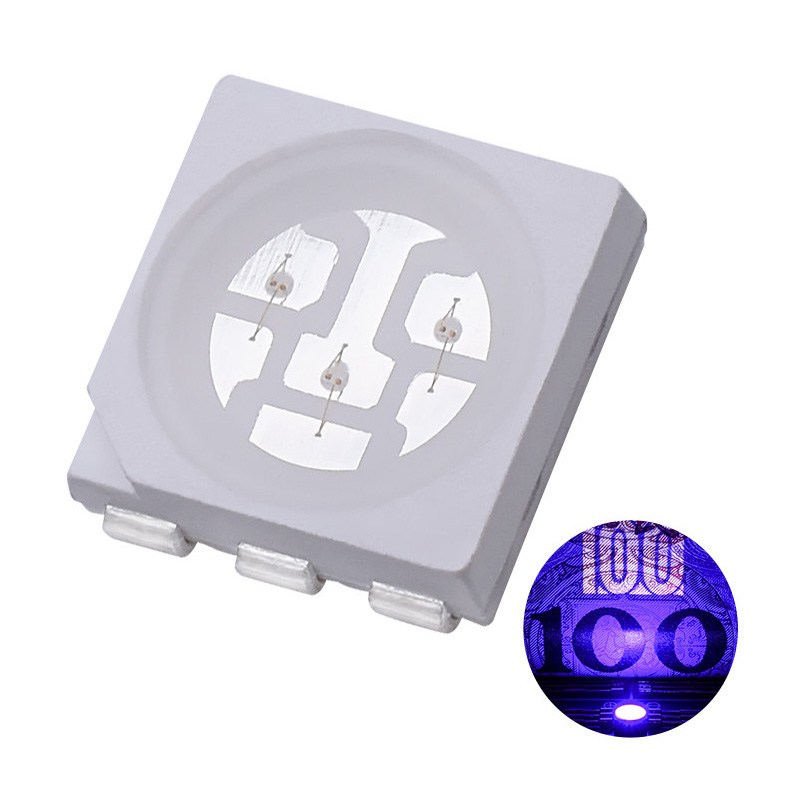
The product is a reel of 500 individual 6-pin surface-mount light-emitting diodes built on a standard 5.0mm × 5.0mm PLCC-6 footprint. Each component features an semiconductor die housed inside an optical reflector cup with a 120° radiation pattern. Engineers, hobbyists, and manufacturers use this smd led chip for custom printed circuit board assembly, surface-mount rework, UV glue curing fixtures, and blacklight instrumentation.
Unlike pre-soldered 5050 SMD flexible LED strip lights, this bulk reel delivers bare electronic components directly to your pick-and-place feeder or hand-soldering workstation. Available in two distinct spectral bands—deep photochemical 365nm-370nm and high-fluorescence 395nm-405nm—these diodes operate at DC 3.0V to 3.4V per circuit.
Measures 5.0mm × 5.0mm × 1.6mm with standard 6-pin solder pads for surface mount assembly.
Available in 2 spectral bands: 365nm-370nm UVA for curing and detection, or 395nm-405nm purple for visual fluorescence.
The 6-lead configuration provides 3 separate anode-cathode pairs, allowing parallel, series, or isolated channel driving.


⚠ Precautions
Q: What is the difference between the 365nm and 395nm wavelength options?
A:The 365nm-370nm option produces mostly invisible ultraviolet light with minimal visible violet glow, making it optimal for UV resin curing, adhesive bonding, and chemical detection. The 395nm-405nm option emits a pronounced purple-violet visible glow and is widely used for blacklight posters, glow-in-the-dark effects, and leak detection dyes.
Q: Can I connect all 6 pins together?
A:Yes. The 5050 package houses 3 internal LED dies. You can wire the 3 anodes together and the 3 cathodes together to run the chip as a single 60mA emitter, or you can route them individually for custom circuit topologies.
Q: Do these chips need external resistors to operate?
A:Yes. Discrete LED chips must never be connected directly to a DC power rail without current limitation. You must incorporate current-limiting resistors or dedicated constant-current driver ICs into your PCB design.