

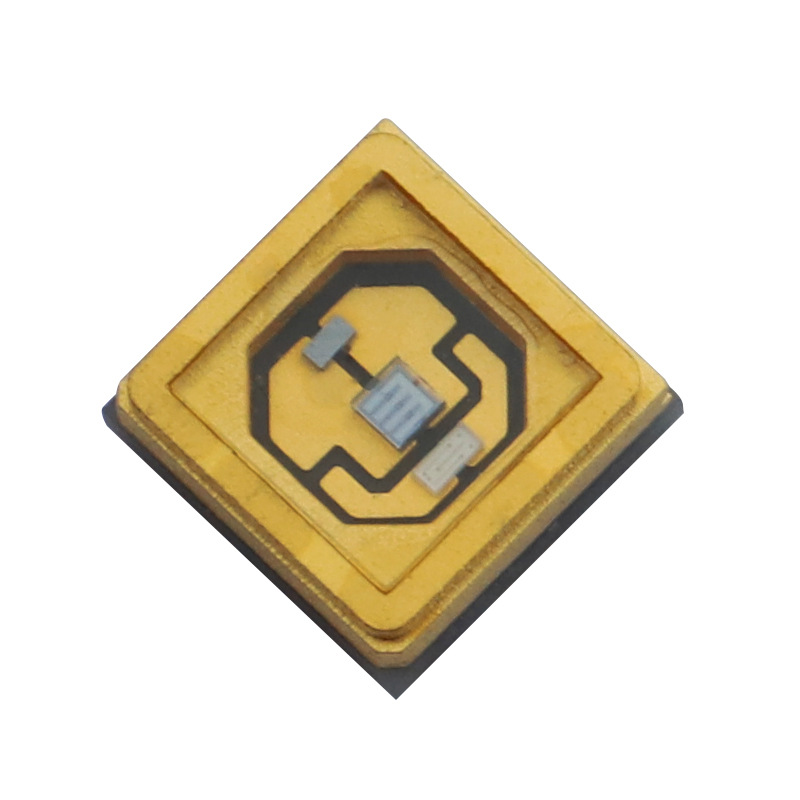
| Select Power: | 0.2W/LED (Base), 0.6W/LED |
|---|---|
| Availability | In Stock |
| Condition | Brand New |
Use this UV-B LED light source for skin treatment, light therapy, plant growth lighting, and reptile calcium supplement.
UV-B light refers to the ultraviolet wavelengths located in the 280-315 nanometers range, which is shorter than UV-A light but longer than UV-C light. Applications include medical biology, photolithography, sensing, and antibacterial.
Standards and Certifications


| Product Type: | 300-305nm UV-B LED |
| LED Chip: | SMD 3535 San'an Chip |
| Chip Size: | 10*20mil |
| Bracket Material: | Ceramics |
| Power: | 0.6W/pcs |
| CRI: | 80 |
| Luminous Flux: | 4 lm |
| Forward Voltage: | 5.4-5.6V |
| Reverse Voltage: | 5V |
| Electrostatic Breakdown Voltage (ESD): | 5V |
| Rated Current: | 40mA |
| Beam Angle: | 120° |
| Luminous Efficiency: | 90lm/W |
| Color Tolerance: | 5 SDCM |
| Thermal Resistance: | ≤5 °/W |
| Maximum Allowable Junction Temperature: | 85° |
| 1000 Hours Conventional Aging: | 98% |
| 6000 Hours Conventional Aging: | 98% |
| LM-80 Test: | Yes |
UV Light Applications - Guide To Know LED UV Light Strip And UV Light Fixtures
UV LEDs Precautions:
1. This device should not be used in any fluid such as water, oil, or organic solvent. If cleaning is needed, please use isopropyl alcohol for cleaning.
2. When the UV LED work, the operating current should be determined according to the maximum ambient temperature.
3. UV LED storage environment must be clean, if UV LEDs need to be stored for 3 months or longer after delivery, please use nitrogen cabinet for storage.
4. UV LEDs need to be used within seven days after opening the moisture-proof package, repack the unused product with the moisture-proof package, fold to seal the opening, and then store in a dry place.
5. LEDs are sensitive to static electricity and surges. When handling UV LEDs, it is recommended to use anti-static wrist straps or anti-static gloves.
6. When soldering LEDs by hand, the solder head must be grounded. If an overvoltage is applied to the UV LED that exceeds the absolute maximum rating, it will cause damage. Damaged LEDs will show some unusual characteristics, such as a significant increase in leakage, reduced turn-on voltage, and LEDs that do not light up at low currents.
7. Warm tips: Ultraviolet light hurts eyes, do not stare at the UV light source, and do not use the UV light source to irradiate the eyes of others!