

| Select Input Voltage: | 110V±20% (US, CA) (Base), 220V±20% (EU, UK, AU) (Base) |
|---|---|
| Select Output Voltage: | AC 24V (Base), AC 12V (Base) |
| Select Power: | 300W (Base) |
| Availability | In Stock |
| Condition | Brand New |
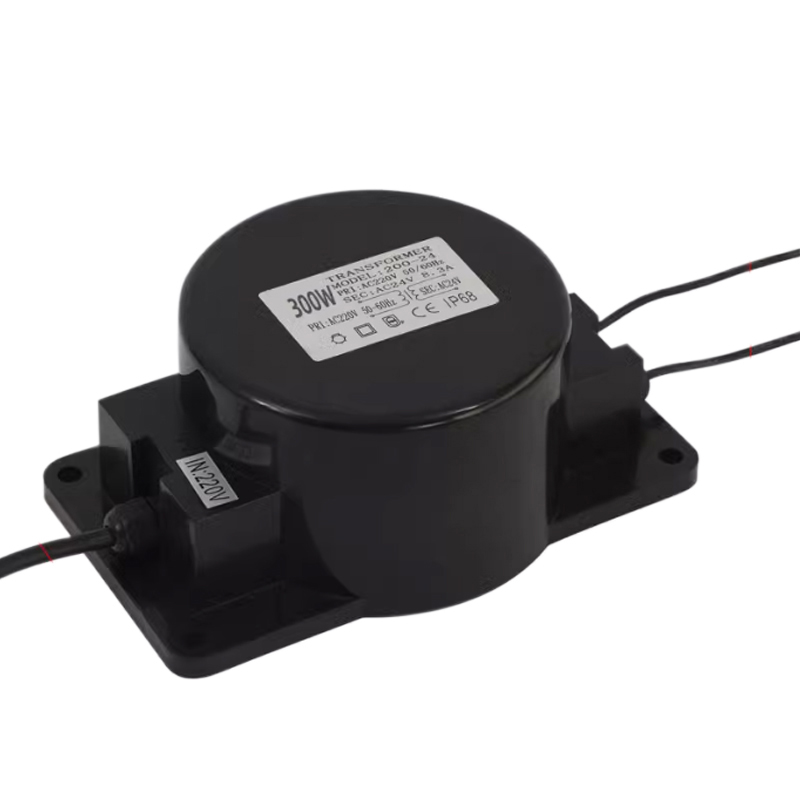
The 24V AC pool light transformer can convert standard AC voltage (120V AC/ 220V AC) to a stable 24V AC, ideal for LED swimming pool lighting and outdoor LED landscape lighting. Pool light power supply can provide a reliable power delivery, meeting the needs of professional lighting projects, including, but not limited to, swimming pool, garden, walkway, fountain, and sculpture lighting.
With the highest IP68 waterproof rating, this swimming pool transformer can operate stably in harsh weather conditions, even in underwater and underground environments. Black weatherproof cables extend from both sides, ensuring full-body water resistance. Its 300-watt large power helps to ensure the lighting needs are fully satisfied, providing ample illumination. Pool transformer 300W uses epoxy resin encapsulation to enhance the weather resistance and durability. The internal coil is carefully designed to ensure reliable output, improved energy efficiency, and reduced maintenance costs.
In addition to this swimming pool LED light transformer 24V, we also offer other excellent IP68 ac ac power adaptors with a range of power capacities for you to select.
This AC/AC 24V transformer is most commonly used for standard RGB ground-buried fountain lights that require a 24V AC input.
| Product Type: | AC 24V 300W Swimming Pool Light Transformer |
| Output Voltage: | AC 24V / AC 12V |
| Input Voltage: | AC 120V / AC 220V |
| Product Size: | L7.72 "x W5.04"X2.99" (196mm*128mm*76mm) |
| Color: | Black |
| Current: | 12.5 A for AC 24V / 25 A for AC 12V |
| Power: | 300W |
| Waterproof: | IP68 underwater/ underground |
| Warranty: | 2 years |
| Weight: | 3.4kg |

Since the lights have conversion efficiency, for example, the output might be 15W, but the input exceeds 18W. The AC power transformer is calculated based on the input power of the lights, which should be 18W in this case.
Due to line loss, the longer the distance, the greater the loss. It is recommended to use twice the power of the lights, e.g., 75W * 2 = 150W.
