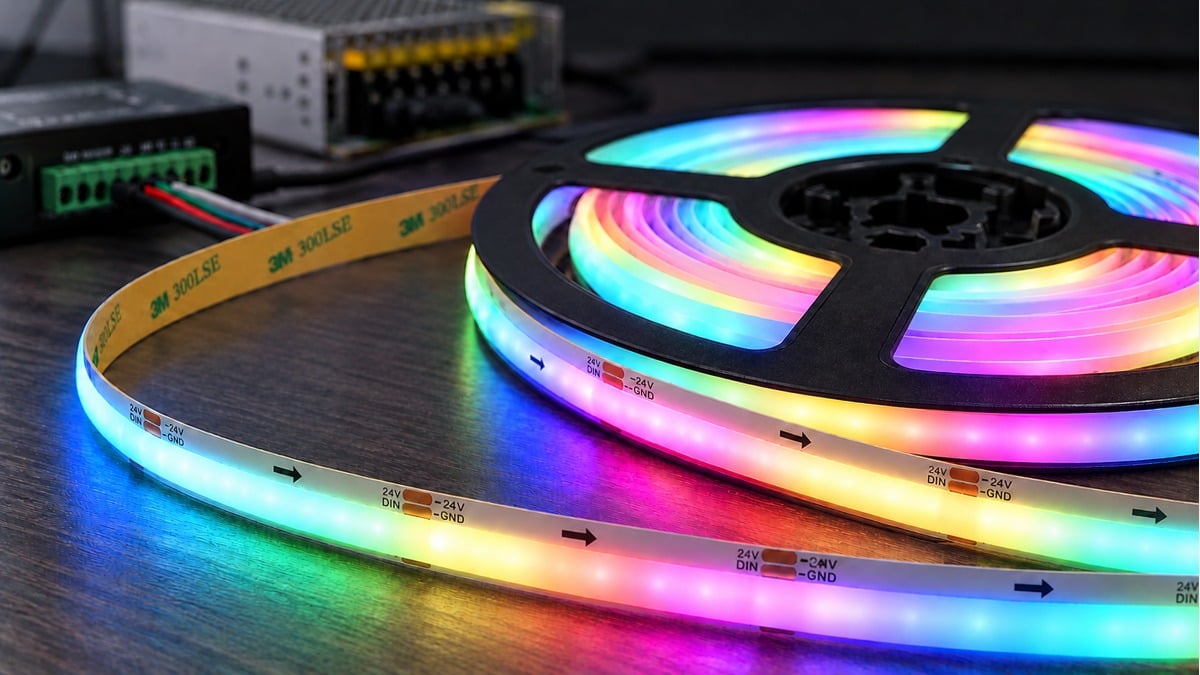
Discover the ultimate breakdown of SuperLightingLED’s addressable COB LED strips. Compare specs, learn wiring tips, and avoid common issues.
Addressable LED Strip Guides
This engineering library covers individually addressable and pixel-controlled LED strip lights — including 5V WS2812B and SK6812 RGBW, 12V dual-signal WS2815 and CS8812, 24V COB RGBIC, high-PWM APA102/SK9822, and commercial DMX512 architectures. Use these field-tested guides to compare IC chip timing, size 5V/12V/24V power injection, select wire gauge, and eliminate WLED or SPI signal flicker before purchasing hardware.
Looking for factory-direct hardware matching these engineering specs? Browse our full Addressable LED Strip Lights catalog, compare dotless Addressable COB LED strips, or match compatible SPI & WLED pixel controllers and regulated DC power supplies.
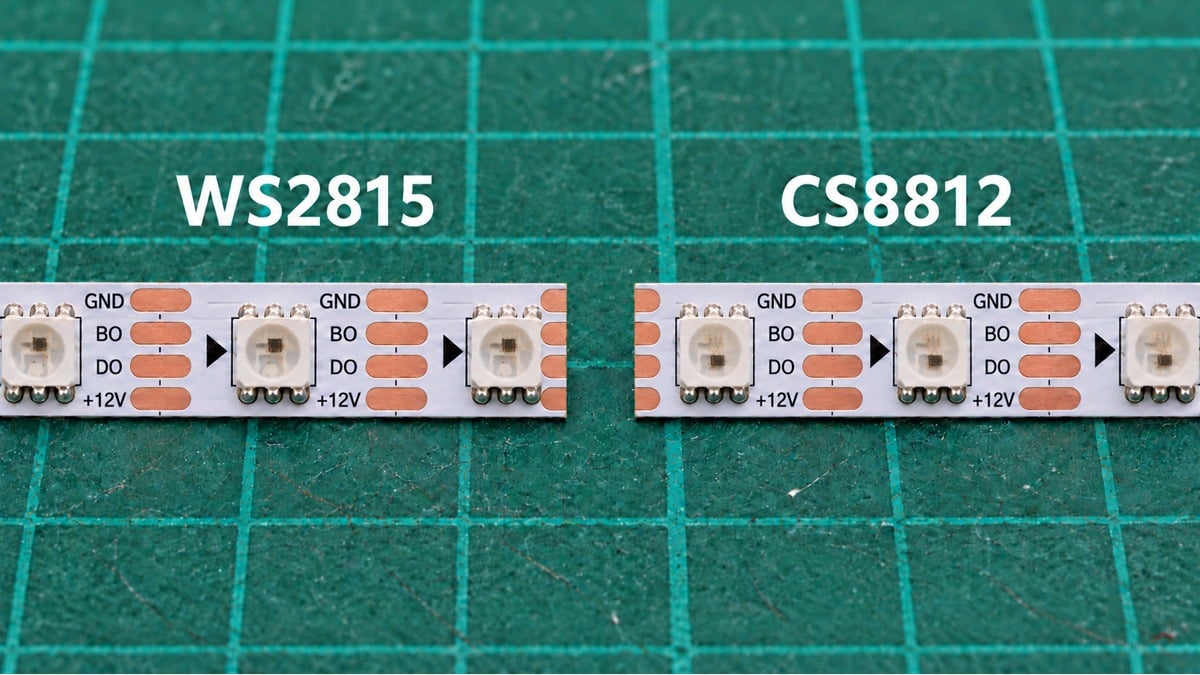
WS2815 vs CS8812: The Practical Comparison
A detailed comparison of WS2815 and CS8812 LED strips. We break down voltage, signal redundancy, cost, and performance to help you choose for your project.
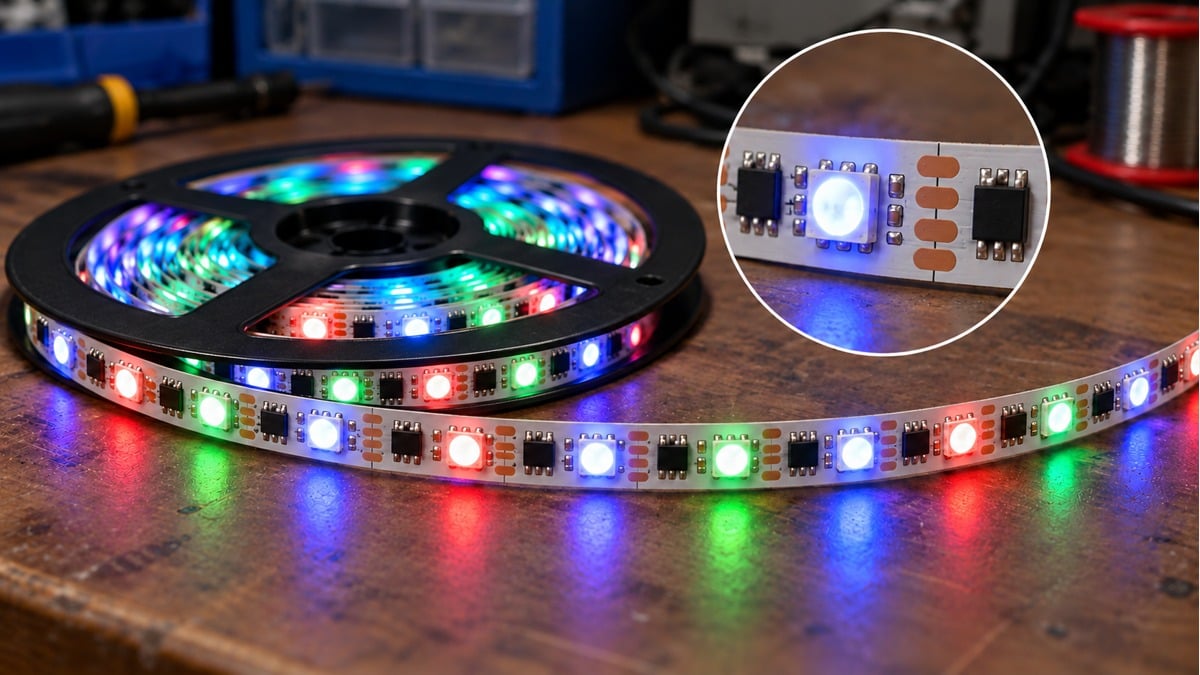
Is There A 24V Individually Addressable LED Strip?
Is there a 24V individually addressable led strip in the market? Super Lighting LED gave you the answer, read on to find out more.
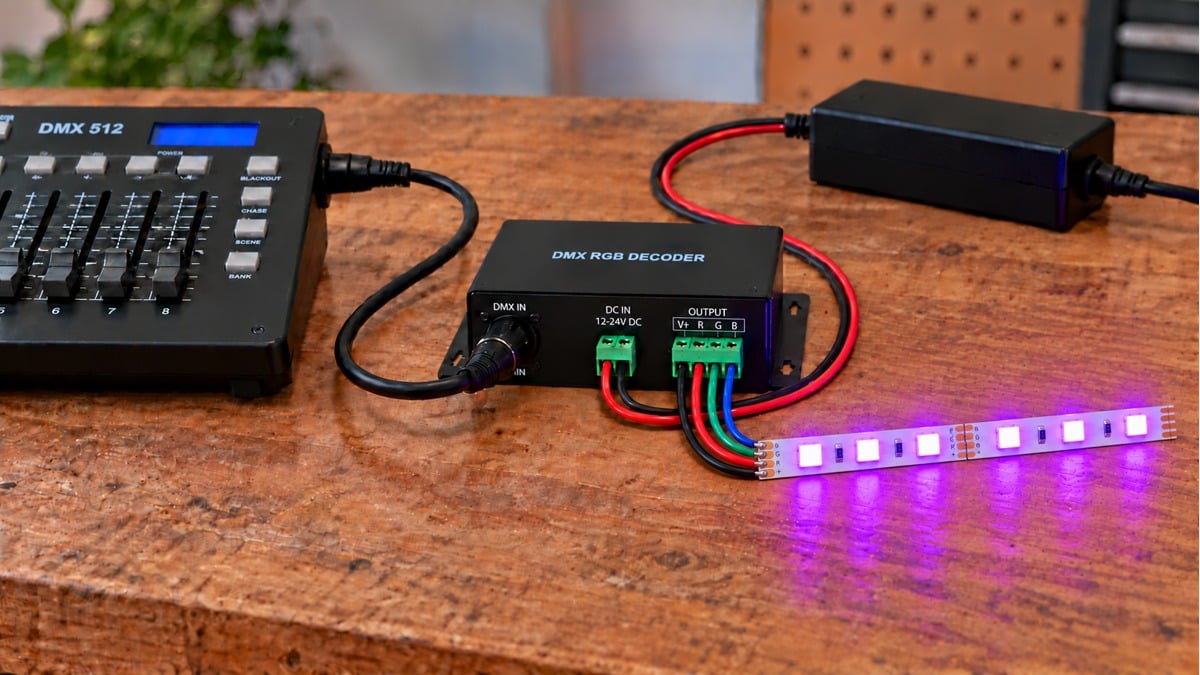
DMX Control LED Lighting Strip – Things You Need To Know
What kind of light strips can DMX control, this article takes you through. And know how to control dmx lighting.
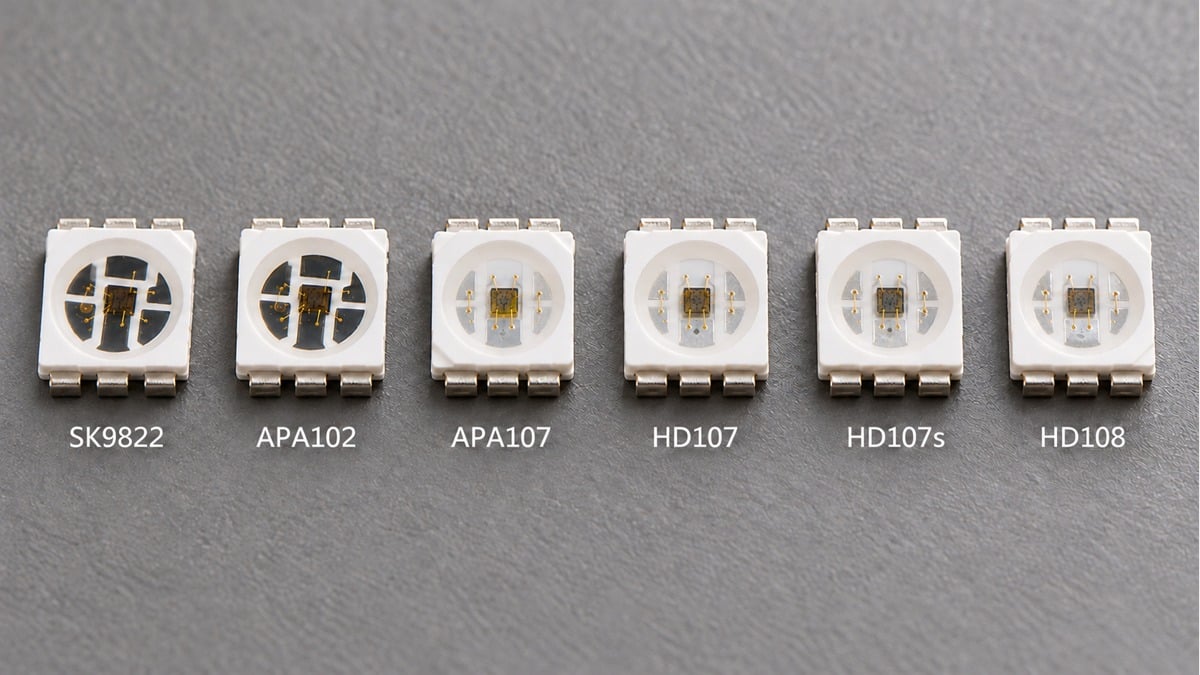
SK9822 vs APA102 vs APA107 vs HD107 vs HD107s vs HD108
Difference between SK9822, APA102, APA107, HD107, HD107s, HD108 led strips. Find the best choice for your project. Discover their differences now!
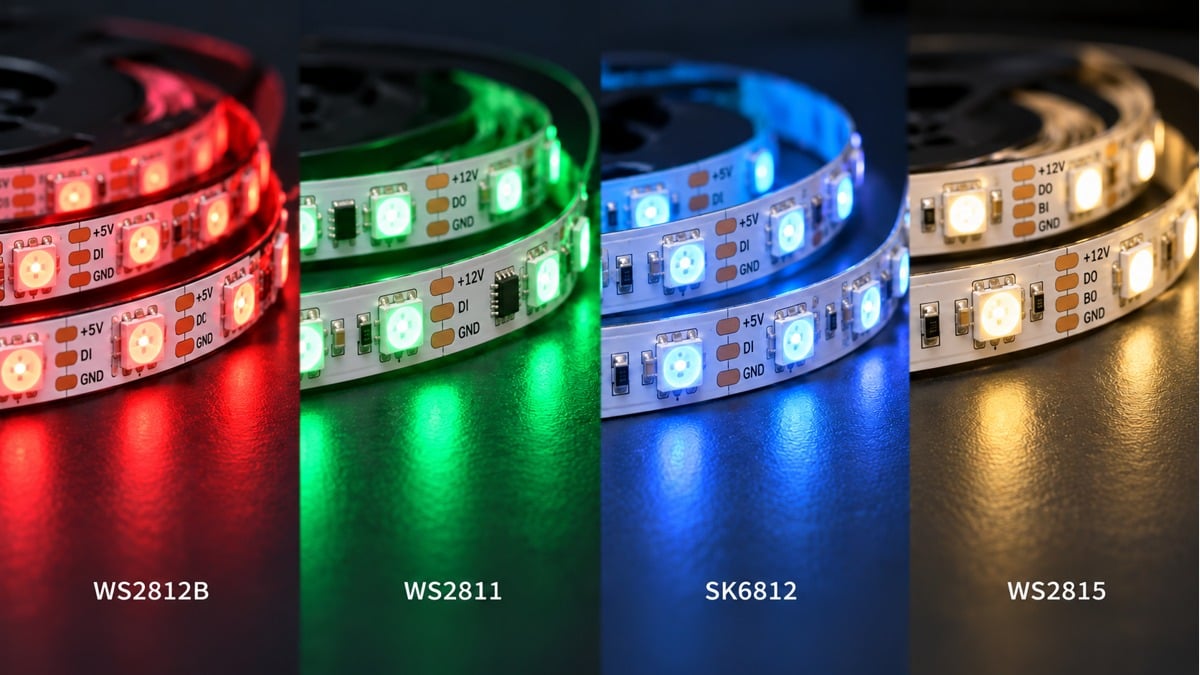
A User Guide For WS2812B WS2811 SK6812 And WS2815
This is a quick guide about WS2812B, WS2811, SK6812, and WS2815, to help those who are just getting started with addressable LED strip lights.
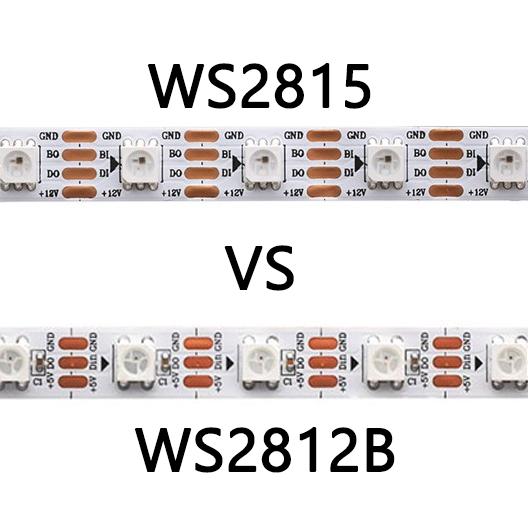
WS2815 VS WS2812B
WS2815 and WS2812B are two of the most popular addressable led strip lights on the market today. In this article, we’ll take a closer look at the WS2815 and WS2812B and compare their features, pros and cons.
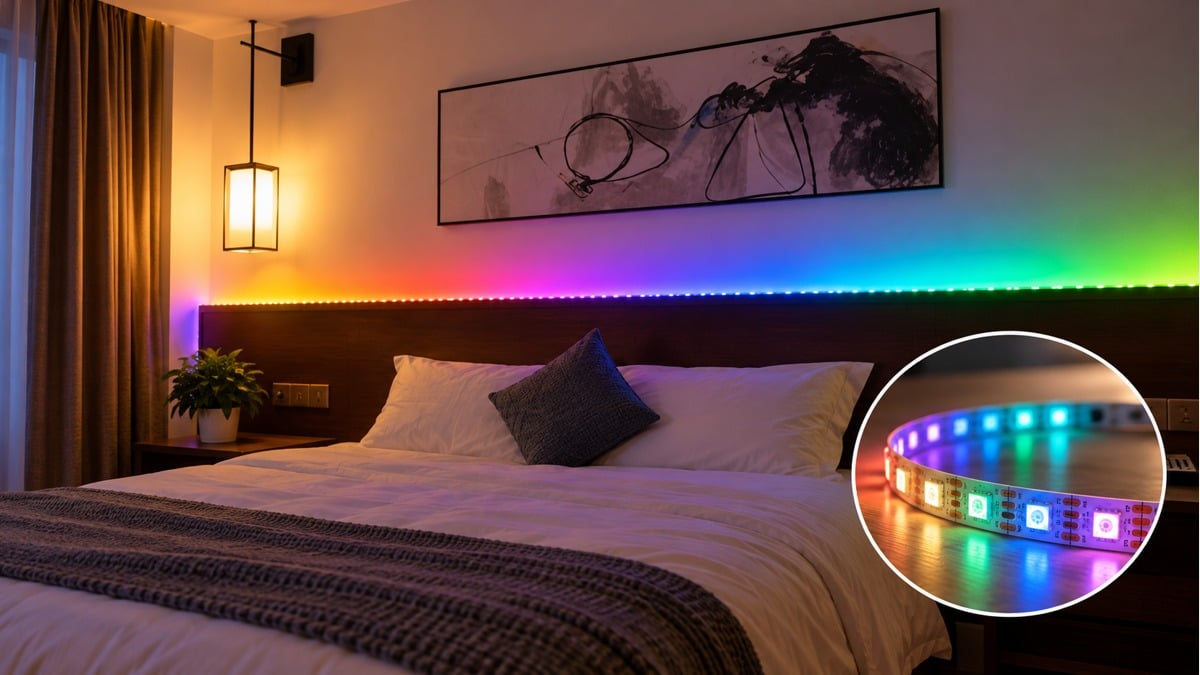
The Best Chasing LED Color Changing Lights Kit For Your Place
Add some color to your room, TV, desk, or pool with a color changing light kit! Color changing LED lights are a quick and easy way to add creativity to your space.
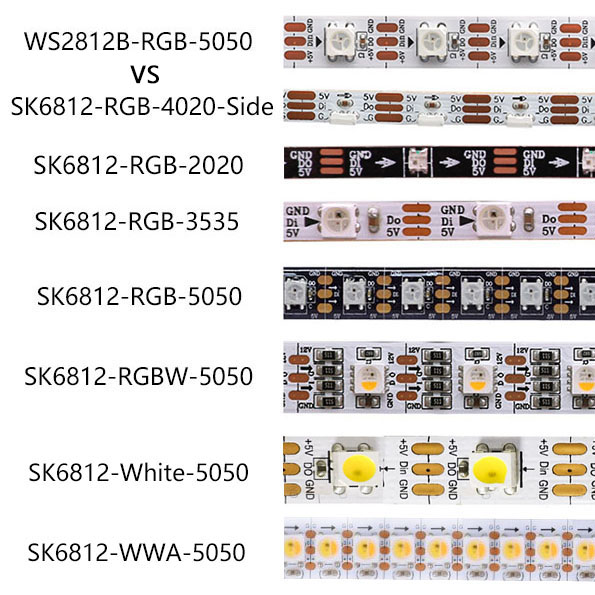
SK6812 VS WS2812B
Look for addressable LED strips and came across WS2812B and SK6812 IC chips? SK6812 is available in RGB, RGBW, and white colors, while WS2812B is RGB only.
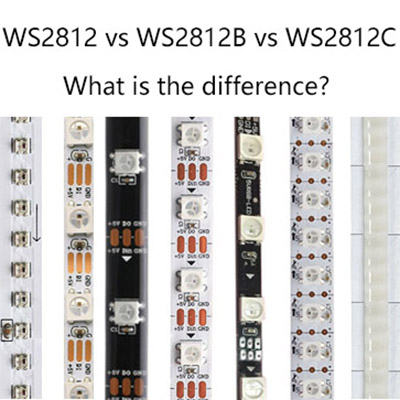
WS2812 VS WS2812B VS WS2812C
WS2812 series addressable LED strip lights are commonly used, the difference between WS2812, WS2812B, and WS2812C is their IC pins and LED size. Here’re more parameters.
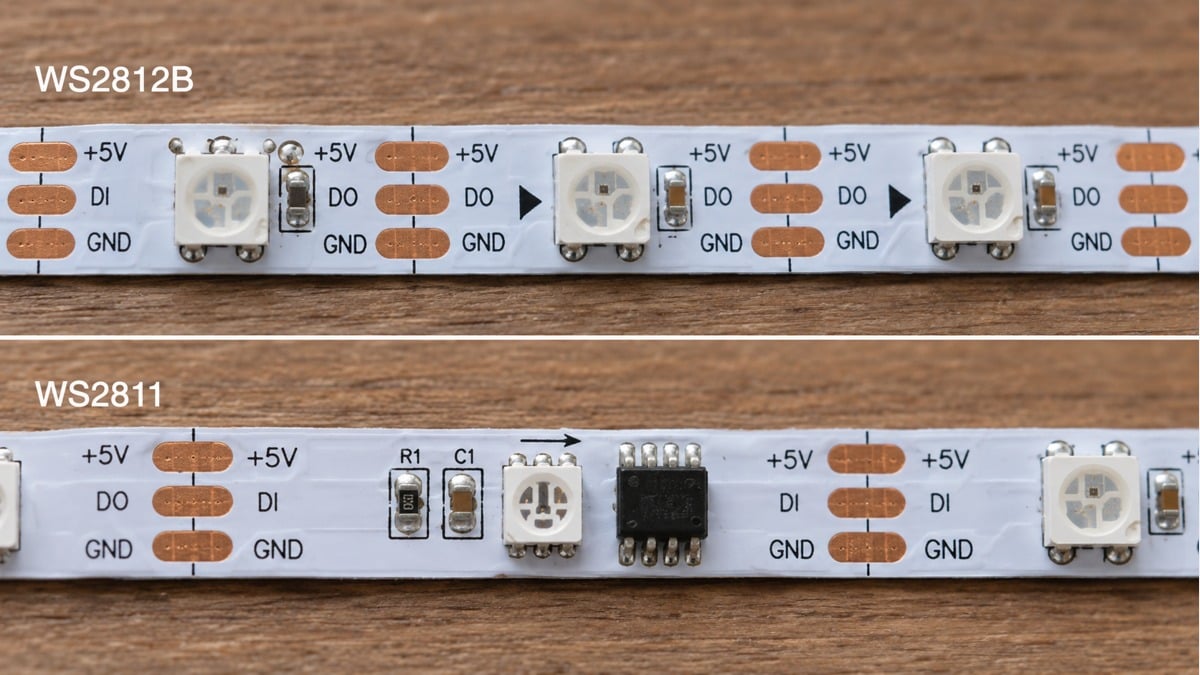
WS2812B VS WS2811
This blog compares WS2811 and WS2812B addressable LED strips in terms of voltage, running length, power, and light color. Help you choose the right one.
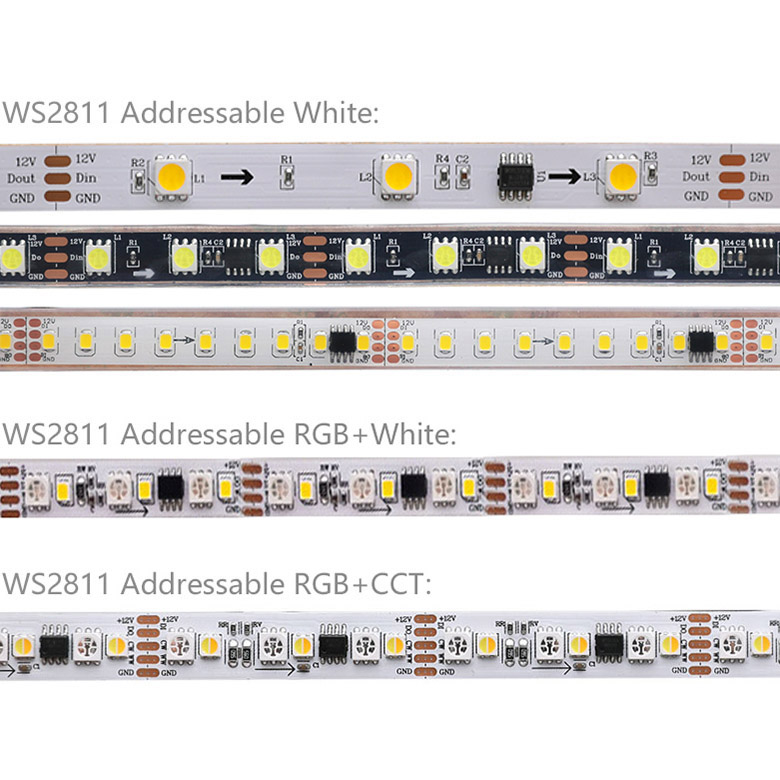
A Practical Guide to Addressable WS2812B LED Strip
WS2812B is the most commonly used addressable IC chip with dynamic light effects. Click to know how it works, how to power and use WS2812B LED strip lights.
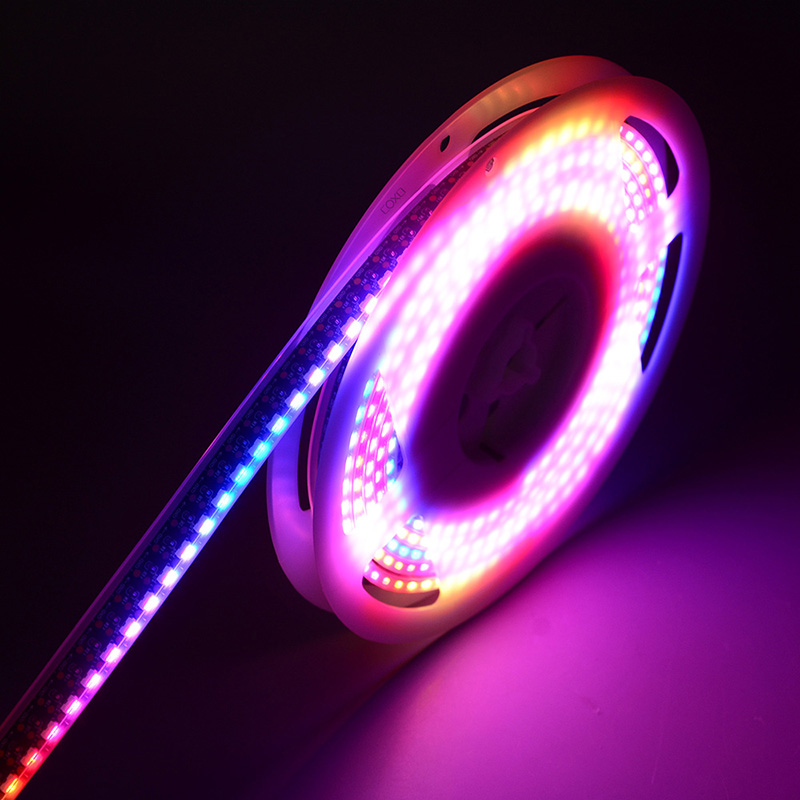
Choosing The Best 12V Addressable LED Strip For Your LED Project
This article helps you choose the most suitable 12V addressable led strip light for you among the many addressable IC chips, WS2815, WS2818, TM1812, GS8208, and LPD6803. The following content will be described according to the specific differences […]
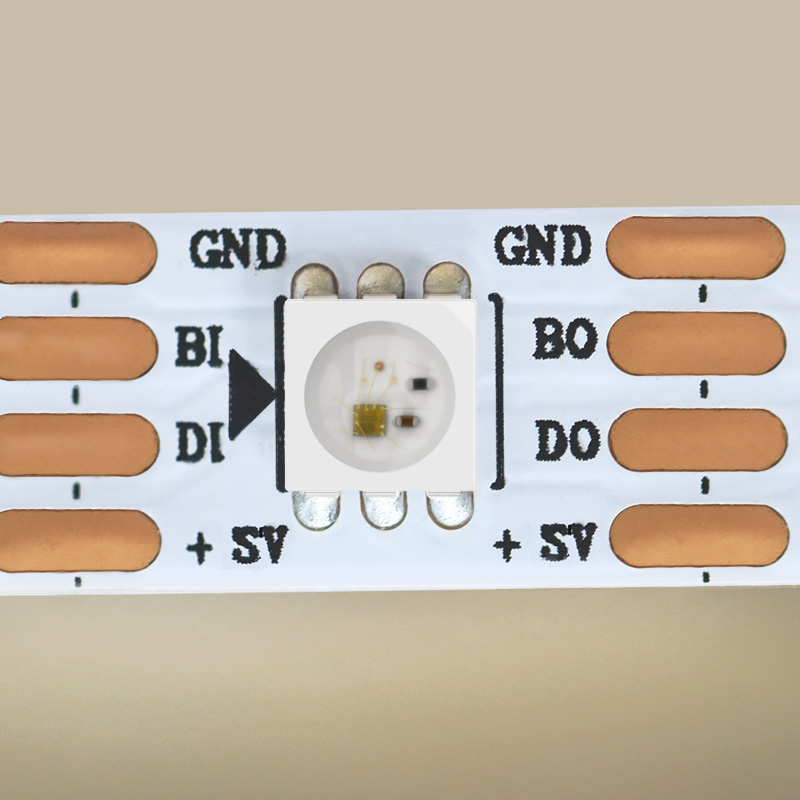
The Best 5V Addressable LED Strip
For addressable LED strip lights, it is essential to choose the right IC chip. Today we will talk about several LED IC chips, they are all powered by DC5V low voltage, what features do they have, and which […]
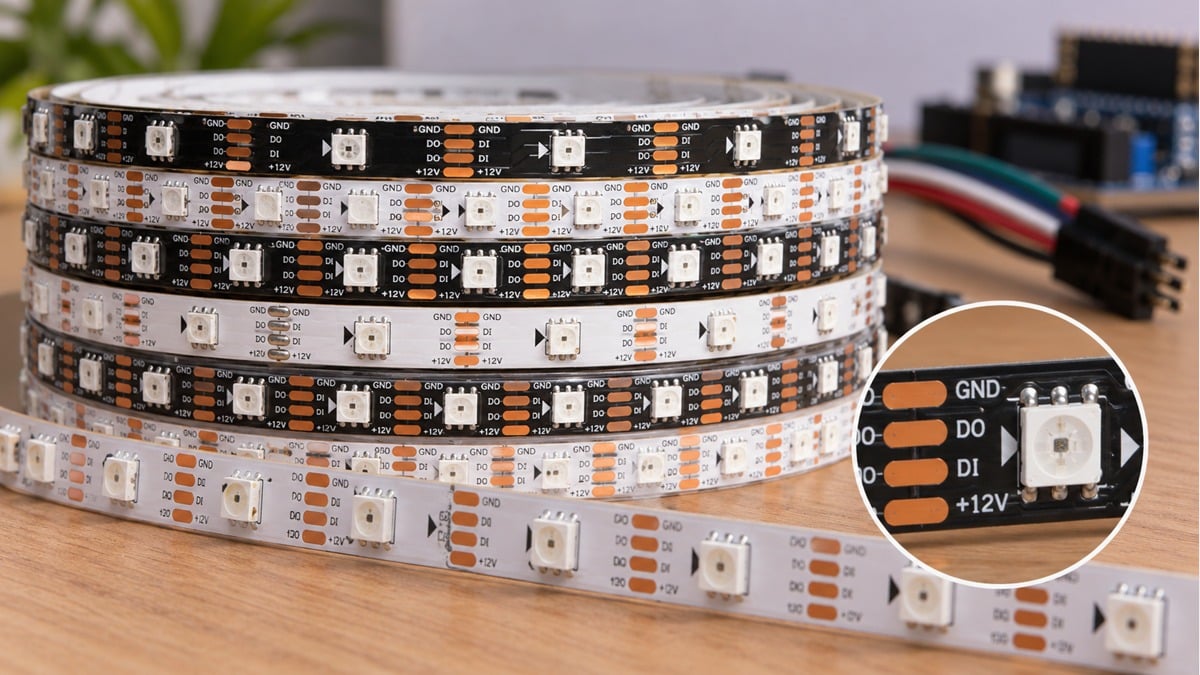
The Most Complete Guide to Addressable LED Strip
The ultimate guide for addressable led strip lights, 3pin single signal vs 4pin dual signal vs 4pin breakpoint resume, SPI vs DMX, how they work and how to install.
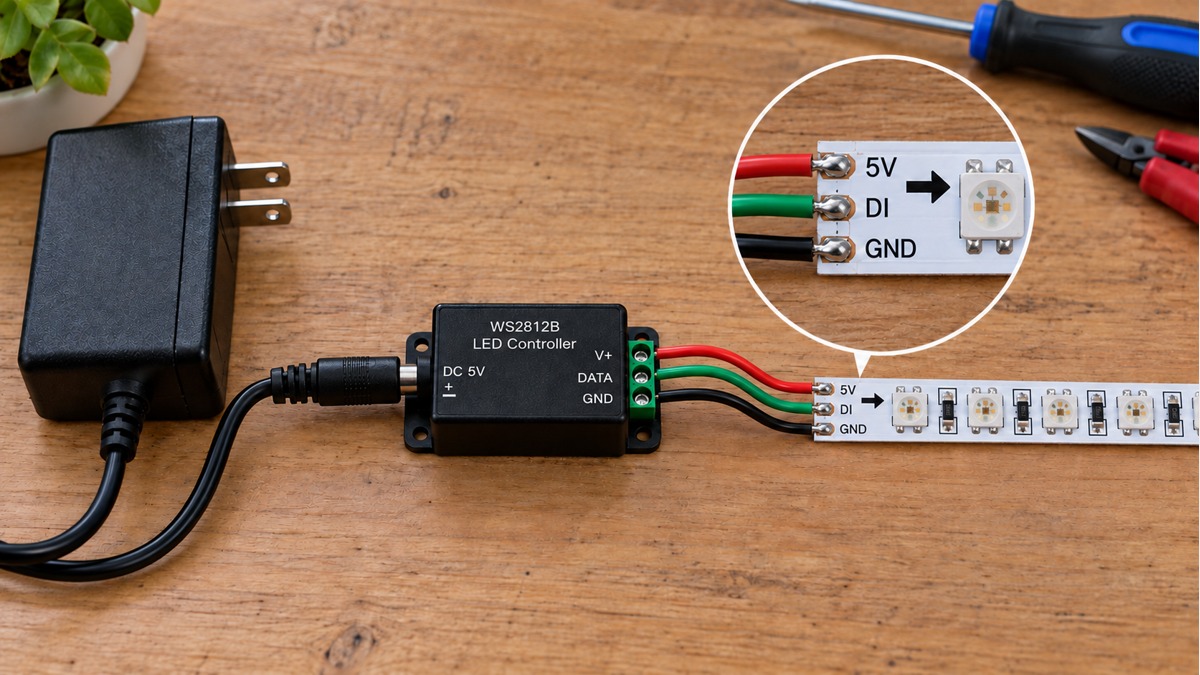
How to Wire Addressable LED Strip Lights?
How to wire and install addressable led strip lights to keep light brightness and color consistent, and no lights flicker when running long distances.
Quick Technical Summary · At-a-Glance Specifications
An addressable LED strip (digital pixel or RGBIC LED strip) integrates a miniature driver IC into each LED package or cuttable segment, enabling independent color and brightness control over a serial data bus (3-wire clockless SPI, 4-wire clocked SPI, or DMX512). Choose 5V DC (WS2812B / SK6812) for single-LED precision under 2–3 m, 12V DC dual-signal (WS2815) for long runs with breakpoint protection, or 24V DC (WS2811 / DMX512) for 10 m+ architectural runs.
Operating Voltage5V / 12V / 24V DC
Control ProtocolsSPI / Dual-Data / DMX512
Pixel Granularity1, 3, or 6 LEDs / IC
PWM Refresh Range400 Hz – 27 kHz
What Makes an Addressable LED Strip Different From Standard RGB Tape?
On a conventional analog RGB or RGBW LED strip, every LED along the entire reel shares the same copper color channels—so the whole strip can only show one color and one brightness level at a time. An addressable LED strip (often called a digital, pixel, or RGBIC LED strip) places a tiny integrated circuit (IC) either inside each LED package or alongside small groups of LEDs. A digital controller streams serial data packets down the strip at 400 kHz to 30 MHz, telling each pixel its exact red, green, blue, and optional white intensity 30 to 400+ times per second.
That single architectural difference unlocks chasing gradients, music-reactive waves, stairwell step animations, architectural facade mapping, and multi-zone ambient lighting on one run of LED tape. If you are new to pixel strips, start with our complete guide to choosing an addressable LED strip before locking in a chip family or power supply.
Key Engineering Rule: Choosing an addressable strip is always a three-way trade-off between pixel resolution (1 LED vs. 3–6 LEDs per IC), operating voltage (5V vs. 12V vs. 24V voltage drop), and signal resilience (single data wire vs. dual backup data line or clocked SPI/DMX512).
Which Addressable IC Chip Should You Choose? (WS2812B vs. WS2815 vs. SK6812 vs. WS2811 vs. APA102 vs. DMX512)
Most project headaches happen when a 5V hobby strip gets installed on a 15-meter ceiling cove, or when a 3-LED-per-pixel 12V strip is used where single-LED sharpness was expected. Use the comparison table below to match the IC chip to your run length, white-light quality, camera flicker requirement, and fault tolerance.
| IC Chip | Voltage | LEDs / Pixel | Signal Wires | Backup Data Line | Color Channels | PWM Frequency | Best Real-World Use |
|---|---|---|---|---|---|---|---|
| WS2812B | 5V DC | 1 LED | 3-pin (5V, DI, GND) | No | RGB (8-bit) | ~400 Hz | Short runs (≤5 m), desk backlighting, wearables, DIY WLED / Arduino builds |
| SK6812 RGBW | 5V DC | 1 LED | 3-pin (5V, DI, GND) | No | RGB + True White (3000K/4000K/6000K) | ~1.1 kHz | Indoor accents needing crisp dedicated white light plus pixel effects |
| WS2815 | 12V DC | 1 LED | 4-pin (12V, DI, BI, GND) | Yes (breakpoint resume) | RGB (or RGBW variants) | ~2 kHz | 5–10 m residential & commercial runs needing 1-LED precision and fault tolerance |
| CS8812 | 12V DC | 1 LED | 4-pin (12V, DI, BI, GND) | Yes (breakpoint resume) | RGB | ~2 kHz | WS2815 alternative with high refresh stability for architectural linear runs |
| WS2811 | 12V / 24V DC | 3 LEDs (12V) or 6 LEDs (24V) | 3-pin (V+, DI, GND) | No (external IC) | RGB / COB pixel segments | ~400 Hz–2 kHz | Long cove runs, roofline outlines, addressable COB neon & continuous-dotless tape |
| APA102 / SK9822 / HD107S | 5V DC | 1 LED | 4-pin (5V, DI, CI, GND) | Separate Clock line | RGB (5-bit global dim + 8-bit color) | 4.7 kHz–27 kHz | Broadcast studios, POV displays, high-speed video cameras (zero rolling-shutter banding) |
| UCS512 / TM512 (DMX512) | 12V / 24V DC | 3–6 LEDs (1 pixel group) | 5-pin (V+, A, B, PI, GND) | Parallel differential bus | RGB / RGBW / RGBCCT | High-rate DMX | Commercial facades, theaters, Madrix / Art-Net shows, runs over 100 m with signal reliability |
Want side-by-side test data for a specific pair? Read our dedicated deep dives: WS2815 vs. WS2812B, WS2812B vs. WS2811, SK6812 vs. WS2812B, WS2815 vs. CS8812, and our high-refresh clocked shootout on SK9822 vs. APA102 vs. HD107S vs. HD108.

Protocol Families: Clockless SPI vs. Dual-Data vs. Clocked 4-Wire & DMX512
Clockless 3-Wire & Dual-Data SPI (WS2812B / WS2815 / SK6812)
- Data rate: Fixed 800 kHz timing; works natively with WLED, ESP32, SP107E, and SP630E controllers.
- Breakpoint safety: Specify dual-data (
BI/BO) ICs such as WS2815 or CS8812 for ceilings, facades, and sealed aluminum channels.
Clocked 4-Wire & Differential DMX512 (APA102 / SK9822 / UCS512)
- Camera-safe refresh: 4-wire clocked ICs push PWM rates up to 20–27 kHz, eliminating rolling-shutter banding on cinema cameras.
- Long cable runs: Differential RS-485 DMX512 (
A/B) transmits reliably over 50–100 m with parallel addressing.
How Does Voltage (5V vs. 12V vs. 24V) Affect Run Length, Power Injection, and Cut Intervals?
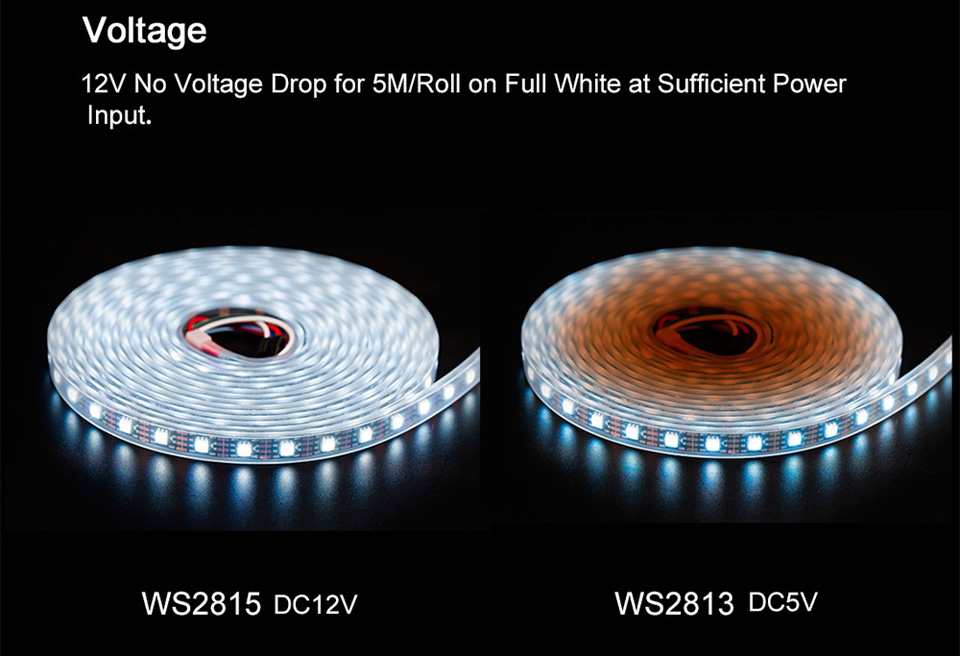
Voltage is the single most common reason an addressable LED strip turns warm-yellow or pink near the far end of a run. Because Power = Voltage × Current (P = V × I), a 5V strip draws 2.4× more current than a 12V strip and 4.8× more current than a 24V strip for the exact same wattage. Higher current across thin copper PCB traces creates faster voltage drop.
| System Voltage | Typical Max Run Before Power Injection | Typical Cut / Pixel Step | Power Loss & Wire Gauge Impact | When to Pick It |
|---|---|---|---|---|
| 5V DC (WS2812B, SK6812, APA102) |
2–3 m at full white (up to 5 m for dynamic colors) | 1 LED (every 16.7 mm at 60 LEDs/m) | High current; requires thick feeder wires (14–16 AWG) and frequent injection | Short builds, high-density 144 LEDs/m strips, USB/microcontroller projects, dedicated RGBW pixel accents |
| 12V DC (WS2815, CS8812, WS2811) |
5 m single-end; 10 m with both-end feed | 1 LED (WS2815/CS8812) or 3 LEDs (WS2811) | Moderate current; much smaller voltage drop over room-scale runs | Best all-around balance for ceilings, stairs, gaming rooms, and 5–10 m architectural lines |
| 24V DC (24V WS2811, COB SPI, DMX512) |
10 m single-end; 15–20 m with dual-end feed | 6 LEDs (~100 mm) or COB IC segments (~50–100 mm) | Lowest current; thinner distribution cable and fewer power supplies | Long coves, commercial corridors, building outlines, and dotless addressable COB or RGBCCT runs |
Wondering whether true 1-LED-at-a-time 24V strips exist, or how to pick the best 5V or 12V tape? See our focused breakdowns on whether a 24V individually addressable LED strip exists, choosing the best 5V addressable strip, and choosing the best 12V addressable strip.
How Do You Wire Addressable LED Strips Without Flicker, Wrong Colors, or Signal Loss?
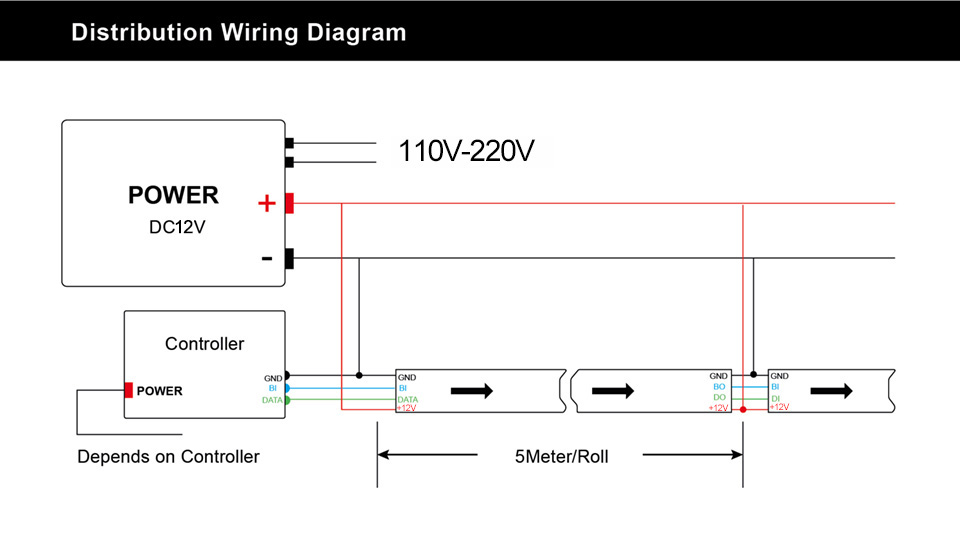
Unlike analog LED tape, addressable strips carry high-speed digital logic alongside high-current DC power. Four practical wiring details prevent 90% of first-time troubleshooting tickets:
- Always follow the data arrow (
DI → DO): Data only flows in one direction on the PCB. Feeding a signal intoDOleaves the entire strip dark even when power is correct. - Tie all DC grounds (
GND) together: If your controller runs on 5V USB while the strip runs on a separate 12V or 24V power supply, you must connect theirGND(V−) terminals together so the data signal has a shared voltage reference. Never tie different positive voltages (5V+ and 12V+) together. - Inject power in parallel—never chain full current through one reel: On 5V strips, inject 5V and GND every 2.5–5 m; on 12V strips, feed both ends of a 5–10 m run. Keep the data wire continuous in series while power feeds branch in parallel from your power supply.
- Protect long data leads: Keep the cable between the controller and the first LED under 2 m when using 3.3V controllers (like ESP32/WLED), or add a 3.3V-to-5V logic level shifter and a 330 Ω–470 Ω series resistor on the data line. For long commercial runs exceeding 10–15 m between controller and fixture, step up to differential DMX512 pixel LED strips.
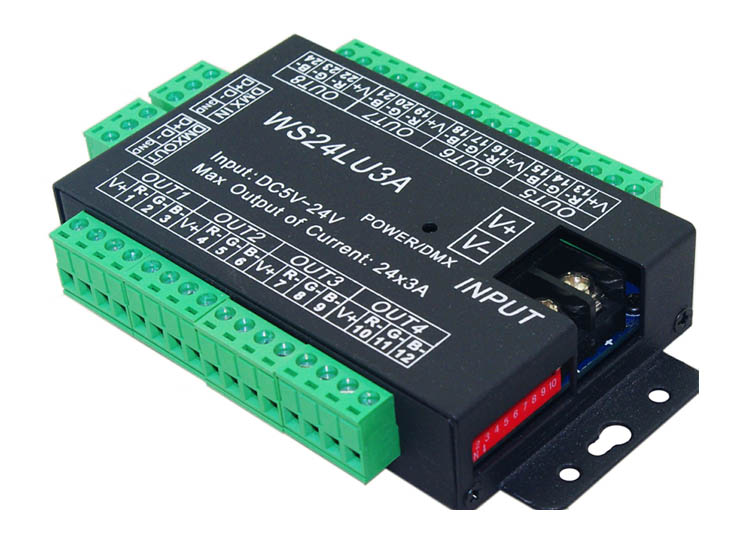
Engineering Checklists: Power Sizing & Logic-Level Protection
Power Supply Sizing Formula (20% Safety Margin)
Always size the power supply for full-white peak draw plus 20% thermal headroom: PSU Watts = Strip Length (m) × Max W/m × 1.2.
Example: Two 5 m reels of 12V WS2815 (14.4 W/m) draw 144 W peak → specify at least a 180 W–200 W (12V 15A–17A) regulated DC supply.
3.3V Controller Signal Protection (ESP32 / WLED)
- Insert a 74AHCT125 level shifter when driving 5V data lines from a 3.3V ESP32/ESP8266 GPIO pin.
- Place a 330–470 Ω series resistor on the data line close to the first pixel and tie controller
GNDdirectly to PSUV-.
Recommended Addressable LED Strips & Pixel Controllers (Verified Specs)
Every specification discussed in this engineering hub maps directly to stocked hardware in our Addressable LED Strip Lights catalog. Below are six proven models frequently specified for residential coves, commercial facades, camera studios, and WLED projects:
 12V DC · Dual-Signal · RGBW
12V WS2815 RGBW Individually Addressable Strip (60 LEDs/m)
Breakpoint-resume backup data line (BI/BO) + dedicated white channel on 10 mm PCB for reliable 5 m runs.
From $60.98View Specs →
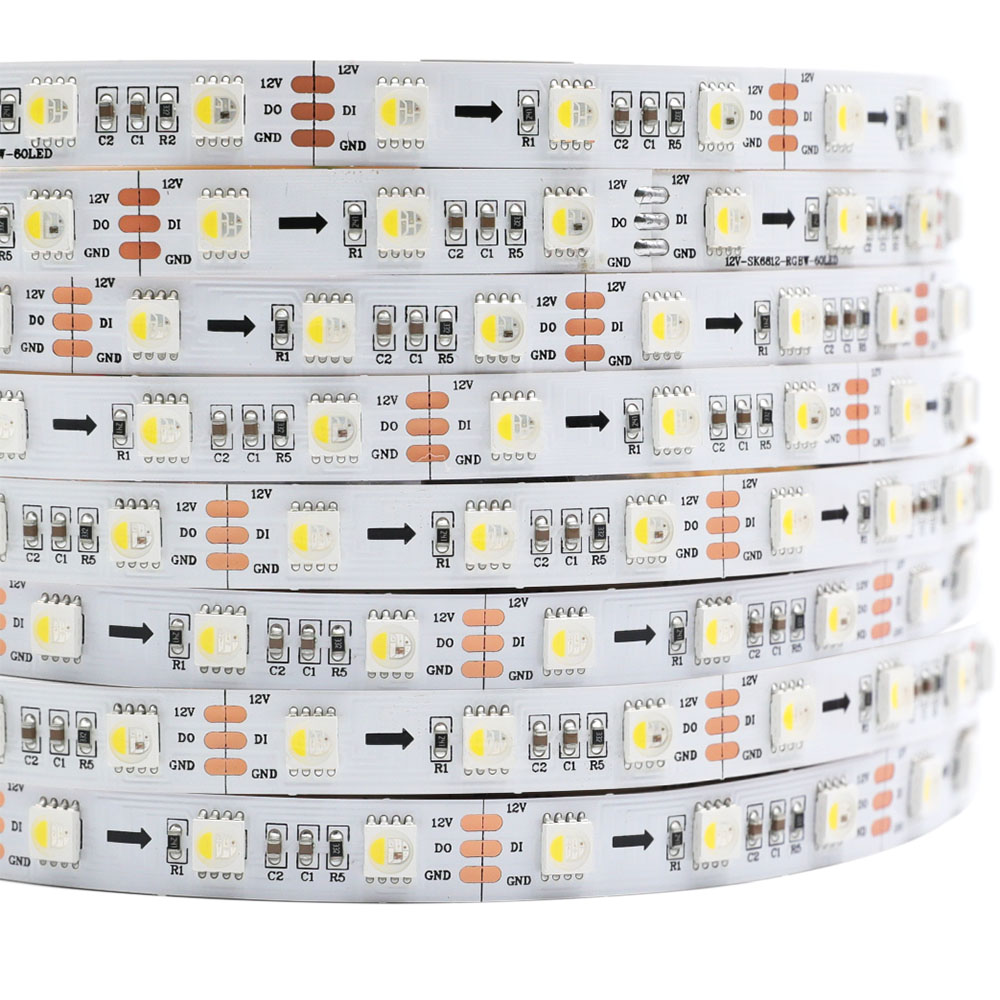 12V DC · SK6812 · 4-in-1 RGBW
SK6812 RGBW Digital Addressable Strip (60 LEDs/m, 5 m)
True Warm/Natural/Cool White phosphor die alongside RGB for architectural rooms requiring clean white light.
From $52.98View Specs →
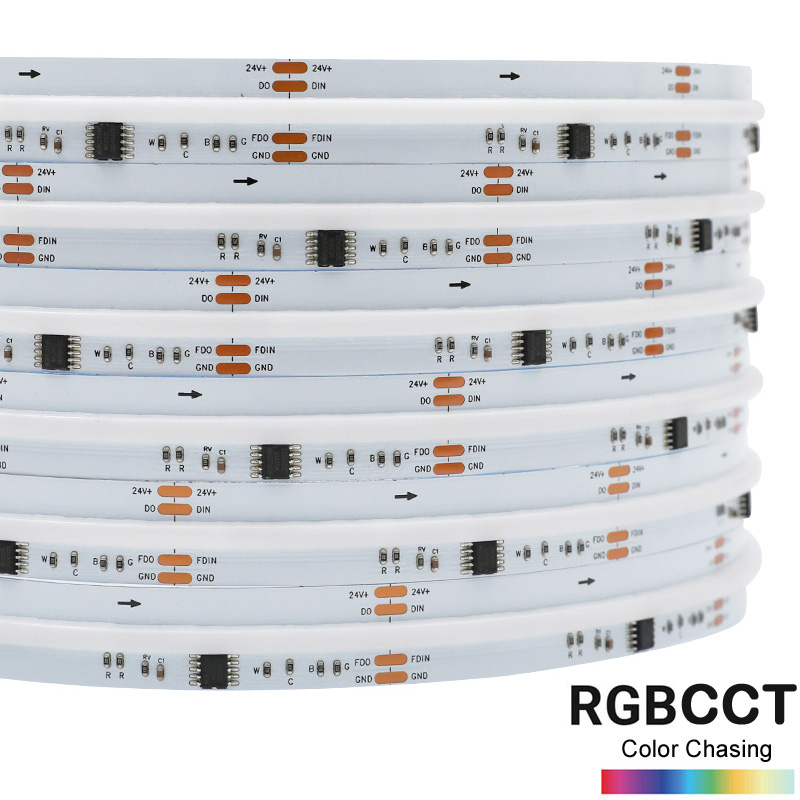 24V DC · COB · RGB+CCT Dual-Data
24V WS2805 RGB+CCT Dotless COB Addressable Strip
5-channel tunable white + RGB chasing with zero LED hotspots and dual-signal protection for long cove runs.
From $49.98View Specs →
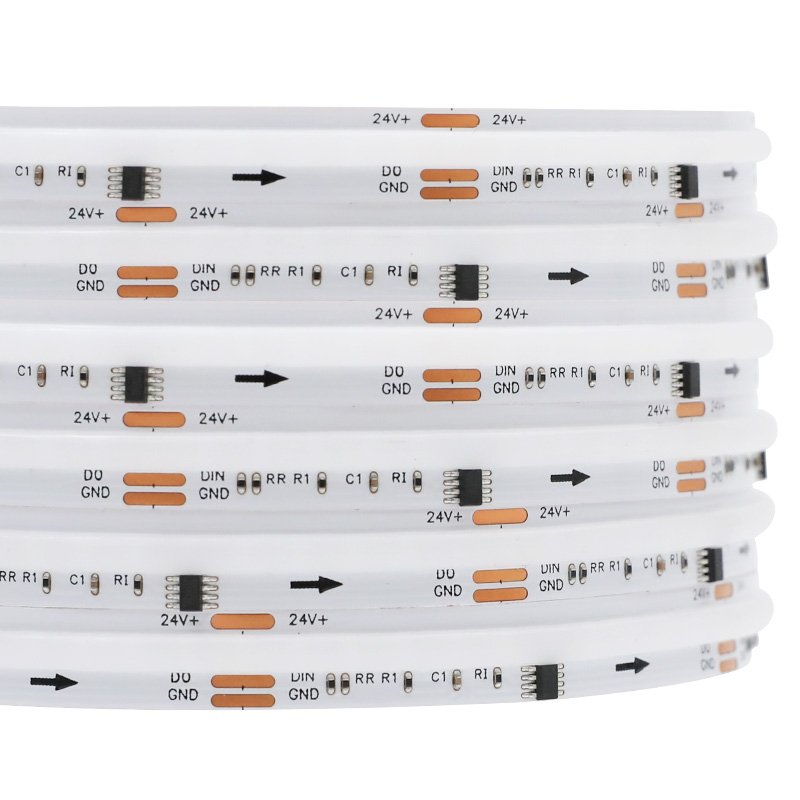 24V DC · 8mm Slim COB · WS2811
24V WS2811 8 mm Slim COB Addressable RGB Strip (720 LEDs/m)
Ultra-narrow 8 mm PCB fits shallow aluminum channels while maintaining uniform brightness across 10 m+ runs.
From $30.98View Specs →
 5V DC · 1-LED Pixel · COB
5V WS2812B High-Density COB Addressable Strip (160 Chips/m)
Fine single-pixel granularity for custom props, desk displays, Arduino/FastLED prototypes, and short accent runs.
From $40.98View Specs →
 ESP32 · WLED · 5V–24V DC
WiFi ESP32 WLED Pixel Controller (RGB / RGBW / SPI)
Pre-flashed WLED controller with built-in 5V logic level shifting, Home Assistant integration, and Art-Net/E1.31 sync.
From $25.98View Specs →
Interactive Engineering Tools & Custom Project Services
Before cutting PCB segments or sizing regulated power supplies, validate your load math and wiring topology with SuperLightingLED's free engineering utilities. These interactive store tools pair directly with our Ultimate Addressable LED Strip Selection Guide, Addressable LED Strip Wiring Reference, and full LED Knowledge Map — or send your floor plan directly to our technical engineering desk.
Calculator Suite
Power & Voltage Drop Calculators
Compute exact 5V / 12V / 24V power supply wattage, 20% headroom, fuse rating, and copper wire AWG sizing.
Launch Calculators →
97 Schematics
LED Strip Wiring Diagram Library
Verified parallel injection, common-ground SPI, DMX512 decoder, and signal amplifier wiring diagrams.
View 97 Diagrams →
Guided Builder
Interactive LED Project Planner
Step-by-step bill-of-materials wizard matching LED strips, aluminum channels, controllers, and drivers.
Start Project Wizard →
OEM Engineering
Custom Lighting & Pre-Wiring
Custom PCB lengths, IP67 silicone end-cap sealing, pre-soldered injection leads, and factory schematic review.
Request Custom Build →
Engineering Datasheets & Wiring PDFs
Before ordering power supplies or cutting aluminum channels, verify exact wattage per meter, PCB width, bin voltage, and controller pinouts in these specification PDFs (or browse the full PDF specification library and LED strip wiring diagrams hub):
Hands-On Video Demonstrations
Seeing real refresh rates, COB diffusion, and controller setup makes choosing an IC much easier. Watch these short lab tests from our LED Video Library:
 2:47
ESP32 WLED Programmable WiFi Controller: Setup & App Testing
 1:46
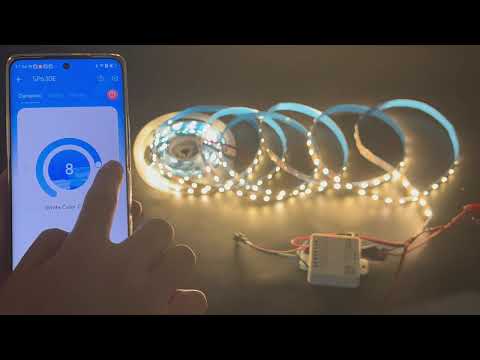
12V WS2815 RGBW Strip: True White & Individual Pixel Effects
 2:18
Wiring & Controlling 12V WS2815 Digital Tape With SP630E
 2:09
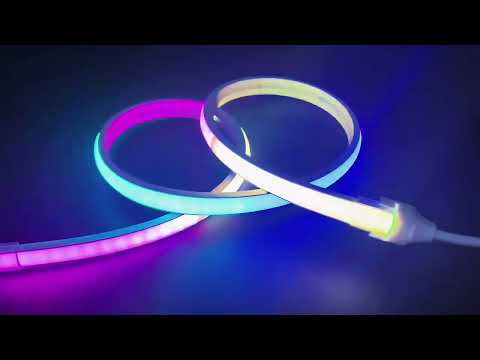
How to Connect COB WS2811 Addressable Neon Flex
 2:17
Writing DMX512 Pixel Address Codes With Art-Net-8
 1:09
Programming Offline Pixel Shows With the K-1000C SD Controller
Matching Hardware & Reference Hubs
Once your wiring plan and voltage are confirmed, compare specifications across the matching product families and technical reference pages:
All Addressable LED Strips
Individually Addressable (1 LED/IC)
12V Addressable Strips
24V Addressable Strips
Addressable RGBW Strips
Addressable RGBCCT Strips
DMX512 Pixel LED Strips
SPI / WLED / Pixel Controllers
DMX512-to-SPI Decoders
5V / 12V / 24V Power Supplies
LED Aluminum Channels
Addressable Wiring Reference Page
01Why does WS2815 outperform WS2812B in architectural LED strip installations?
A 12V WS2815 LED strip operates at higher voltage and integrates a dual-signal backup data line (BIN), preventing a single failed IC from breaking downstream data flow. While a 5V WS2812B LED strip draws roughly 18W/m (3.6A at full white) and requires power injection every 2.5 to 3 meters due to severe I²R voltage drop, a 12V WS2815 LED strip draws only 1.2A to 1.5A per meter. This lower current density allows continuous 5-meter runs without discoloration. For mission-critical coves and commercial trim, reviewing our ws2815 vs ws2812b engineering analysis and deploying WS2815 LED strip lights slashes field maintenance by eliminating cascading pixel failure.
02Why does an ESP32 require a level shifter for addressable LED strips?
An ESP32 microcontroller outputs a 3.3V logic high, whereas 5V WS2812B and 12V WS2811 or WS2815 LED strip data inputs require a minimum logic high threshold of 0.7 × VDD (approximately 3.5V to 3.7V). Feeding a bare 3.3V GPIO signal into the first pixel causes intermittent packet loss, random strobe flashes, or complete signal drop across leads longer than 150mm. Adding a high-speed 74AHCT125 bus transceiver converts 3.3V logic to a clean 5V square wave. Pair an engineered WiFi ESP32 WLED controller featuring an onboard WLED ESP32 level shifter with commercial-grade addressable pixel LED controllers to maintain signal integrity over 5 to 15 meters of data wiring.
03How do you calculate power injection intervals and wire gauge for LED strips?
Determine power injection spacing by multiplying the LED strip wattage rating by length to calculate total current, targeting a maximum voltage drop under 10% (0.5V on 5V circuits or 1.2V on 12V circuits). For example, a 5-meter 60 LED/m 5V LED strip drawing 60mA per pixel consumes up to 18A (90W), causing severe copper trace resistance that shifts pure white to dull yellow past 2.5 meters. Use our online LED strip power supply calculator to evaluate wire gauge voltage drop across 14 AWG or 16 AWG injection feeds, and reference verified LED strip wiring diagrams to execute proper LED strip power injection at both ends and the center.
04Why do SK6812 RGBW LED strips produce superior white light to WS2812B?
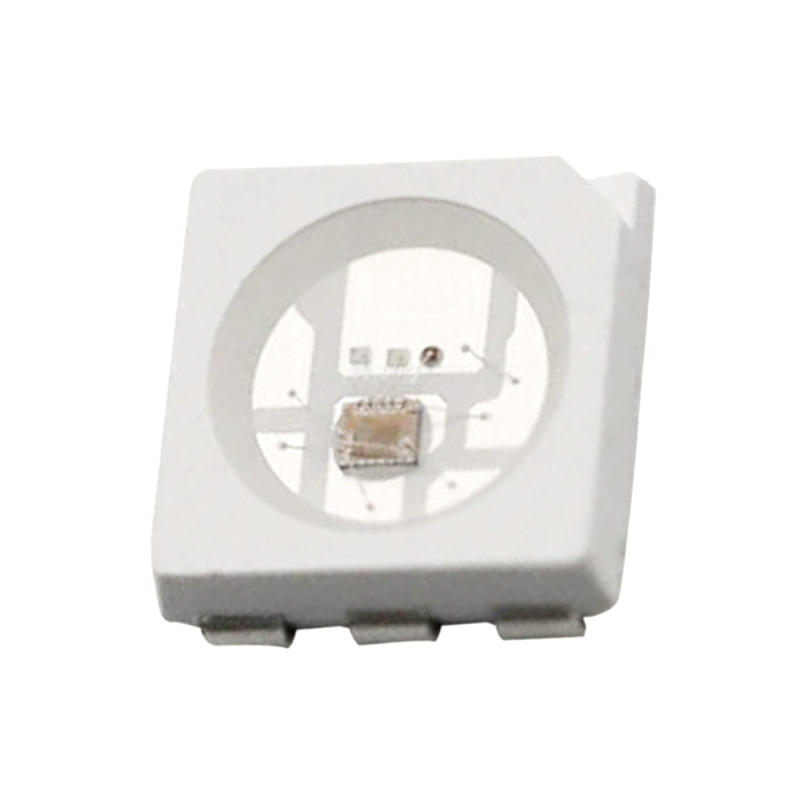
An SK6812 RGBW LED strip integrates a dedicated white emitter diode alongside red, green, and blue diodes under a single 5050 package, delivering high CRI (Ra > 90) at standard correlated color temperatures such as 3000K warm white or 6000K daylight. In contrast, a WS2812B LED strip must mix red, green, and blue dies at 100% duty cycle, yielding an unnatural bluish white (~7500K) with a dismal CRI below 65 while consuming nearly three times more current (60mA vs. 20mA). Review the technical breakdown in our SK6812 vs WS2812B guide, or install true phosphor-white 12V SK6812 RGBW LED strip lights for dual functional task lighting and animation.
05Can you run individually addressable LED strips directly at 24V DC?
Yes, advanced IC architectures like WS2805 enable 24V addressable LED strip runs with individual IC control per cut section, whereas legacy WS2811 LED strips group 6 LEDs per addressable IC pixel at 24V. Standard 24V DC operation drastically reduces thermal dissipation across high-density layouts, drawing half the current of 12V systems (typically 0.6A to 0.9A per meter at 18W/m to 21W/m). This allows continuous 10-meter single-end power runs without visible chromatic shift. Read our engineering analysis on 24V individually addressable LED strips, or select a high-performance 24V WS2805 RGB+CCT COB addressable LED strip for architectural seamless illumination.
06How does an addressable COB LED strip eliminate hotspot spotting in shallow channels?
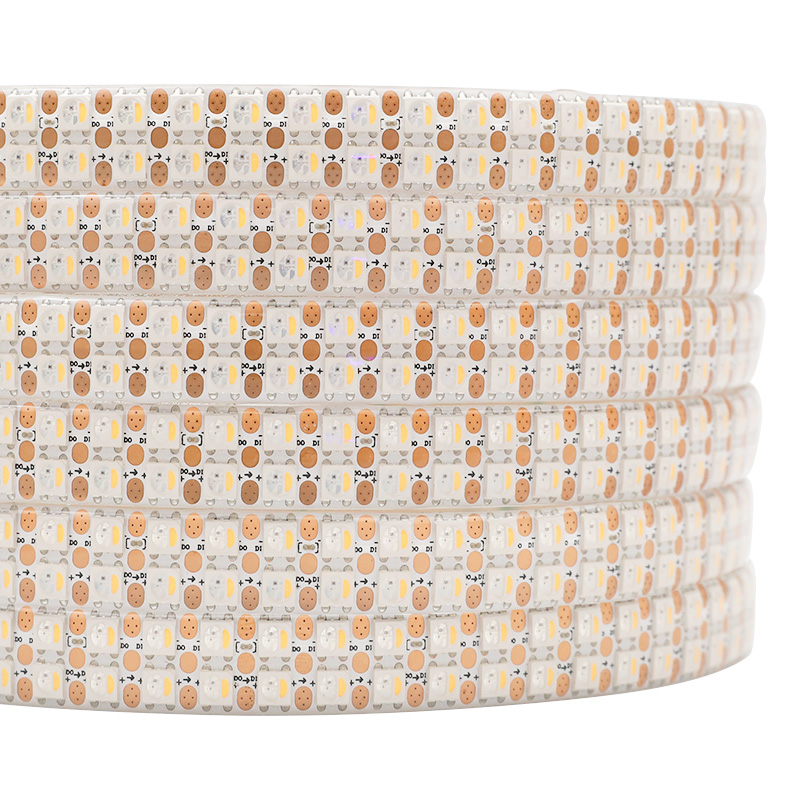
An addressable COB LED strip packages 576 to 720 microscopic flip-chips per meter directly onto a flexible PCB under a continuous phosphor silicone extrusion, achieving 180° beam diffusion with zero LED diodes visible. Traditional SMD5050 addressable LED strip products place distinct diodes spaced 16.6mm apart at 60 LEDs/m, demanding a diffuser channel depth of at least 15mm to avoid harsh pixel imaging. Exploring our high pixel density addressable COB LED strip lights or deploying an ultra-narrow 24V WS2811 8mm COB addressable LED strip produces spotless linear neon lines even within ultra-shallow 6mm aluminum extrusions.
07Why do broadcast camera setups require APA102 or SK9822 addressable LED strips?
Broadcast cameras and high-speed shutter systems capture rolling shutter banding and strobe artifacts when recording standard WS2812B or WS2811 LED strip installations, which pulse at a low 400Hz to 800Hz PWM frequency. High-clocked SPI chips like APA102 and SK9822 feature independent clock and data lines (CI and DI) capable of transmitting data at 20MHz to 30MHz with a PWM refresh rate exceeding 4.7kHz to 19kHz. This high refresh rate prevents camera PWM flicker distortion on 120fps video rigs and film stages. Examine timing tolerances in our APA102 vs. SK9822 comparison guide, and verify high-framerate video testing clips in our LED strip video library.
08When should you choose DMX512 addressable LED strips over SPI pixel LED strips?
Deploy a DMX512 addressable LED strip when control cable runs between the driver and the first pixel exceed 10 meters, or when integrating directly into professional stage lighting consoles like grandMA. Standard single-wire SPI addressable LED strip signals degrade rapidly over 3 to 5 meters due to capacitance and high-frequency noise. In contrast, differential RS-485 DMX512 transmission handles distances up to 300 meters without signal repeaters and provides parallel data routing so downstream pixels continue operating even if intermediate nodes lose power. Learn protocol specifications in our DMX512 control LED strip guide, and evaluate our heavy-duty DMX512 addressable LED strip lights for commercial venues.
09Why do addressable LED strips flash random colors during initial power-up?
Random flashes occur during startup because the floating data pin on an uninitialized microcontroller picks up capacitive EMI noise, which the high-impedance input on the first LED strip pixel interprets as valid 800kHz NRZ data frames. To suppress this behavior, place a 100kΩ pull-down resistor from the data line to ground, insert a 330Ω to 470Ω damping resistor in series near the data output pin to dampen ringing reflections, and install a 1000µF 16V electrolytic capacitor across the DC power input. Follow our step-by-step addressable LED strip wiring guide and ensure a stable, low-ripple regulated LED power supply is energized before sending control commands.
10How does CS8812 compare against WS2815 in dual-data 12V LED strip installations?
CS8812 is an upgraded drop-in alternative to WS2815, delivering identical 12V operation and dual-data breakpoint continuation (DI and BI), but featuring higher PWM refresh rates (2kHz vs. 1.2kHz) and reduced static standby power. Both chips allow downstream pixels to continue functioning if a single pixel dies, but CS8812 demonstrates tighter IC timing margins and superior resistance to inductive voltage spikes on unbuffered long LED strip harness runs. Read our lab findings in the WS2815 vs CS8812 comparison, or examine industrial-grade alternatives like the 12V WS2815 RGBW addressable LED strip for installations requiring redundant reliability.
11How do you choose between 5V, 12V, and 24V addressable LED strips?
Voltage selection depends directly on run length, pixel pitch granularity, and power injection constraints. A 5V addressable LED strip offers tight 1-LED individual addressability (ideal for small matrix screens under 2 meters) but requires heavy power injection due to high current draw. A 12V addressable LED strip triples run length to 5 meters before needing injection while maintaining 1-LED addressability on chips like WS2815. A 24V addressable LED strip supports 10-meter continuous runs with minimal copper heating, ideal for perimeter architectural accents. Consult our ultimate addressable LED strip selection guide or browse our catalog of addressable LED strip lights to match your system parameters.
12What causes the first pixel to burn out on an addressable LED strip?
The primary cause of first-pixel burnout is inductive voltage spike transients entering the unbuffered data pin or VCC line when hot-plugging DC power supplies or switching under load. Because the first pixel's internal ESD protection diodes clamp transient spikes above 6V on 5V systems, inductive ringing instantly punctures the CMOS silicon gate. Always wire a 1000µF capacitor across the DC power input terminals and place a 300Ω to 500Ω resistor on the data trace within 100mm of the first LED strip pixel. For custom pre-wired protection circuits, contact our custom OEM engineering lighting services or consult SuperLightingLED technical engineering support for schematic reviews.