
COB (Chip-on-Board) LED strips are trending because they produce a completely uniform, seamless line of light without the visible dots or ‘hotspots’ of traditional SMD strips. This is achieved by mounting hundreds of tiny LED chips directly onto the flexible circuit board and covering them with a continuous phosphor layer.
Here at SuperLightingLED, we’ve seen a massive surge in demand for our COB LED strips. Customers who try them for one project often come back and buy them for everything else. You’ve probably read a few guides on them, but as a manufacturer who designs and builds these strips every day, we wanted to share what really makes them special.
It isn’t just one thing. It’s a combination of that perfectly smooth, dotless light, surprising flexibility, and a robustness that solves some old frustrations. Let’s dig into why COB technology is more than just a trend—it’s a genuine step forward for linear lighting.
- COB (Chip-on-Board) technology creates a completely uniform, dotless line of light, eliminating the ‘hotspot’ effect common with SMD strips.
- Compared to SMD strips, COB strips are generally more flexible and durable due to the direct chip mounting and protective phosphor layer.
- COB strips come in a vast range of types, including standard, narrow-beam, and even ‘any-cut’ versions for ultimate project flexibility.
- A wide variety of voltages are available (from 3V DC to 220V AC), allowing for everything from small DIY projects to long architectural runs.
- The quality of the dotless effect depends on LED density, so it’s important to choose a high-density strip for the most seamless look.
- First, What Exactly is a COB LED Strip?
- An Inside Look: The Three Main Types of COB Strips
- COB vs. SMD Strips: A Head-to-Head Comparison
- Why the Big Shift? The Quest for Perfect, Dotless Light
- What Voltage Do I Need? Powering Your COB Strip
- Can I Cut COB Strips for a Custom Fit?
- Where to Buy Quality COB LED Strips
First, What Exactly is a COB LED Strip?
Have you ever installed an LED strip in a visible location, only to be disappointed by the series of bright dots reflecting off the surface? The primary goal of COB technology is to solve that exact problem. It’s designed from the ground up to produce a single, uninterrupted line of light.
The name gives away the method: COB stands for ‘Chip-on-Board’. Instead of soldering individually packaged LEDs (like the familiar square SMD chips) onto the strip, we mount hundreds or even thousands of tiny, bare LED chips directly onto the flexible circuit board. These chips are packed incredibly close together.
Then, the entire array of chips is covered with a continuous layer of phosphor coating. When the chips are powered on, they excite this phosphor layer, causing it to glow evenly along its entire length. The result is a light source that looks more like a slim, flexible fluorescent tube than a string of individual lights. You’ll often see the term FCOB, which simply stands for ‘Flexible COB’.

An Inside Look: The Three Main Types of COB Strips
While they all look similar at a glance, the way they’re constructed can change how the light is delivered. From our manufacturing perspective, there are three main designs you’ll encounter.
First is the **Linear COB**. This is the most popular and what most people think of when they picture a COB strip. It has a wide, 180-degree beam angle, casting light out in a broad, even pattern. It’s the default choice for general applications like cove lighting, under-cabinet lighting, and backlighting.
Next is the less common **Dotted COB**. This is a niche product that uses COB technology but is designed to mimic the appearance of an SMD strip with distinct points of light. Its market is quite small, but it exists for specific aesthetic goals.

Finally, and gaining popularity, is the **Narrow Beam Angle COB**. In this design, we add barriers of white colloid along both sides of the phosphor layer. This simple addition acts like a blinder, shaping the light and reducing the beam angle from 180 degrees down to about 120. This is fantastic for task lighting or wall grazing, as it reduces unwanted light spill and reflection off the strip’s own circuit board, directing more light where you actually want it.

COB vs. SMD Strips: A Head-to-Head Comparison
So how does this new kid on the block really stack up against the classic SMD (Surface Mounted Device) strip? The differences are fundamental.
Right out of the box, they look completely different. An SMD strip is a series of distinct yellow squares soldered onto a PCB. A COB strip just looks like a clean, solid line of colored phosphor. This difference becomes dramatic when they’re turned on, especially inside a shallow LED aluminum profile where SMD ‘hotspots’ are most obvious.

This visual difference is a direct result of LED density. Because SMD chips are packaged individually, there’s a physical limit to how close you can place them. With COB, the bare chips are tiny, allowing us to pack them in at densities that are impossible for SMD. Some of our high-end SMD strips can reach impressive densities like 264 LEDs/meter, but that’s where they top out. COB strips can easily exceed 700, 800, or even 1600 LEDs/meter, which is the key to that flawless, continuous light.
There’s also a durability advantage. Each chip on an SMD strip has two solder points connecting it to the PCB. If you bend the strip too sharply, you can stress these joints and cause one to fail, creating a dead spot. The ‘chip-on-board’ process and the protective phosphor seal make COB technology inherently more robust against twisting and bending. Some of our models can be bent and twisted in ways that would instantly break a standard SMD strip.
Why the Big Shift? The Quest for Perfect, Dotless Light
While we talk about COB strips being ‘dotless,’ it’s important to understand that the quality of that seamless effect can vary. It’s not an automatic guarantee. The magic lies in the density of the LED chips and the quality of the phosphor diffusion layer. A low-density COB strip might still show very subtle scalloping if you look closely, while a high-density one will be absolutely flawless.
Simply put, the higher the chip density, the more uniform the light. As a manufacturer, we offer a huge range of densities to match different applications and budgets. A strip with 320 LEDs/meter might be perfect for general use, but for a high-end architectural reveal or a piece of illuminated furniture, you might opt for a 528 or 720 LEDs/meter version for that pristine, unbroken glow. The options are vast.
| Strip Type | Common Densities |
|---|---|
| Single Color | 312, 320, 378, 384, 480, 528, 560, 624, 720, up to 1600 |
| Addressable Single Color | 320, 360 |
| Tunable White (CCT) | 500, 560, 576, 608, 624, 840 |
| Addressable CCT | 574 |
| RGB | 420, 576, 630, 756, 768, 810, 840, up to 1080 |
| Addressable RGB | 100, 160, 240, 332, 360, 420, 576, 630, 720, 840 |
| RGBW | 768, 784, 840, 896, 960, up to 1408 |
| Addressable RGBW | 576, 784 |
| RGBCCT | 720, 840, 960 |
| Addressable RGBCCT | 840, 1428 |
What Voltage Do I Need? Powering Your COB Strip
Do COB strips come in the voltage you need? Absolutely. COB is now a fully mature category within the LED strip world, meaning there’s a huge range of power options available. Whether you’re building a tiny battery-powered model or lighting up the entire side of a building, there’s a COB product to match.
For most interior projects, vehicle lighting, and other low-voltage applications, you’ll find a wide selection of DC options: 3V, 3.7V, 5V, 12V, 24V, and even 48V. The 24V option is the most common for general architectural use, offering a great balance of power and manageable run length.
For very long installations where voltage drop is a major concern, we also manufacture high-voltage AC COB strips in 110V and 220V. These can run up to 50 meters (over 164 feet) from a single power connection, making them ideal for large-scale architectural and commercial projects. This variety means you can power runs from a few inches all the way up to 50 meters.

Can I Cut COB Strips for a Custom Fit?
Yes, you can. Standard COB strips have designated cut marks printed right on the circuit board, just like SMD strips. Depending on the voltage and chip configuration, these cut points can be spaced anywhere from every 10mm to 83.33mm, allowing for a high degree of precision.
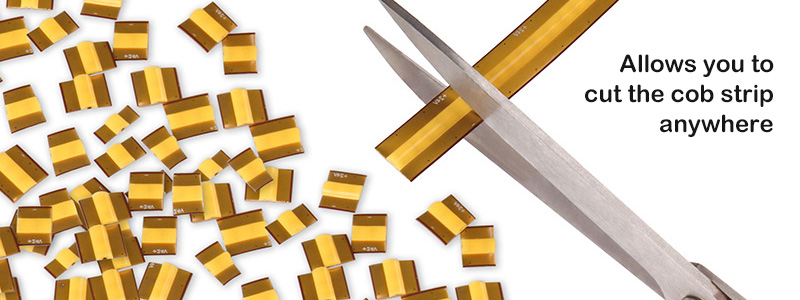
But in the last couple of years, a new innovation has made custom projects even easier: ‘Any-Cut’ COB strips. These are a game-changer. As the name implies, you can cut them at literally any point along their length. You don’t even have to cut in a perfectly straight line.
The convenience is incredible. When you’re making a custom neon sign, you can trim the excess strip perfectly to the edge of your letter shape. When you’re fitting a strip into a cabinet or stair tread, you no longer have to worry about ending up with an awkward unlit section or a segment that’s slightly too long. We currently offer white and CCT Any-Cut COB strips from 5mm to 10mm wide. This feature makes them the perfect light source to pair with silicone neon diffusers for achieving truly custom shapes and lengths. Even our waterproof IP67 versions can be cut anywhere, giving you ultimate flexibility. For more on the basics, you can read our guide on how to cut LED strips.
Where to Buy Quality COB LED Strips
Many people’s first encounter with a COB light strip is on a large marketplace like Amazon. That’s a fine place to start, but for designers, professional installers, fabricators, and serious hobbyists, sourcing directly from a specialist manufacturer is a much better path.
At SuperLightingLED, we’ve been manufacturing and refining COB strips for years. This isn’t just one product among thousands for us; it’s a core part of our business. We keep a massive variety of Flexible COB LED Strip Lights in stock, from single color to addressable RGBCCT, in dozens of densities and voltages. Because we control the production lines, we are constantly innovating and releasing new versions.
Buying directly from us means you get access to better pricing, expert support from people who actually make the product, and the ability to request custom runs for projects with unique requirements. We’re here to be your partner, not just a checkout button.
FAQ
Are COB LED strips dimmable?
Do COB LED strips get hotter than SMD strips?
Are COB LED strips more energy-efficient than SMD?
Can I use COB LED strips outdoors?
What kind of power supply do I need for a COB LED strip?
Do I still need an aluminum profile for COB LED strips?
Related LED strip articles
 Which Is The Brightest LED Light Strip?
 6 Best LED Strip Lighting Ideas For Rooms
 LED Strip Lights: Performance And Reasons Of LED Voltage Drop
 Is It Worth Getting LED Strip Lights To Lighting Your Place?
 Are There Really Small LED Strip Lights You Want?
 Right Recessed Ceiling Light Installation With LED Strip Lights