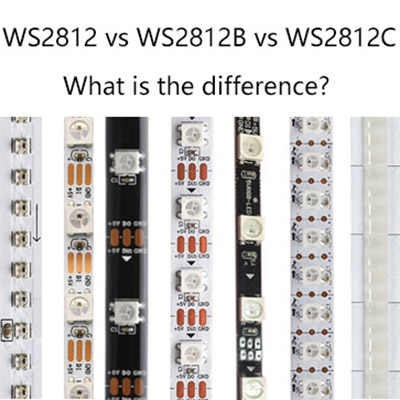
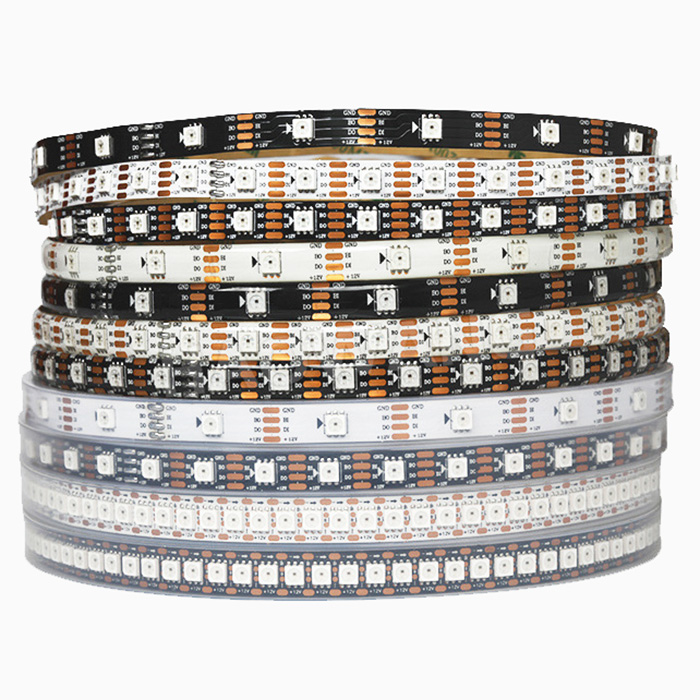
Both WS2815 and CS8812 are 12V addressable LED strips featuring individual pixel control and a backup data line for signal redundancy. The WS2815 is a long-established industry standard. The CS8812 offers virtually identical performance and features, making it an excellent, cost-effective alternative for most projects.
The WS2815 has been a favorite in the world of addressable LEDs for a long time, and for good reason. It brought 12-volt power and a redundant data line to the pixel party, solving some major headaches for installers. Here at SuperLightingLED, our CS8812 series was developed as a direct, modern counterpart to this popular chip.
So what are the real differences? When you’re planning a project, which one should you choose? Let’s break down the similarities and the key distinction so you can make the right call for your needs and your budget.
- Both WS2815 and CS8812 are 12V addressable LED strips, allowing for longer runs with less voltage drop compared to 5V strips.
- The key feature for both is signal redundancy (breakpoint resume), where a backup data line prevents one failed pixel from taking out the rest of the strip.
- WS2815 is the established standard, while CS8812 offers nearly identical functionality, often at a lower price point.
- Both use a single IC per 5050 SMD LED, providing true individual pixel control for complex animations and effects.
- Your choice often comes down to budget versus brand familiarity; for new projects, CS8812 is a highly viable, cost-effective alternative.
At a Glance: Feature Comparison
Before diving into the details, let’s look at the specifications side-by-side. As you’ll see, on paper, these two ICs are designed to accomplish the exact same goal.
| Feature | WS2815 | CS8812 |
|---|---|---|
| Input Voltage | DC 12V | DC 12V |
| LED Package | SMD 5050 | SMD 5050 |
| Control | Single Point, Single Control | Single Point, Single Control |
| Signal | Dual Signal (Data + Backup) | Single Signal / Dual Signal (Data + Backup) |
| Color Options | RGB, RGBW, White | RGB, RGBW |
The Shared Foundation: 12V Power and Individual Pixel Control
Why is 12V such a big deal for addressable strips? It all comes down to voltage drop. Lower voltage strips, like the classic 5V WS2812B, can’t be run in long sections without the voltage dwindling, causing colors to shift and pixels to dim at the far end of the strip. By operating at DC 12V, both WS2815 and CS8812 strips let you run much longer single lengths from one power supply, simplifying wiring significantly.
Both of these strips also offer ‘single point, single control’. This means the control IC is integrated directly inside each SMD 5050 LED package. Every single LED is its own pixel that can be addressed and colored independently. This is a massive leap from older digital light strips where you could only control segments of 3 or 6 LEDs at once. For creating smooth, fluid animations, chasing effects, or detailed light shows, individual pixel control is absolutely essential.

Signal Redundancy: The Breakpoint Resume Feature
Have you ever had one bad pixel take down an entire section of an LED strip? It’s one of the most frustrating points of failure. Both the WS2815 and CS8812 solve this problem with a feature called breakpoint resume, or a backup data line.
Here’s how it works: In addition to the main data line that tells each pixel what to do, there’s a second, redundant data line. If the IC inside a single pixel fails and can no longer pass the data signal along, the backup line automatically takes over. The signal simply bypasses the dead pixel and continues on to the rest of the strip, which remains fully functional. This makes installations far more robust and reliable, especially in hard-to-access locations.
Crucially, both ICs are compatible with the same popular controllers and software libraries. Whether you’re using an Arduino with the FastLED library, an ESP32 running WLED, or a Raspberry Pi, the control protocol is the same. You can drive a CS8812 strip using the same code you’d use for a WS2815.
So, Is CS8812 a Direct Replacement for WS2815?
Yes, absolutely. For the vast majority of applications, you can consider the CS8812 a direct, cost-effective alternative to the WS2815. The core functionality—12V power, individual pixel control, and breakpoint signal resume—is identical. Performance and visual output are indistinguishable to the naked eye.
The primary difference comes down to market position and cost. The WS2815 is a well-known, established brand name IC. The CS8812 provides the same result and reliability, but often at a more competitive price point. If your lighting project is on a tight budget, looking at our [[L2]]CS8812 LED strips[/L2]] is a smart move that doesn’t compromise on features.
Of course, there is nothing wrong with sticking to what you know. If your project specifications explicitly call for the WS2815 by name, or if you simply prefer it, our range of WS2815 programmable LED strips offers plenty of options.
Making the Right Choice for Your Project
When you get down to it, the choice is simple. Budget is the biggest factor. For new projects where you have the flexibility to choose components, the CS8812 delivers the same high-end features for less money.
Beyond price, you should check the specific configurations available for each type. Do you need a specific pixel density (like 30, 60, or more LEDs/meter)? A particular waterproof rating like IP65 or IP67? A black or white PCB? We stock a wide variety of both, so it’s worth comparing the product pages to see which line has the exact spec you need off-the-shelf.
If you have a very specific need—for example, a custom length, a non-standard LED density, or a particular color temperature for an RGBW strip—that isn’t covered by our stock items, we can help.
Final Thoughts
This comparison is focused on the practical choice between two finished LED strip products for your lighting project. If you are an engineer looking for a deeper dive into the electronic characteristics of the ICs themselves, we always recommend consulting the official PDF datasheets for each component.
WS2815 RGB Datasheet Download 
CS8812 RGBW Datasheet Download
FAQ
Can I use the same controller for both WS2815 and CS8812 strips?
Why should I choose a 12V addressable strip like WS2815 over a 5V WS2812B?
Are WS2815 strips brighter than CS8812 strips?
Do you offer WS2815 or CS8812 in an RGBW version?
Can I cut and reconnect WS2815 and CS8812 LED strips?
Are WS2815 and CS8812 waterproof?