
Wireless LED Strip Receiver
2 productsLTECH R4 Wireless LED Receivers for the DX / WiFi-104 Control System
LTECH R4 Series wireless receivers are designed for the LTECH DX / WiFi-104 lighting control system, providing flexible wireless control for compatible LED strips and LED fixtures. Use them with the WiFi-104 master controller for smartphone-based lighting control, or pair them with supported UX8 wireless touch panel for convenient local operation in residential and commercial spaces.
Multiple receivers can be assigned to different zones, allowing separate lighting areas to be controlled independently. R4-5A and R4-CC are intended for the specified LTECH DX control ecosystem. They should not be assumed to work with other third-party RF products merely.
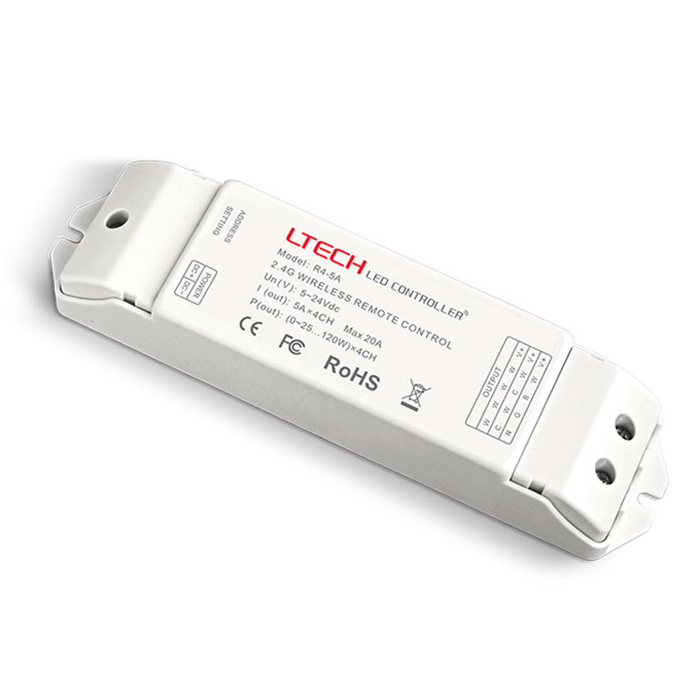

Two Receiver Types for Different LED Loads
The R4-5A Constant-Voltage PWM LED Receiver is a four-channel controller designed for compatible single-color, CCT, RGB, and RGBW LED strips. Choose R4-5A when you need to control constant-voltage LED tape lights using a compatible DC power supply. Match the supply voltage to the LED strip and ensure that the current limits of each channel and the total output are not exceeded.
The R4-CC Constant-Current LED Receiver is a four-channel controller designed for compatible lighting fixtures requiring regulated constant-current output. It is suited to current-driven lights, such as downlights and other constant-current luminaires that match its electrical specifications.
Choose R4-CC when the connected LED fixture requires constant-current drive. Confirm the required LED current, operating voltage, and power rating before installation.
FAQ About Wireless LED Strip Receiver
Direct engineering answers on wiring, load capacities, RF range, and ecosystem compatibility for LTECH DX wireless receivers.
A wireless LED strip receiver sits between your DC power supply and your LED strip lights to translate wireless RF or Wi-Fi commands into physical PWM dimming. It does not generate power on its own; it regulates the voltage or current feeding the diodes based on signals sent from an LTECH DX hand remote, a UX8 wall panel, or a WiFi-104 gateway. If you cut power upstream, the receiver powers down, but it retains its paired zone memory when line voltage returns.
You choose an R4-5A wireless LED strip receiver for standard 5V, 12V, or 24V constant-voltage LED strip lights, and the R4-CC for current-driven LED fixtures like downlights. The R4-5A handles up to 5 A per channel across 4 channels (20 A total), making it suitable for single-color, tunable white, RGB, or RGBW tape. The R4-CC takes DC 12V to 48V input and lets you select 350 mA, 700 mA, or 1050 mA outputs via onboard DIP switches. Connecting constant-voltage tape to a constant-current receiver will burn out the diodes immediately.
A constant-voltage wireless LED strip receiver like the R4-5A handles 100 W at 5V, 240 W at 12V, and 480 W at 24V across its 4 output channels. That breaks down to 5 A per terminal, with a hard ceiling of 20 A combined across the entire terminal block. If your LED strip layout pulls 18 A continuously, you are within electrical limits, but we recommend keeping sustained loads under 80% (16 A) to prevent thermal stress on the internal switching MOSFETs. For larger runs, split the tape across multiple receivers assigned to the same zone.
No, a wireless LED strip receiver in the LTECH DX series only communicates with LTECH DX-compatible transmitters using their proprietary RF protocol. Generic 2.4 GHz remotes, Tuya remotes, or standard Zigbee hubs will not bind with an R4-5A or R4-CC. To send commands, you need dedicated transmitters such as the WiFi-104 gateway for mobile app control or touch panel controllers mounted to standard wall switch boxes. Once paired, you can bind multiple receivers to a single zone button without running control wires between them.
Mount your wireless LED strip receiver in open air or inside a plastic enclosure, keeping it outside fully enclosed metal junction boxes that act as Faraday cages. In unobstructed open air, reliable RF reception reaches roughly 30 m, but concrete walls, metal studs, and aluminum cabinetry attenuate that distance to 10 m to 15 m. Keep the receiver at least 1 m away from high-power switching power supplies or large inductive motors to prevent radio interference from dropping dimmer packets mid-fade.