
IR Controller
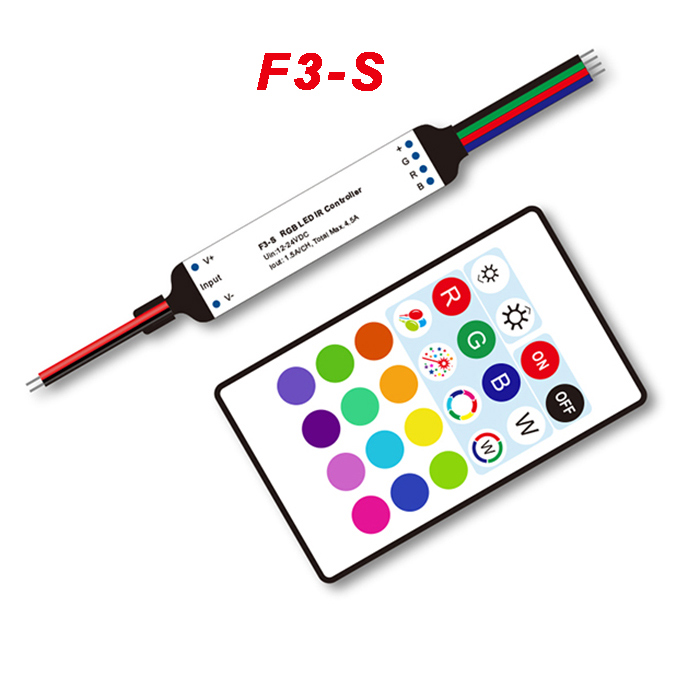
1 sub-categoriesSkydance infrared remote control series products include infrared remote control constant voltage dimmer and infrared remote control constant voltage RGB/RGBW controller, low cost, easy to install, for controlling 1-5 meters of low voltage single color or RGB LED strip or RGBW strip light.
Generally, the working principle of an Infrared (IR) controller for regulating LED strips and lights relies on a precise, line-of-sight infrared beam. Compared to RF (Radio Frequency) signals that cover a wider range, the IR signal is specifically designed for hyper-focused, one-to-one precision control and settings, preventing cross-room interference.
With the widespread adoption of smartphone smart control, Wi-Fi-enabled infrared LED controllers have also emerged. This integration allows LED fixtures to work seamlessly with the entire smart home system while remaining effortlessly accessible for independent, individual control.

IR CV Controller
Our IR infrared LED controllers support a wide working voltage range of DC 5-24V or DC 12-24V, offering dual-mode operations for maximum flexibility. You can easily perform basic adjustments using the physical buttons directly on the controller or connect it seamlessly to your smartphone via the Tuya Smart App for advanced smart automation and global remote control.
For Single Color LED Strips
-
Power Controls: On/Off master switch.
-
Stepless Dimming: Manual brightness adjustment buttons for precise fine-tuning.
-
Quick Brightness Presets: 4 dedicated buttons for fixed brightness levels (e.g., 25%, 50%, 75%, 100% for rapid setting).
-
0.5s & 3s On/Off Fade: You can choose a quick 0.5-second fade for instant yet soft illumination, or a 3-second slow fade for a premium, cinema-style lighting transition that prevents sudden eye strain.
-
Night Light Mode: One-click activation for a soft, ultra-low brightness ambient glow—perfect for bedtime or night walks.
For RGB/RGBW Multi-Color LED Strips
-
Static Colors Choice: Multiple shortcut keys for instantly switching to solid target colors.
-
Dynamic Modes: Built-in transition effects including fade, jump, and flash with speed control adjustments.
-
Best-selling IR Controller
1–8 of 8 products




Should You Choose IR or RF to Control Your LED Strips?
Your choice depends entirely on your control intent, LED load requirements, and fixture compatibility:
-
Control Intent (Interference vs. Range): Choose IR if you need precise, one-to-one control within a direct line of sight without interference. Choose RF if you require long-range control that can pass through walls and obstacles.
-
Controller Load & Capacity Limitations: Please note that our IR series is currently engineered exclusively for low-voltage, constant voltage (CV) Single Color and color-changing RGB, RGBW LED strips.
-
Technical & Interface Specifications: These IR controllers are designed with a mini form factor for space-saving installations. They carry a relatively low current capacity of around 4-5A. For connectivity, they feature bare wires or DC jacks to connect the DC power supply, and bare wires, DC jacks, or pin ternimal connectors to interface with the LED strips.
Are IR remote controls universal?
No, IR remotes are not universally interchangeable across different brands, but they are universal within the same product series.
IR remotes operate on specific infrared carrier frequencies and protocol codes (such as NEC or RC5). A remote from another electronics manufacturer or a different brand of LED controllers will not work unless they happen to share the exact same coding chip.
Always use the dedicated IR remote provided by SuperLightingLED for your specific controller model to ensure full feature compatibility.
Can one IR remote control all of my identical IR controllers?
Yes, absolutely! One IR remote can control multiple identical controllers instantly without any pairing required.
Unlike RF systems that require digital address code pairing (one-to-one or group learning), IR controllers do not utilize a pairing mechanism. They simply react to any matching infrared light signal they receive.
If you install three identical IR controllers, the three matching remotes in your hands are 100% interchangeable and can be used completely at random. Any of the remotes can control any of the controllers without setup.
Frequently Asked Questions About IR Controllers for LED Strip Lights
Direct answers on infrared line-of-sight control, amp limits, multi-zone isolation, and Tuya Wi-Fi hybrid setups from our pre-sales engineering desk.
An IR controller for LED lights relies on direct line-of-sight optical transmission at a 38 kHz carrier frequency rather than omnidirectional radio waves. That physical constraint is actually its primary advantage: infrared light cannot pass through drywall, glass, or cabinetry. These IR units offer complete optical room isolation. If you operate identical single color or RGB LED strip lights in adjacent hotel guest rooms, hospital patient bays, or adjoining office cubicles, an IR unit prevents remotes in one room from accidentally altering lighting in the next.
Mount the sensor of an IR controller for LED lights where the remote has an unobstructed optical line to the diode, angled within 30 to 45 degrees of your primary standing or sitting area. The physical receiver module on units like the F1-M or F4-M features a small black photodiode dome on a flexible lead. Never bury this diode inside a solid aluminium extrusion, behind an opaque wooden valence, or underneath deep acoustic ceiling foam. If your LED strip lights run inside an architectural channel, route the diode through a neat 5 mm drill hole or tuck it flush along the profile end cap.
An IR LED controller in our SkyDance range is rated for 4A to 5A total output, which handles standard 5-meter reels of low-voltage LED strip lights. For example, a 24V single color strip drawing 9.6 W/m consumes 48W over a 5m run, pulling 2.0A—well under the 5A ceiling of an F1-M(WT). On 12V strips, current doubles for the same wattage: a 5m reel drawing 48W pulls 4.0A, leaving a safe 20% operating margin on a 5A receiver. If your continuous lighting layout exceeds 5 meters or pulls over 5A, do not overload the receiver board; divide your load with signal repeaters.
A non-responsive LED IR controller is usually caused by an obstructed receiver eye or a depleted CR2025 coin cell battery. First, check that the clear plastic battery insulation tab was pulled completely out of the handheld transmitter. Next, ensure you are standing within the 10-meter line-of-sight range and aiming directly at the receiver diode. A quick bench test: open your smartphone camera app, aim the front of the IR remote into the camera lens, and press any button. Phone camera sensors detect infrared wavelengths—if you see a flashing purplish glow on screen, the remote is transmitting and the issue sits in receiver wiring or line of sight.
An IR controller for LED lights uses dedicated 38 kHz pulse-code modulation that ignores standard consumer TV remotes. SkyDance IR remotes (such as the RC1 and RC3) transmit distinct binary command preambles assigned exclusively to lighting dimming, color selection, and dynamic modes. We have supplied LED strip lights and control hardware to commercial installs since 2015, and accidental crossover with Samsung, LG, or Sony television sets is non-existent. However, placing the receiver diode directly adjacent to an unshielded plasma television screen or high-intensity halogen spotlight can flood the optical sensor with ambient infrared noise, reducing remote reception range.
Multiple IR LED controller setups operate independently across separate rooms because infrared light cannot penetrate physical walls, closed doors, or solid partitions. While 2.4 GHz RF signals routinely travel 30 meters through drywall and cause accidental multi-room triggering, infrared optical signals stay trapped in the room where they are fired. In a hotel corridor with 50 rooms or a showroom with 20 partitioned display vitrines, you can install identical F1-M or F3-M receivers and identical remotes in every bay. Occupants control their local LED strip lights without cross-talking into neighbouring units.
On a hybrid IR controller for LED lights, the internal 2.4 GHz Wi-Fi module pairs with the Tuya Smart Life app, while the optical IR sensor remains active for instant wall or table remote adjustments. In fact, 63% of our live IR models feature integrated Wi-Fi—compared to just 10% on SkyDance sibling categories—giving you dual-path control right out of the box. You can schedule sunrise automation or adjust your lighting via Amazon Alexa and Google Assistant on your phone, while keeping the RC3 remote on the bedside table for immediate tactile control when guests prefer not to open an app.
To extend runs beyond the 5A threshold of an IR controller for LED lights, install a constant voltage power repeater instead of pushing excessive current through the mini receiver. While our IR controllers top out at 4A or 5A, you can route the PWM output from your F1-M or F3-M receiver into our power repeaters (we stock 20 distinct models). The repeater reads the controller's dimming signal and synchronously powers additional 5m, 10m, or 20m runs from an auxiliary 12V or 24V power supply. This keeps the primary IR receiver cool and eliminates voltage drop across large architectural coves.
No, an IR controller for LED lights cannot be operated by generic universal TV remotes because commercial universal remotes lack the proprietary hex codes used by lighting dimmers. You must pair the controller with the designated SkyDance transmitter—such as the RC1 for single color or RC3 for RGB and RGBW units. Because infrared communication uses direct optical code pairing rather than RF radio handshakes, replacement remotes work immediately without complex pairing buttons. If you misplace a handheld unit, keep the receiver in place and order a standalone RC1 or RC3 remote directly from our warehouse.
A mini LED IR controller is ideal for retail jewelry showcases, museum vitrines, and kitchen under-cabinet runs where compact footprint is mandatory. Units like the F1-S and F3-S measure barely 60 mm long and 14 mm wide, sliding effortlessly behind face frames or inside shallow cabinet recesses. The thin sensor wire threads through 6 mm shelf holes to position the photodiode discreetly at the cabinet face.