
WiFi LED Controllers
1 productsThe LTECH WiFi-104 is an app-based wireless lighting control system in the LTECH DX series, designed to manage compatible LED lighting through dedicated R4 Series wireless receiving controllers. It combines smartphone control, multi-zone management, and 2.4GHz RF communication to provide flexible lighting adjustment without requiring wired control signals between the WiFi-104 master controller and each receiver.
Unlike the LTECH L-BUS WiFi-106 system, which belongs to a different wireless control ecosystem, the WiFi-104 system described here uses R4-5A constant-voltage receivers or R4-CC constant-current receivers to control the connected LED lighting. Choose the receiver according to your lighting load and electrical requirements.
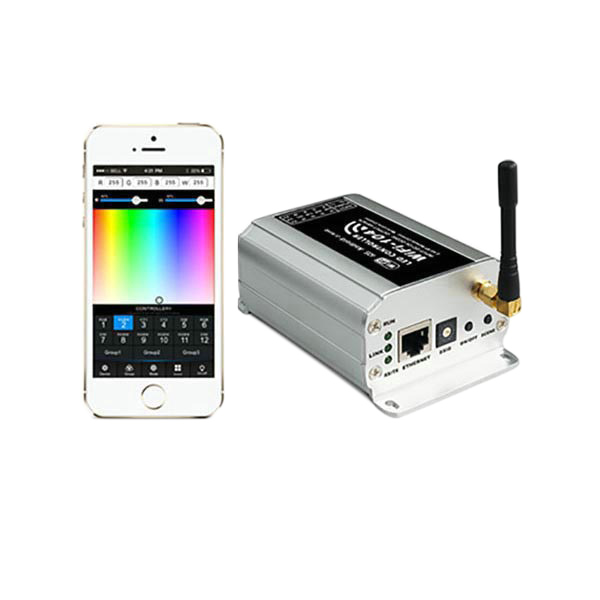
LED WiFi-104 RF 16 Zones Wireless Synchronization Group Controller
App-Based Control with Flexible Multi-Zone Operation
Connect a compatible iOS or Android device to the WiFi-104 system directly or through a compatible Wi-Fi router. The system supports up to 12 lighting zones, allowing compatible lighting areas to be controlled individually or grouped for coordinated operation.
Depending on the connected R4 receiver and lighting configuration, supported functions include brightness adjustment, tunable white (CCT) control, RGB color mixing, RGBW lighting, and customized dynamic lighting effects. The system is suitable for residential lighting, cabinet and cove lighting, display areas, and other installations that benefit from convenient app-based multi-zone control.
A compatible M12 RF remote can also provide handheld control in supported configurations. WiFi-104, the remote, and the R4 receivers must be paired and configured according to the product instructions.
FAQ About WiFi LED Controllers
Direct technical answers on wiring, router pairing, zone management, and receiver compatibility for the LTECH WiFi-104 control system.
A WiFi LED controller bridges your mobile device to your lighting by receiving 2.4GHz Wi-Fi commands and translating them into RF signals for wireless receivers. In this DX series setup, the master unit does not wire directly to your LED strip lights in remote rooms. Instead, it converts commands from the iOS or Android app and broadcasts them across 2.4GHz RF to localized R4-5A or R4-CC receivers up to 30 meters away through interior drywall.
Yes, a controller wifi led hub can generate its own independent local Wi-Fi network for direct smartphone pairing without an external internet router. The unit features dual operating modes: AP mode (Access Point) and Station mode. In AP mode, you connect your mobile device directly to the unit's local SSID within an 8-to-15 meter radius on the jobsite. For whole-home coverage, switch it to Station mode so it joins your existing 2.4GHz Wi-Fi router.
The master unit delivers 4 channels rated at 4A per channel, yielding a total local capacity of 16A at 12V to 24V DC. That means you can wire up to 192W of 12V LED strip lights or 384W of 24V tape light directly to the master unit's onboard screw terminals. For larger projects, the hardware acts as an RF transmitter controlling up to 12 zones through satellite receivers, bypassing physical output limits. Check our WiFi-104 controller for complete hardware pinout specs.
The wireless 2.4GHz RF communication between the master WiFi unit and an R4 receiving controller spans up to 30 meters indoors and 100 meters in open line-of-sight. Solid concrete, brick walls, and metal stud construction attenuate RF propagation, cutting reliable indoor transmission down to roughly 15 to 20 meters. If you are placing receivers inside metal enclosure boxes, always mount an external antenna lead or position the receiver outside the metal shield to prevent signal dropouts.
Yes, multiple smartphones can control the same WiFi LED controller as long as every phone is connected to the same local Wi-Fi router network. Once the master controller joins your home router in Station mode, any iOS or Android device running the companion app discovers the hardware automatically. Up to 16 mobile clients can monitor and trigger scene changes simultaneously without requiring you to re-pair the receivers or disconnect previous sessions.