
PWM CC Power amplifier
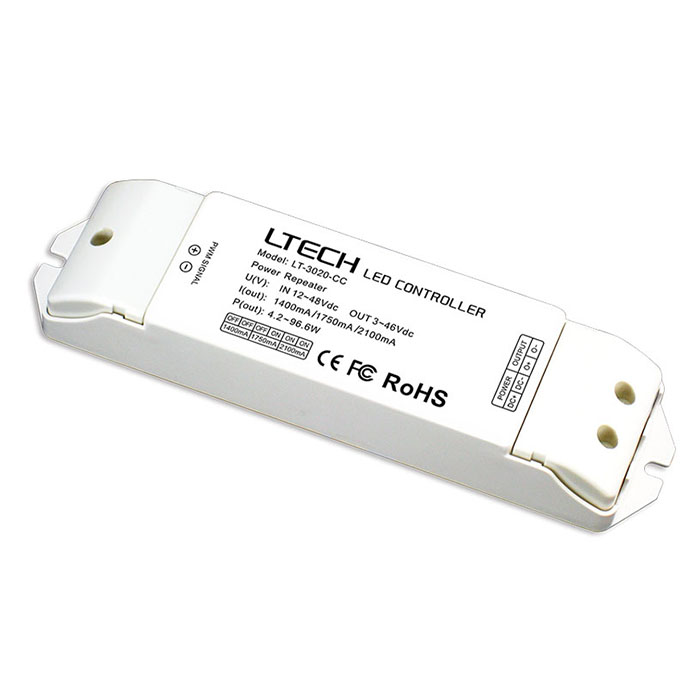
7 productsThese Ltech Constant Current (CC) LED PWM Power Amplifiers can act as PWM to constant current converters, PWM signal input and constant current 350mA/700mA/1050mA or 1400mA/1750mA/2100mA output, to achieve PWM dimming control of different constant current led lamps.
Adding a CC power amplifier allows you to connect a multiple number of constant current LEDs. In theory, an infinite number of PWM constant current power amplifiers can be connected.


FAQ About PWM CC Power Amplifiers
Direct engineering answers on selecting, sizing, wiring, and troubleshooting constant current PWM repeaters.
A PWM CC power amplifier converts a low-voltage PWM dimming signal from a master controller into a regulated constant current output (such as 350mA, 700mA, or 1050mA) to dim constant current LED fixtures. If you have high-power LED downlights, spotlight pucks, or architectural wall washers that require fixed milliamps rather than fixed 12V or 24V, a constant voltage controller cannot run them directly without frying the emitters. The amplifier reads the controller's duty cycle on its signal input and adjusts its internal current regulation from 0.1% to 100% duty, letting you synchronize dozens of CC luminaires across one dimming zone.
You select the milliamp rating on a PWM CC power amplifier by matching the LED fixture's exact factory drive current, never exceeding its rated mA. Driving a 350mA COB downlight at 700mA will generate intense thermal stress and destroy the diode within hours. On multi-current units like the LT-3030-CC, an onboard DIP switch lets you toggle between 350mA, 700mA, and 1050mA per channel. Always check the stamped rating on your light engine before setting the switches and applying line power.
A PWM CC power amplifier requires a DC12V to DC48V power supply, and that supply voltage must sit at least 2V to 3V higher than the total forward voltage of your connected LED string. For example, if you wire eight 350mA puck lights in series with an individual forward voltage of 3.2V each, your string needs 25.6V. A 24V power supply will drop out of regulation and fail to light the string to full brightness. You must feed the amplifier with a 36V or 48V power supply so its DC3V to DC46V output stage has adequate headroom.
A PWM CC power amplifier maintains a fixed current across its output circuit, meaning all connected LED fixtures must be wired in series so each diode receives that identical current. If you wire constant current fixtures in parallel on a 700mA output, the current splits unevenly between them based on small differences in internal resistance. The diode drawing slightly more current runs hotter, drops its internal resistance further, draws even more current, and suffers rapid thermal runaway. Series daisy-chaining prevents that failure completely.
Repetitive flashing on a PWM CC power amplifier happens when the total forward voltage of your series LED string exceeds the amplifier's maximum output voltage or the DC supply voltage feeding it. When an amplifier rated for DC3V to DC46V output sees a series load demanding 49V, its internal buck-boost regulator hits over-voltage protection, cuts power, restarts, and hits the ceiling again in an endless loop. Reduce the number of series fixtures on that channel or increase your primary DC input rail up to the 48V hardware limit.
A multi-channel PWM CC power amplifier like the LT-3040-CC controls multi-color fixtures smoothly by regulating constant current across each individual color channel. Standard RGB controllers output 12V or 24V PWM common-anode signals. When you connect the controller's red, green, and blue negative outputs to the amplifier's PWM inputs, the amplifier drives dedicated red, green, and blue series LED circuits at matching constant currents. Make sure your RGB fixtures have separate anode and cathode leads for each diode channel rather than internal parallel circuits.
You calculate the required power supply for a PWM CC power amplifier by multiplying your total series forward voltage by the operating current, adding the amplifier's internal consumption, and applying an 80% safety margin. If one channel runs twelve 3.2V LEDs at 700mA, the lamp load consumes 38.4V × 0.7A = 26.88W. On a three-channel unit like the LT-3030-CC fully loaded, total demand reaches 80.64W. Divide that by 0.8 to select a 100W or 120W DC48V industrial power supply.
Spotlights glowing faintly when dimmed down to zero usually mean the master controller is outputting a residual floating PWM signal or low duty cycle that keeps the amplifier's current regulation active. Some budget controllers never pull their signal output completely to 0V ground at low trim. You can resolve this by adding a 10k-ohm pull-down resistor between the amplifier's PWM signal input terminal and common ground, which drains residual leakage voltage and forces the internal optocoupler into a clean, zero-current off state.