
DMX512 Control System
8 sub-categoriesThe SkyDance DMX512 Control System provides a versatile lighting control solution for residential and commercial LED lighting applications. By connecting 1–5 channel constant voltage LED strips, addressable LED strips, or 1–4 channel constant current LED fixtures to compatible DMX decoders, and linking them to a wall-mounted DMX master panel, you can achieve centralized lighting control, synchronized operation, or independent multi-zone control. Adjust brightness, color temperature, RGB/RGBW colors, and other lighting functions through an intuitive wall panel.
For more advanced lighting projects, USB-to-DMX masters provide a computer-based control solution, allowing you to program and manage DMX lighting through dedicated software, with 128-channel and 512-channel options available.
SkyDance also offers a range of DMX signal converters to extend DMX control beyond conventional LED strips and fixtures. DMX-to-0/1-10V converters allow you to integrate 0-10V or 1-10V dimmable LED drivers and lighting fixtures, while DMX Triac dimmers enable DMX control of compatible AC Triac-dimmable lights and drivers.
From simple residential lighting setups to multi-zone commercial installations and integrated lighting projects, SkyDance DMX512 provides a flexible and expandable control system for different LED lighting technologies.

DMX512 Master
The SkyDance DMX512 Master Series is designed to provide convenient and flexible control for DMX512-based LED lighting systems, making professional DMX lighting more accessible to homeowners, electricians, lighting installers, and commercial lighting contractors. Whether you need straightforward wall-mounted control for residential lighting or more advanced computer-based control for commercial lighting projects, SkyDance offers different DMX master solutions to match your application.
The working principle is simple: a DMX master acts as the central control unit, generating DMX512 control data and transmitting it through the DMX signal lines (A/B) to compatible constant-voltage, constant-current DMX decoders, or high-voltage DMX decoders, or DMX-SPI decoders. The decoders then translate these commands into output signals to control the connected LED strips and fixtures.

CV DMX512&RDM Decoder
Skydance CV Constant Voltage DMX 512 LED decoder are compatible with latest DMX512, DMX512(1990), DMX512-A, RDM V1.0 (E1.20 - 2006 ESTA Standard) international standard protocols. These CV led DMX decoders convert universal DMX512/1990 digital signal to constant voltage PWM signal to drive LED strip lights and controlled by DMX512 console or our DMX master to realize 0-100% lighting adjustment.
To control single color, dual color, RGB, RGBW or RGB+CCT constant voltage LED strip lighting with 1/3/4/5/12/24 channels CV DMX decoder. The DMX address can be set via a digital tube display /OLED screen key or a 10-pin DIP switch, or remotely via a DMX512/RDM console.
Over-heat / Over-load / Short circuit / Reverse polarity protection. Work with power repeater to expand output unlimitedly.
Product spec sheets & downloads

CC DMX512&RDM Decoder
Skydance CC Constant Current DMX512 led decoders are compatible with latest DMX512, DMX512(1990), DMX512-A, RDM V1.0 (E1.20 - 2006 ESTA Standard) international standard protocols. CC DMX decoder converts universal DMX512/1990 digital signal to constant current PWM signal to drive constant current LED lights and controlled by DMX512 console or our DMX master to realize 0-100% lighting adjustment.
3/4channels CC DMX led decoder to control single color, color temperature, RGB or RGBW constant current LED lamps. The DMX address can be set via a digital tube display key, or remotely via a DMX512/RDM console. Short circuit / Reverse polarity protection.
Product spec sheets & downloads

High Voltage DMX512&RDM Decoder
Skydance high voltage LED strip DMX512 decoder are compatible with latest DMX512, DMX512(1990), DMX512-A, RDM V1.0 (E1.20 - 2006 ESTA Standard) international standard protocols. The AC 110V-240V high voltage DMX LED strip decoders convert universal DMX512/1990 digital signal to constant voltage PWM signal to drive AC LED lights and controlled by DMX512 console or our DMX master to realize 0-100% lighting adjustment.
3/4 channels high voltage LED strip DMX decoder to control single color, CCT, RGB or RGBW high voltage LED strips. The DMX address can be set via a digital tube display key, or remotely via a DMX512/RDM console. Over-load protection.
Product spec sheets & downloads

DMX-SPI Decoder
All latest products of the Skydance DMX-SPI Decoder System come with a built-in RF module. They are fully compatible with addressable RGB and RGBW LED strips & fixtures, including UCS1903/UCS2903, TM1812, SK6813, WS2811/SM16703, WS2815, GS8206, GS8208, LPD6803, LPD8806, WS2801, SK9822, as well as TM1814 RGBW, SK6812 RGBW, SM16714 RGBW and WS2814 RGBW.
Please note that the wireless RF remote function cannot work simultaneously with a DMX master controller. Therefore, if you use the Skydance RGB or RGBW remote to control your pixel lighting, this setup is typically used for standalone or independent applications where a complex DMX console is not required, allowing you to easily manage lighting effects, color transitions, and dimming directly via wireless convenience.
Like the DMX-SPI signal converters from the Ltech brand, these decoders come with a 5-year warranty.
Product spec sheets & downloads

DMX0/1-10V Decoder
DMX 0/1-10V decoder comply with the latest DMX512, DMX512(1990), DMX512-A, RDM V1.0 (E1.20 - 2006 ESTA Standard) standard protocols. DMX 0-10V decoder converts standard DMX512/1990 signal into 0-10V signal for control of 0-10V dimmable led drivers and lights. DMX 1-10V decoder converts standard DMX512/1990 signal into 1-10V signal for control of 1-10V dimmable LED drivers and lights. The DMX address can be set via a digital tube display key, or remotely via a DMX512/RDM console.
Product spec sheets & downloads

DMX Triac Dimmable
DMX Triac dimmer comply with the latest DMX512, DMX512(1990), DMX512-A, RDM V1.0 (E1.20 - 2006 ESTA Standard) standard protocols. DMX to Triac dimmer converts standard DMX512/1990 signal into 1/2 channel AC phase-cut output for control of Traic dimmable LED drivers and lamps. Compatible with leading edge dimming or trailing edge dimming, the minimum brightness set by digital tube display key. The DMX address can be set via a digital tube display key, or remotely via a DMX512/RDM console. Over-heat protection.
Product spec sheets & downloads

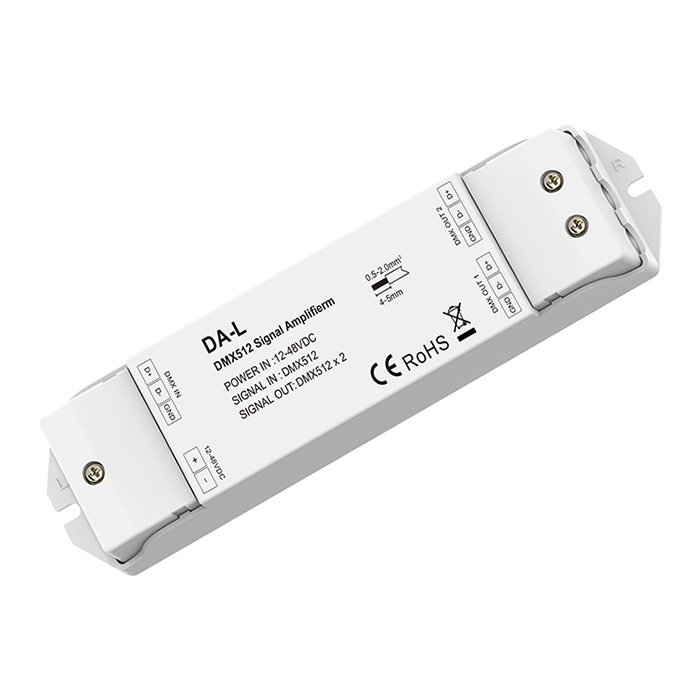
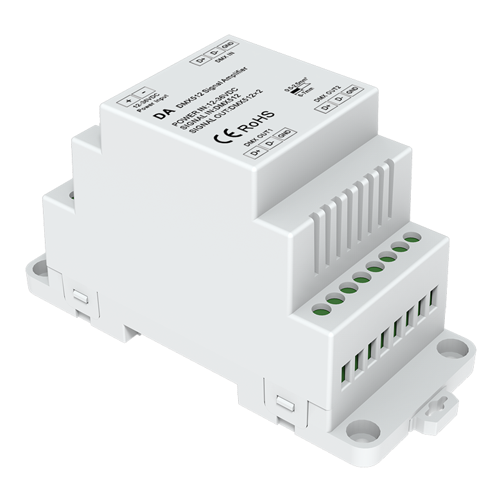
DMX512 Signal Amplifier
Skydance DMX signal amplifier is dedicated to the DMX512(or rs-485) bus for signal amplification, distribution, and isolation. The DMX signal is transmitted over a long distance, or the DMX signal attenuation after multiple DMX decoder devices are connected together is processed by shaping and amplifying to extend the signal transmission distance. 1 way input, 1/2/4 way output, photoelectric isolation between input and output.
Product spec sheets & downloads
Best-selling DMX512 Control System
1–20 of 86 products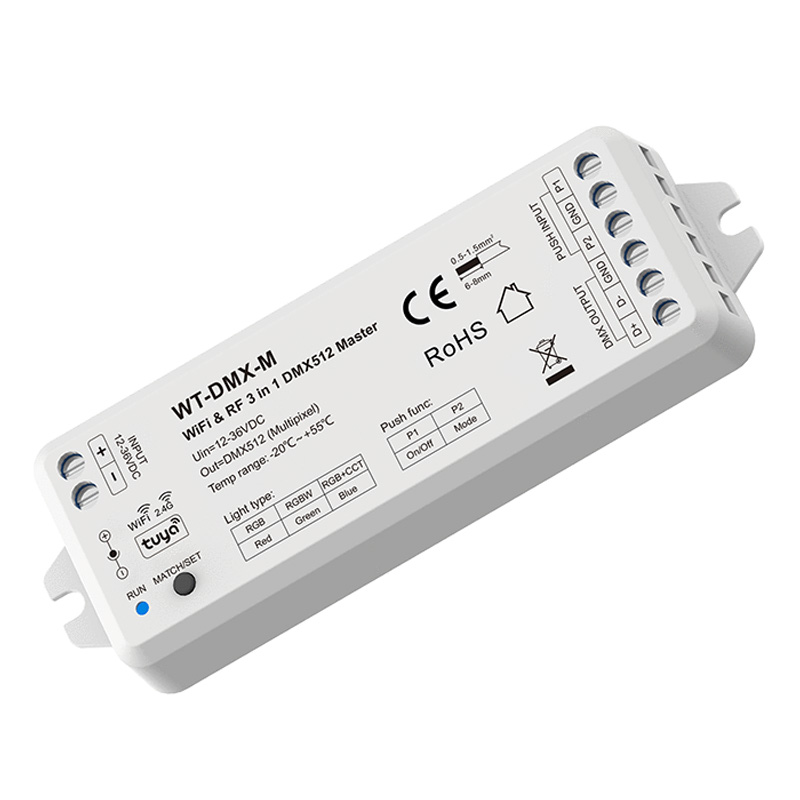
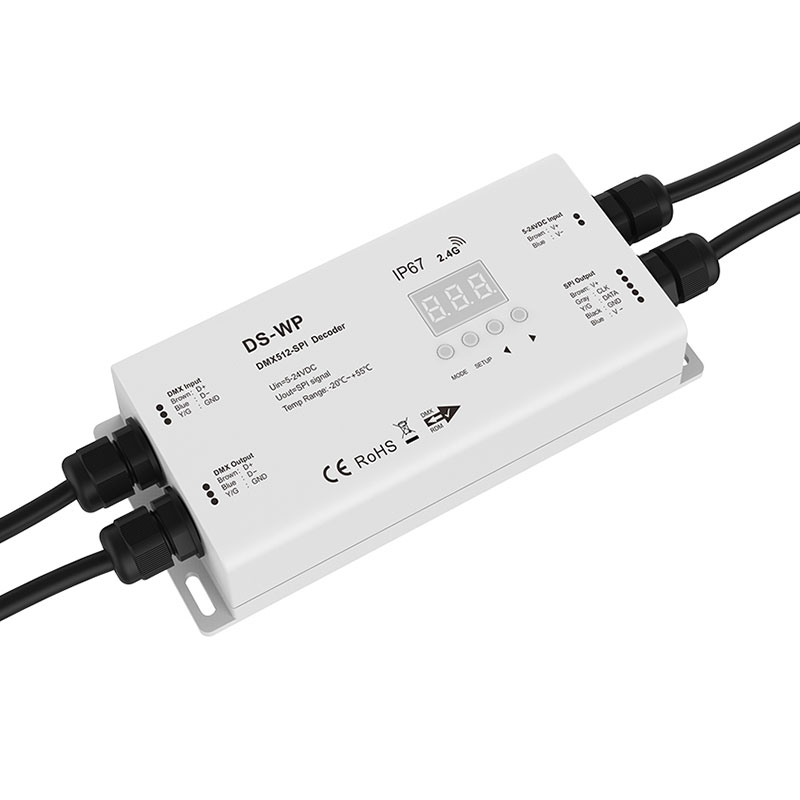
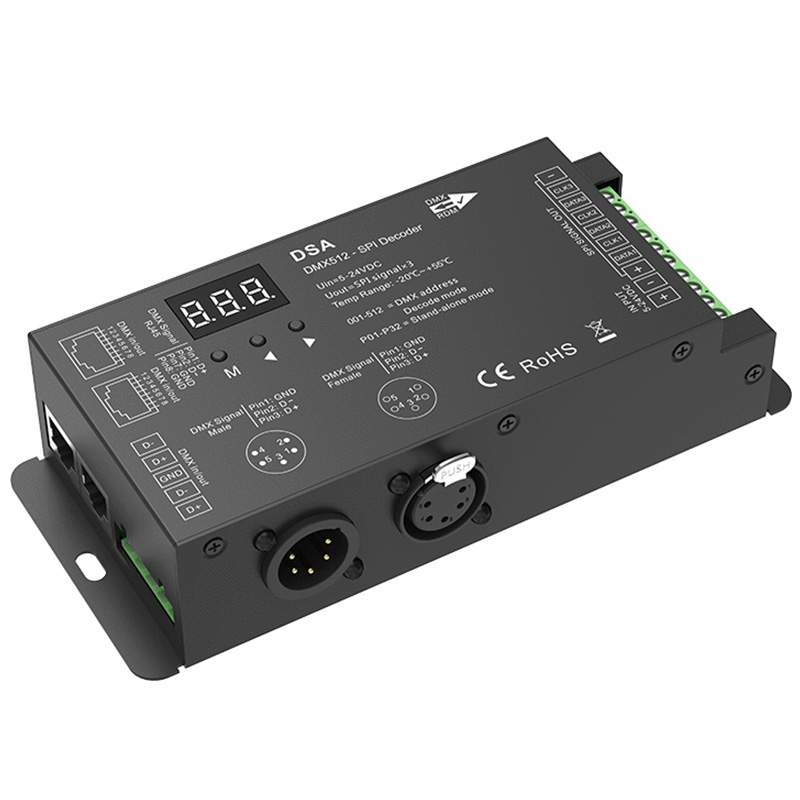

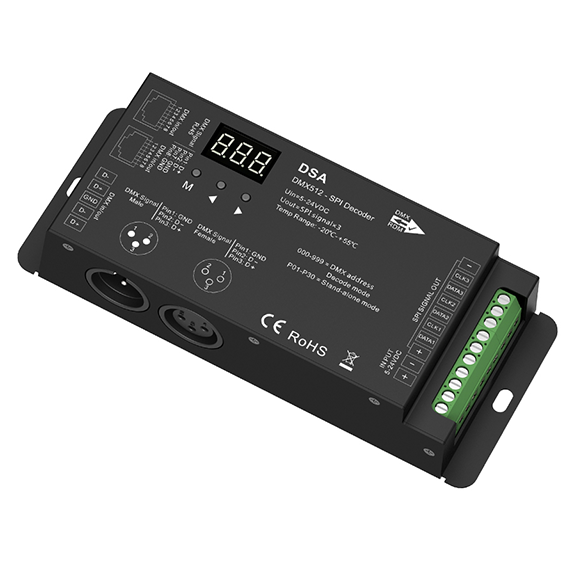






 (1)


Product spec sheets & downloads
Which DMX Control System Should You Choose?
Choosing the right DMX control system depends on your project requirements and preferred control architecture.
If your DMX system requires Ethernet-based network control or you prefer integrated DMX LED drivers, explore our LTech DMX Series.
If product certifications are an important requirement for your project, take a look at our SunRicher DMX Series.
For projects that require complete DMX-controlled lighting fixtures rather than separate controllers and decoders, explore our MiBoxer (Mi-Light) DMX Series and Outdoor Lighting Collection.
Blog: DMX Control LED Lighting Strip – Things You Need To Know
FAQ About DMX512 Control Systems
Direct answers to real jobsite questions about DMX512 wiring, decoders, signal limits, and lighting control from our senior engineering desk.
To control LED lights with DMX, connect your DMX512 console or wall master to a dedicated DMX decoder using shielded twisted-pair cable, then run low-voltage DC power from the decoder outputs to your LED strip lights. The master sends 8-bit or 16-bit channel values over the bus, and the decoder translates those digital frames into pulse-width modulation (PWM) dimming for single-color, tunable white, RGB, or RGBW tape. For multi-channel jobs, our CV DMX decoders provide terminal blocks for DC12V to DC48V inputs and let you assign distinct start addresses directly on-device or over RDM.
DMX512 is an RS-485 differential bus protocol running up to 512 channels per universe over hundreds of meters, whereas SPI is a single-ended, chip-level protocol designed for short-distance addressable IC data. Standard low-voltage LED strip lights lack microchips, so they rely on a DMX decoder to dim entire sections together. If you need chasing patterns or individual pixel nodes, use a dedicated translator like our DMX-SPI decoders to bridge DMX512 console commands into SPI clock and data lines for chips like WS2811, WS2812B, or UCS1903.
You control RGB LED strip lights by wiring the common positive lead and the red, green, and blue cathode channels to a 3-channel or 4-channel DMX decoder, then mapping 3 consecutive DMX addresses on your board. For example, setting the decoder start address to 001 maps Red to channel 1, Green to channel 2, and Blue to channel 3. If you run 4-in-1 chips, our RGBW LED strip lights pair directly with 4-channel units like the D4-L, giving you independent pastel tone tuning and pure white task light alongside standard color mixing.
The RS-485 transceiver chips driving standard DMX512 ports can reliably supply electrical current to a maximum of 32 unit loads over 300 m before signal attenuation corrupts your data frames. When your installation demands 50 or 100 separate driver locations, insert an optically isolated DMX distribution amplifier every 32 fixtures. The amplifier regenerates the electrical pulse edges and isolates electrical noise, preventing ground loops between remote power supplies from knocking out the entire lighting run.
Remote Device Management (RDM, ANSI E1.20) adds bi-directional data over the standard 3-pin DMX cable pair so you can discover, configure, and monitor decoders from the console without climbing a ladder. On standard decoders, setting addresses means manually toggling dip switches or pressing buttons on recessed junction boxes. With RDM-capable decoders, your lighting console interrogates the link, retrieves the decoder serial ID, reassigns start addresses remotely, and reads operating temperatures and fault statuses across the network.
Alexa can control DMX LED strip lights, but it requires a bridge controller that translates cloud IoT commands into local DMX512 packets. Compact wireless masters like our WT-DMX-M or WT-DMX-S connect to 2.4 GHz Wi-Fi via the Tuya platform while transmitting hardwired DMX signals to downstream decoders. When you issue a voice command to change scenes, adjust brightness, or select a color, the Wi-Fi master encodes that instruction into standard DMX512 universe channels instantly.
Constant voltage (CV) DMX decoders output a fixed 12V, 24V, or 48V DC bus and modulate brightness by rapidly switching the negative return on and off via PWM, which matches standard flexible LED tape. In contrast, constant current (CC) decoders regulate the operating milliamp output (commonly 350 mA, 700 mA, or 1050 mA) directly, which is required for high-power architectural wall washers, landscape spotlights, and bare downlight diodes. Pairing a CC fixture with a CV decoder will overdrive the emitter and burn out the LEDs within minutes.