
RF RGBW Remote Control
17 productsThe SkyDance RF RGBW Remote Control Series is developed for compatible SkyDance constant-voltage (CV) RGBW controllers and constant-current (CC) RGBW controllers. Using 2.4GHz RF wireless communication, these handheld remotes connect to compatible RGBW controllers without requiring a direct wired control connection, giving you convenient access to your four-channel RGBW lighting system.
With a compatible RF RGBW remote, you can switch your RGBW lights on or off, select and mix static RGBW colors, adjust lighting brightness, and explore dynamic color-changing effects with adjustable running speeds. Scene selection and multi-zone functions are also available on supported models, making it easier to customize lighting effects for different rooms, areas, and applications.
Special RF Controllers and PIR Sensors as Wireless Remotes
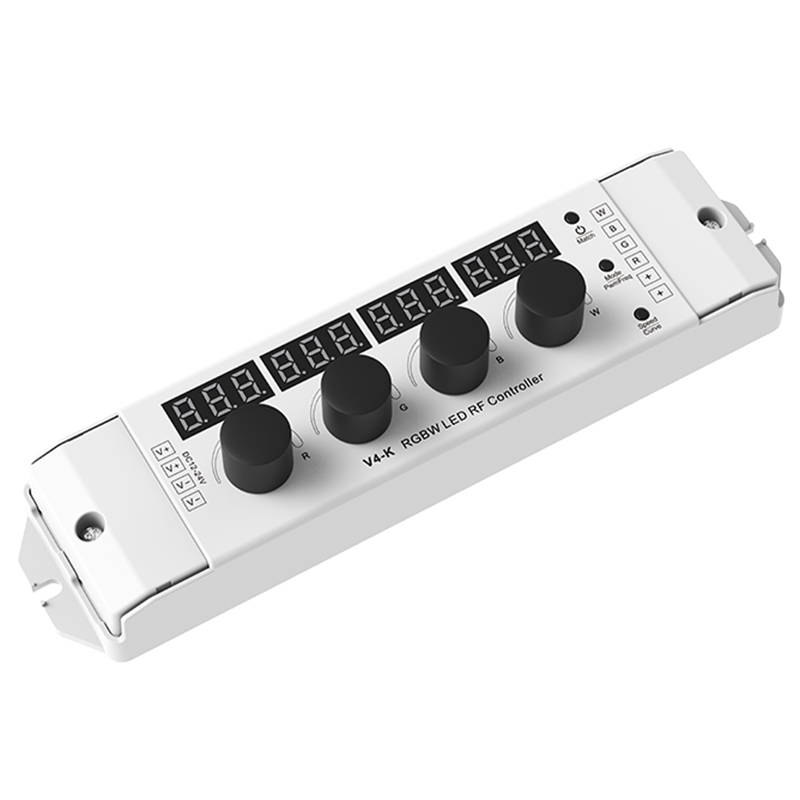
An additional feature of the SkyDance RF RGBW ecosystem is that selected constant-voltage RGBW controllers and RF motion-sensing controllers can also function as wireless control transmitters for other compatible RF receivers. These models require a suitable DC voltage input to operate in this wireless control configuration.
RF PIR motion sensors provide another convenient way to trigger RGBW lighting wirelessly. When movement is detected, they can send an RF command to activate compatible LED RGBW lighting, with automatic switch-off after a preset delay when motion is no longer detected.
Multiple Remotes and Flexible Zone Pairing
Within an unobstructed wireless range of up to 30 meters, one compatible RF RGBW handheld remote can operate a single controller or multiple controllers simultaneously. This allows you to synchronize RGBW lighting across an entire area or assign controllers to different zones for independent operation.
Up to 10 compatible RGBW remotes can be paired with one controller, allowing the same lighting installation to be operated from multiple locations. Multi-zone RGBW remotes provide even more flexibility: different zones can be paired with their corresponding controllers, while multiple controllers can also be assigned to the same zone for coordinated lighting control.




Frequently Asked Questions About RF RGBW Remote Controls
Direct answers from our senior bench engineers on selecting, wiring, pairing, and troubleshooting 2.4GHz handheld remotes for 4-channel RGBW LED installations.
To pair a 2.4 g rf remote to multiple receivers simultaneously, you can use either the receiver match key or a simple AC power-cycle sequence within 5 seconds. If your receivers are exposed, press the small 'Match' button on each receiver, then immediately press the desired Zone key or On button on the remote; the run flashes 3 times to confirm. For hidden gear installed in ceiling coves or joinery, switch off the AC power to the constant voltage RF receivers, restore power, and tap the remote's Zone key 3 times within 5 seconds. One zone can pair to an unlimited number of receivers.
Wiring RGBW LED strip lights to an RF receiver requires connecting the 5-conductor lead: black to common positive (+12V or +24V), and red, green, blue, and white to their respective negative output terminals. Never cross the white negative wire with the positive input terminal, or you will short the receiver's internal MOSFET switches. Keep your low-voltage feed under 10 meters per run to prevent noticeable voltage drop along the trace; for runs past 10 meters, feed power to both ends or insert a 4-channel signal amplifier. For detailed terminal schematics, read our guide on wiring RGBW LED strips.
When a 2.4 g rf remote drains coin-cell batteries prematurely, the cause is usually capacitive touch-wheel activation from being placed directly against metal surfaces or humid stone countertops. The ultra-sensitive touch wheels on remotes like the R8 and RS4 draw under 10 microamps in sleep mode, lasting 6 to 12 months on a single CR2032. However, if stored on metal tables, magnetic plates, or damp marble counters, the capacitive sensor detects a continuous touch event and keeps the RF transmitter awake. Store the remote in its plastic wall cradle, or choose an AAA-powered model like the RS9 for heavy commercial use.
An RF RGBW remote control gives you independent brightness control over the white diode channel so you never wash out vivid saturated colors unless you choose to blend them. Handheld models such as the R14 feature an independent touch slider or dual push keys dedicated solely to channel 4 (white). This allows you to dial in saturated crimson or emerald on your RGBW LED strip lights using the 360-degree color wheel, and then separately adjust the 3000K or 4000K white output from 1% to 100% to create subtle ambient background light without altering the RGB hue.
Our multi-zone remotes can control both 4-channel RGBW and 3-channel RGB strip lights across different zones. When you pair an 8-zone transmitter like the RS8, Zone 1 through Zone 4 can be matched to 4-channel RGBW controllers running living room coves, while Zone 5 through Zone 8 can pair to 3-channel RGB receivers driving display cabinets. The remote automatically sends the appropriate 3-channel or 4-channel PWM packets based on how each receiver's DIP switches are set during installation.
A 2.4 g rf remote easily penetrates standard drywall, wood, and glass up to 30 meters, but an enclosed metal cabinet forms a Faraday cage that cuts wireless RF range down to 2 to 3 meters. If you must house the receiver inside a steel electrical enclosure or behind commercial stainless-steel prep counters, mount the receiver near an opening or use a model with an external antenna extension lead. In standard residential wood vanities, sheetrock coves, or acrylic displays, the 2.4GHz signal passes through cleanly without requiring line of sight.
Operating on 2.4GHz GFSK wireless modulation, a 2.4 g rf remote uses automatic frequency hopping and 32-bit digital IDs to prevent interference with Wi-Fi routers or neighbouring remotes. During pairing, the remote transmits a unique digital signature to the matched receiver; the receiver then listens exclusively to that ID and ignores transmissions from other units. Even in large multi-family buildings or hotels with dozens of active remotes and heavy 2.4GHz Wi-Fi traffic, the low-duty transmission pulses avoid packet collisions and prevent unwanted room cross-talk.
If red shows up as green or blue on your LED strip lights, the 4-channel PWM negative leads are wired to mismatched terminals on the receiver rather than a defect in the RF RGBW remote control. Strip manufacturers use different lead wire color codes; some use black for positive and white for the white channel, while others use white for positive and yellow for the white channel. Turn off power, trace each wire back to the copper solder pads on the strip (+, R, G, B, W), and match each letter directly to the corresponding screw terminal on the receiver.