
RF RGB CC Controller
2 productsThe SkyDance RF RGB CC Controller Series is designed specifically for wireless control of constant-current (CC) RGB LED fixtures. Unlike constant-voltage RGB controllers, these units deliver 150-500mA or 350-1200mA three-channel PWM constant-current output to independently control the red, green, and blue LED channels. With DC 12V, 24V, 36V, and 48V input options, they provide a flexible control solution for different constant-current RGB lighting installations. The CC controller can be configured for RGB operation through its built-in DIP switch, with 4096-level PWM dimming for smooth and precise color and brightness adjustment.
Wireless Pairing with SkyDance RF RGB Remotes
Pair these CC RGB controllers with compatible SkyDance RF RGB handheld remotes or wall-mounted panel remotes to operate your connected constant-current RGB fixtures wirelessly. One controller can accept pairing with up to 10 compatible RF remotes, allowing convenient lighting control from different locations.
Multiple SkyDance RF RGB CC controllers can work together through 2.4GHz RF wireless communication, allowing you to coordinate RGB lighting across different fixtures and areas. Use compatible remotes to operate multiple controllers together or organize them into separate lighting zones for independent color and brightness control.
For added installation flexibility, the CC RGB controller also supports an external Push switch for wired on/off and 0–100% dimming operation. Built-in short-circuit and reverse-polarity protection help safeguard the controller and connected LED fixtures.
FAQ About RF RGB CC Controller
Direct answers on constant current RF control, forward voltage sizing, series wiring, and wireless receiver setups.
An RF RGB CC controller delivers a fixed milliamp current directly to each color diode rather than supplying a static 12V or 24V rail. Instead of using passive current-limiting resistors that waste energy as heat, it uses pulse width modulation (PWM) across 4096 dimming steps to cycle the constant current output rapidly without visible flicker. You get precise color mixing and uniform thermal performance across red, green, and blue diodes.
No, standard 12V or 24V strip lights will overheat and fail quickly on an RF RGB CC controller because the fixed milliamp drive overpowers their integrated resistors. Conventional strips need a constant voltage source. If you connect a 24V strip with SMD resistors to a 350mA or 700mA CC output, the controller forces its full rated current through the traces, pushing internal junction temperatures past safe limits inside a few minutes. Check the fixture label: if it specifies milliamps (mA), use CC; if it specifies volts (V), use CV.
You can operate an RF RGB CC controller directly from a standard momentary wall switch wired into the Push Dim terminal, eliminating the need to search for a handheld remote. A short press toggles the lighting on or off with smooth soft-ramping, while holding the button down ramps brightness smoothly from 0% to 100%. The controller stores your selected brightness in non-volatile memory, so it re-engages at the same output level after a main power cut.
Rapid flashing from an RF RGB CC controller usually indicates an open circuit, reverse polarity on one channel, or an input power supply voltage that is lower than the LED forward voltage. When the input voltage cannot overcome the combined forward drop of your series diodes, the controller enters constant-current compliance failure and restarts repeatedly. Measure the DC voltage across your driver terminals under load to verify that the power supply isn't sagging below your string requirement.
Every unit features a reliable 30-meter direct transmission range, and built-in auto-transmitting mesh synchronization relays the control signal between controllers to cover hundreds of meters. Each receiver automatically re-transmits the radio signal to neighboring receivers within 30 meters. You can pair up to 10 separate handheld RF RGB remote controls to one controller, letting wall panels and handheld remotes share partition control effortlessly.
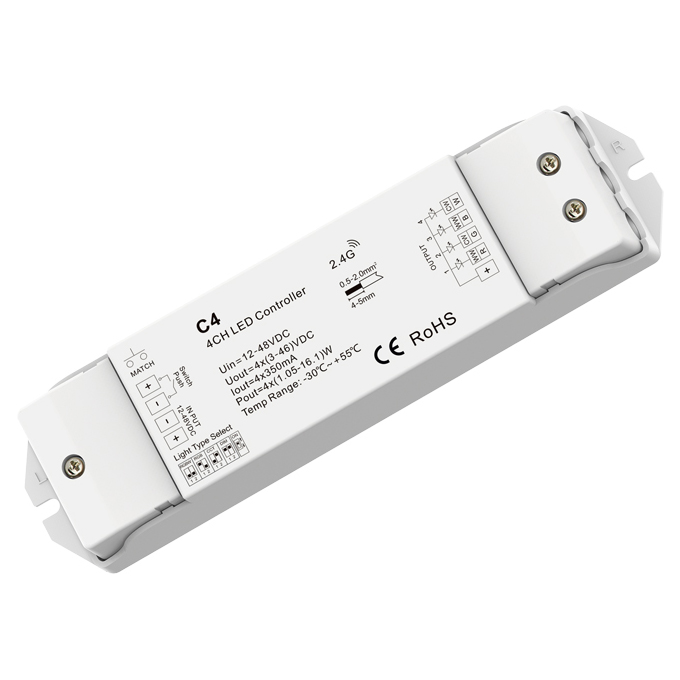
Leaving the fourth channel open on the C4 constant current controller will not damage the unit or trigger a fault code. The C4 incorporates independent constant current drivers across all 4 channels (each rated at 350mA from 12V to 48V DC). You simply set the onboard DIP switch to RGB mode; the receiver then assigns the 2.4G radio address to 3-channel color mixing and ignores the unpopulated white channel entirely.
To calculate total forward voltage for an RF RGB CC controller, multiply each diode's rated forward drop by the number of series chips per channel, then select an input driver that exceeds that number by 3V. For example, twelve red LEDs at 2.2V Vf equal 26.4V, while twelve blue LEDs at 3.3V Vf equal 39.6V. Because the blue channel requires 39.6V, you must supply the controller with a 48V DC power source so all three color channels maintain full current regulation.