
High Voltage RGB LED Strips
8 products
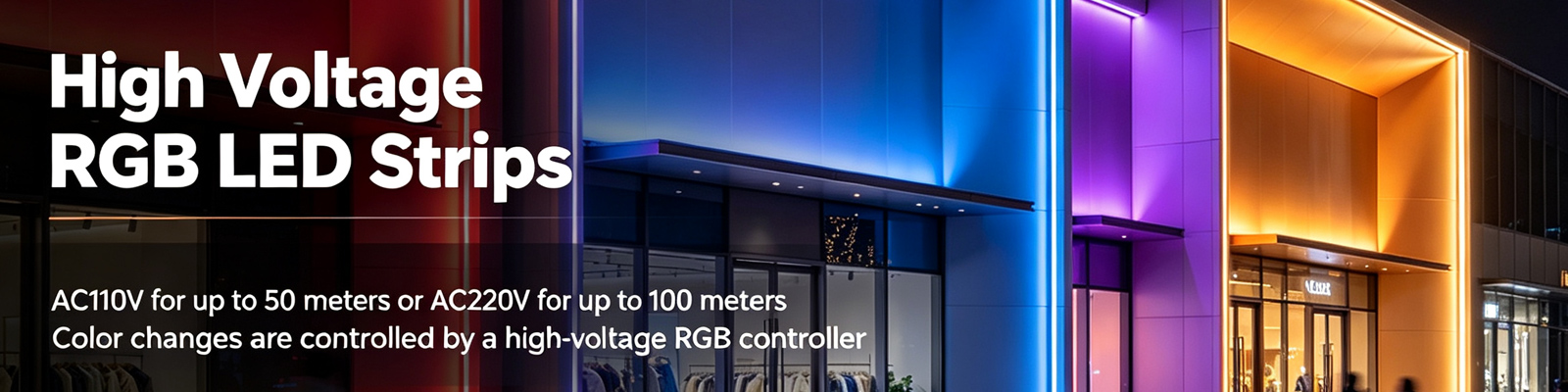
When your lighting project needs to span more than 10 meters, SUPERLIGHTINGLED High Voltage RGB LED Strips are the answer. Unlike low-volateg DC RGB LED strips that suffer from voltage drop and require multiple power supplies and amplifiers for long runs, these AC color-changing light strips plug directly into your mains power. We build them to run up to 50-100 meters (164-328 feet) from line-voltage power source, delivering consistent brightness and color from the first LED to the last. This makes them the go-to solution for large-scale architectural accents, landscape lighting, and expansive commercial installations where running low-voltage wiring is impractical.
Our high voltage RGB lighting strips are designed for durability, especially outdoors. They come fully encased in a thick, protective PVC or silicone jacket, giving them an IP67 waterproof rating right out of the box. This robust construction not only protects against rain and dust but also provides resistance to UV exposure and higher temperatures, making them high-temp LED lights suitable for sun-drenched areas. Whether you need 110V LED strip lights for a US installation or a 220V LED strip for international projects, we have a model that eliminates the complexity of external drivers and weatherproofing, simplifying your setup significantly.

IP68 Waterproof LED Strip Lights Kit - Addressable RGB Light TM1914 - 5m~50m
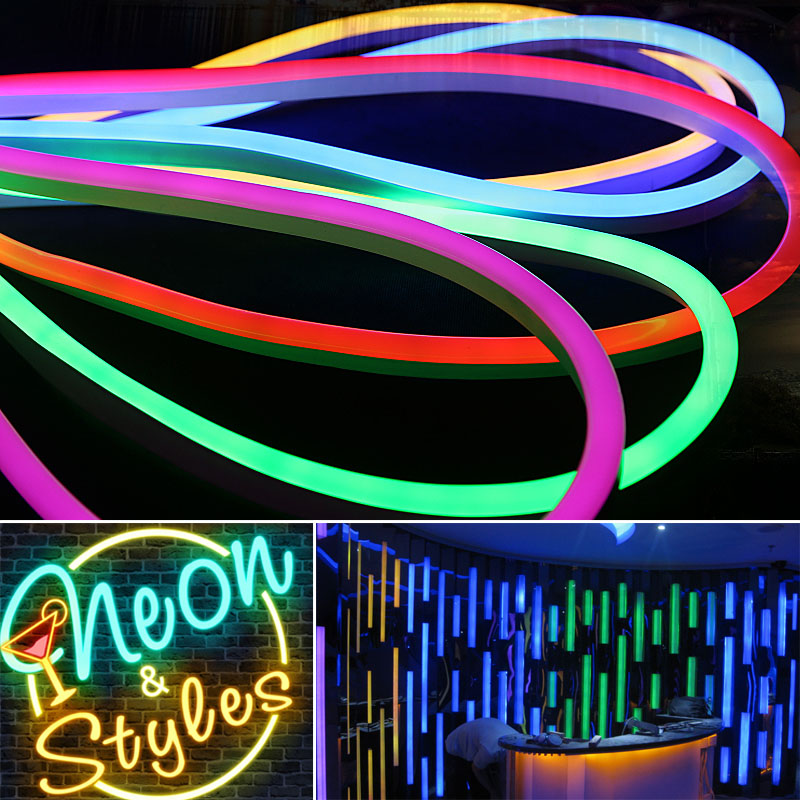
110V/220V Single Color RGB Color Changing LED Neon Light Strip
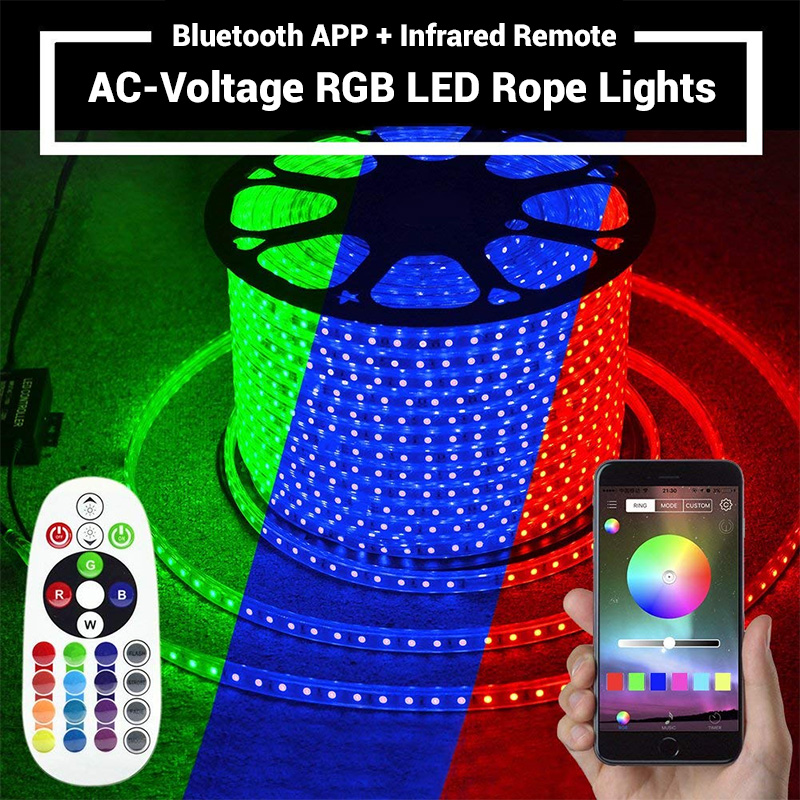
AC 110V 220V High Voltage Outdoor RGB LED Strip 10m-100m
 Per Reel By Sale.jpg)
AC110V 220V 5050 Color Changing RGB Waterproof LED Strip Lights
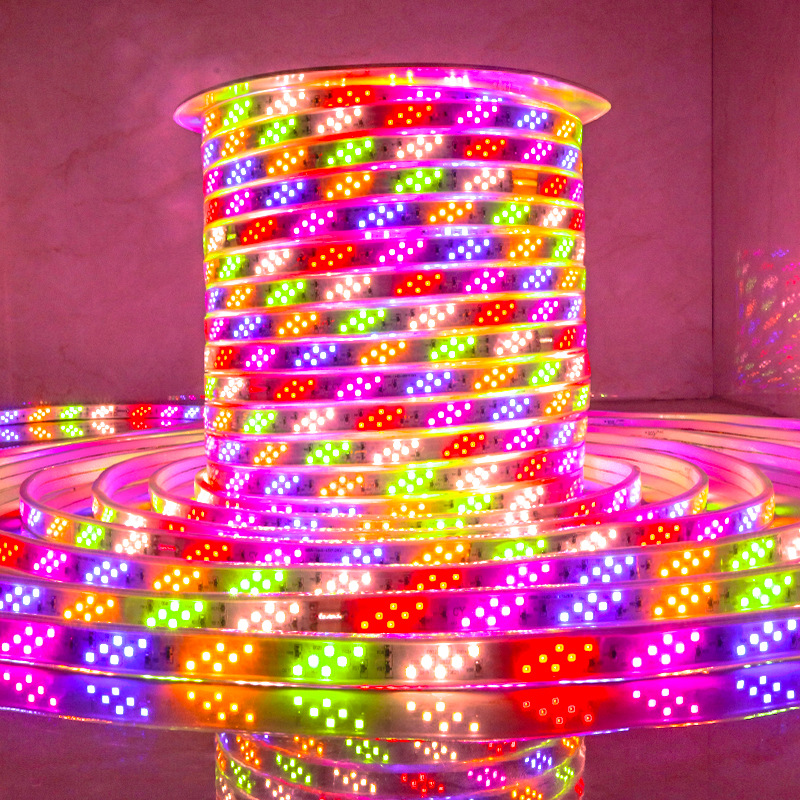
Outdoor AC110V Colorful Snowflake Light Chasing LED Strip
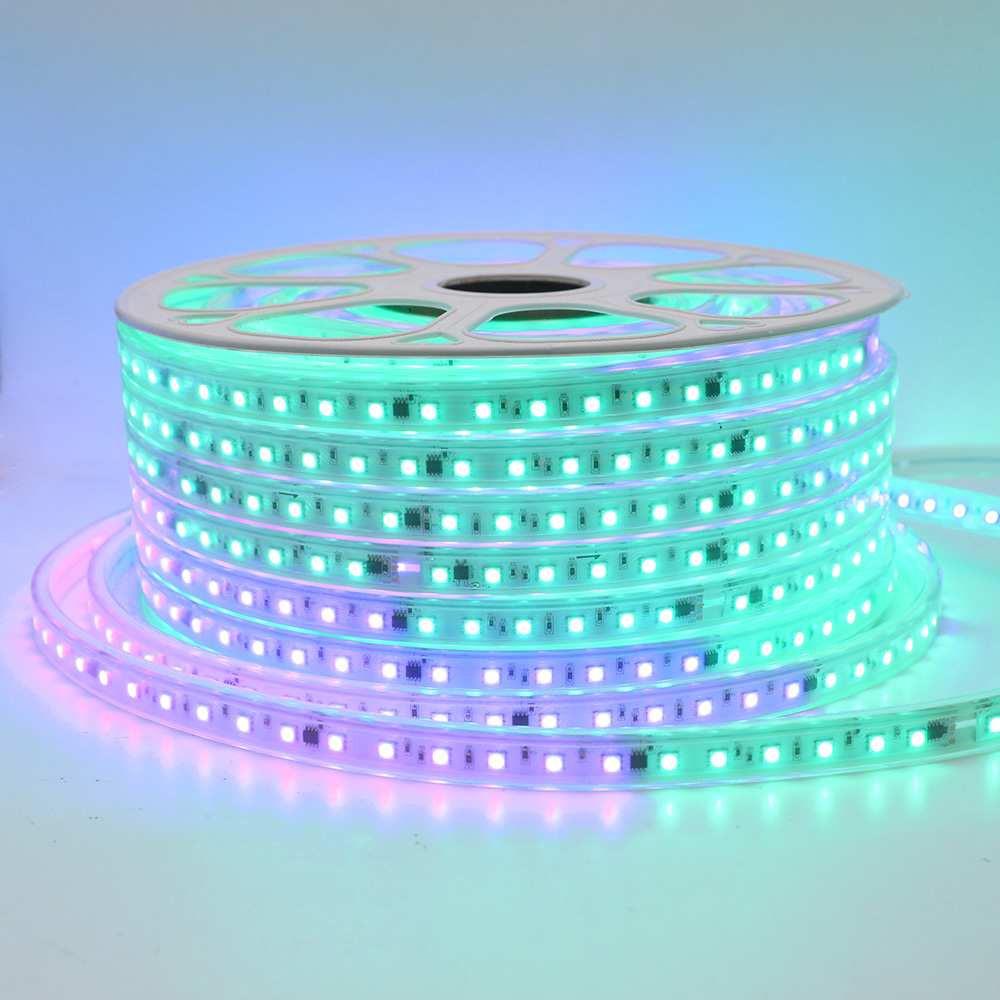
Color Modes Auto-Play 110V LED Color Chasing RGB Light Strip

D19mm 320° Neon AC 110V 220V RGB LED Rope Lights Outdoor
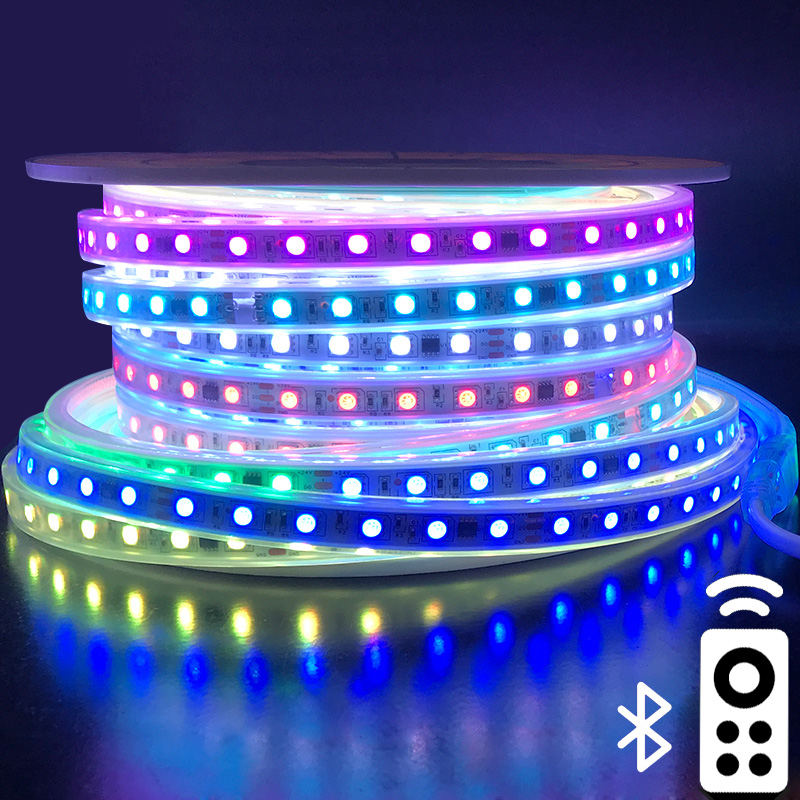
AC 110V 220V High Voltage Addressable RGB LED Tape Light Outdoor
High Voltage AC vs. Low Voltage DC: Which RGB Strip is Right for You?
The choice between high voltage (AC) and low voltage (DC) strips comes down to the length of your run and how you need to cut it. AC strips are champions of distance, perfect for long, straight runs. DC strips offer precision, with cut points every few inches for detailed work like under-cabinet lighting. Before you decide, it's crucial to understand the trade-offs in installation, cost, and flexibility. For a complete breakdown, see our guide on choosing between high and low voltage strips.
| Feature | High Voltage (AC 110V/220V) RGB Strips | Low Voltage (DC 12V/24V) RGB Strips | Low Voltage (DC 48V) RGB Strips |
| Max Run Length | Up to 100m (328 ft) on a single plug | 5-10m (16-32 ft) before voltage drop occurs | Up to 50m (164 ft) with a single power |
| Power Supply | None needed; plugs directly into mains power | Requires an external AC-to-DC 12V/24V power adapter | Requires an external AC-to-DC 48V power adapter |
| Cut Points | Every 0.5 or 1 meter (approx. 20-39 inches) | Every 2.5-10 cm (approx. 1-4 inches) | Every 10+ cm (approx. 4+ inches) |
| Installation | Simpler for long runs; no extra wiring for power | More complex for long runs; needs amplifiers/repeater wiring | Simpler for longer runs; needs extra wiring for power |
How do you control high voltage RGB LED strips?
Controlling the color and brightness of a 110V or 220V RGB strip requires a dedicated high voltage controller that sits between the plug and the strip itself. You can't use the standard DC controllers. We stock several options to control your AC RGB LEDs, from simple RF wireless remotes for basic color cycling and dimming to more advanced WiFi-enabled units. These allow you to use a smartphone app for more granular control, setting custom scenes and schedules.
For dynamic chasing effects, some of our strips, like the Color Modes Auto-Play strip, have built-in controllers with pre-programmed modes, offering a plug-and-play solution without any extra hardware.
Installation and Safety: What to Know Before You Buy
Working with any 110 volt LED light is different from low-voltage projects. Because these strips connect directly to mains power, safety is paramount. We always recommend consulting a qualified electrician for installation. The most important limitation to plan for is the cutting interval. High voltage strips can only be cut at designated marks, which are typically spaced every 50cm or 100cm (20 or 39 inches). This is very different from DC strips that can be cut every few inches. Measure your runs carefully to ensure the lengths will work with these fixed segments. When you do cut the strip, the end must be sealed with a non-conductive end cap and silicone sealant to maintain its waterproof rating and ensure safety. All the necessary connectors and mounting parts are available right here.
Frequently Asked Questions About High Voltage RGB LED Strips
Got a question about setting up a long-run lighting project? We've probably answered it here. If not, our desk is open.
They're safe when you handle them correctly, but you're working with mains voltage (110V/220V), not 12V. The strip itself is fully insulated. The key is to make sure all connections are made with the power OFF at the breaker. Use the supplied power cord and never leave the cut ends exposed — always seal them with the end caps and silicone glue (not include).
The led light voltage going into your wall is 110V or 220V AC, but the LEDs themselves still run on low voltage DC. Each cuttable section of the high voltage LED strip has its own tiny rectifier and components that convert the AC to DC right on the strip. So while the input is high voltage AC, the actual voltage of a led chip is still low.
It's because of how they're wired internally. Unlike a 12V strip where every few LEDs form a circuit, a high voltage strip groups a much larger number of LEDs into a series circuit that runs on the rectified AC voltage. The cut mark is placed after a complete circuit group, which is why the interval is much longer, usually 0.5m or 1m.
If a single, distinct section between two cut marks goes out, it usually means a component within that specific series circuit has failed. Because these are wired in long series, that section isn't user-repairable. The fix is to cut out the bad section at the marked cut points and splice in a new piece using a pin connector.
For the strip itself, no. You can run it up to its maximum rated length—often 100 meters—from one plug without the end getting dim. That's their main advantage. You don't need a complex voltage drop calculator for the strip because the high voltage pushes power efficiently down the entire length.
The factory-sealed ends are fully waterproof, but a cut you make is only as waterproof as the seal you create. To maintain the IP67 rating, you must inject a generous amount of silicone sealant into the end cap before pushing it onto the strip's end. This creates a durable, watertight barrier. We also stock fully sealed IP68 connectors for splicing runs.
Standard high voltage RGB strips can only show one color at a time across the entire length. To get chasing effects or have different sections showing different colors, you need a high voltage *addressable* RGB strip, sometimes called RGBIC. We have models with dream color controllers and even some that run pre-programmed chases with no controller needed at all.
Each segment of the strip has a simple circuit that acts as an led voltage regulator. It takes the high voltage AC input, rectifies it to DC, and then drops the led on voltage to the correct level for that segment's group of LEDs. This ensures each LED gets the stable forward voltage it needs to operate without flickering or burning out.
Choose high voltage AC strips for long, continuous runs over 10-15 meters, especially outdoors. It simplifies wiring dramatically since you don't need multiple large DC power supplies and amplifiers. For shorter runs, or where you need very short cut points (like under-cabinet lighting), a low-voltage DC strip is the better choice. It's a trade-off between run length and cutting precision.
A very subtle, high-frequency flicker can sometimes be visible, especially on camera. This is inherent to how some simple AC-to-DC rectification circuits work inside the strip, which can have a slight ripple at twice the mains frequency (120Hz in the US). For most architectural applications, it's unnoticeable, but for video or sensitive environments, a high-quality constant voltage DC system is better.
Yes, absolutely. A huge part of our business is building custom lighting solutions that never appear on the website. For a project like that, you'd send us your drawing or even just a sketch with measurements. Our engineers will spec out the exact lengths of RGB neon flex, determine the power and control layout, and send you a complete parts list and quote, usually within 12 hours. There's no fee for the consultation.
It's simpler than with low voltage. The product page for the strip will list its power consumption in watts per meter (W/m). Just multiply that by your total length (e.g., 9 W/m x 50m = 450W). Then, select a compatible high-voltage controller and power plug combo that is rated for at least that wattage. Our guide to long LED strips has a section that walks through this calculation step-by-step.