
The Color Difference Between Warm White, Pure White and Cool White
Warm white, natural white, daylight white and cool white are names for ranges on the Kelvin (K) scale. The lower the number, the warmer and more yellow the light; the higher the number, the whiter and then bluer it gets:
- Warm white, 2700K–3000K (also called soft white): a warm white/yellow glow. Living rooms, bedrooms, kitchens, bathrooms.
- Natural white, 4000K–4500K (also called neutral white): a bright, crisp white. Corridors and halls.
- Daylight white, 6000K–6500K: a crisp daylight glow. Display cabinets, offices and task lighting.
- Cool white, above 7000K: a cold glow with bluish hues. High illuminance spaces such as museums.
Brightness rises with the number: 2700K < 3000K < 4000K < 6000K. Want more than one white? See tunable white LED strips.
At SuperLightingLED we sell white LED strips from warm white to cool white, and the question we hear most is which Kelvin number to order. This page gives you a color temperature chart, a room-by-room pick, a 3000K vs 4000K comparison and where to shop each white.
Many people encounter this situation when buying white LED lights, the white light led strip will be marked with 2700K, 3000K, 4000K, 6000K, and other words.
What do they mean? This article takes you to fully understand how to choose the right white LED strip and their suitable application scenarios.
The following table is a general summary of the color temperature of the white LED strip lights. The color of the background frame roughly represents the color temperature. For a more detailed understanding, please continue reading.
| Color temperature | 2700K | 3000K | 4000K | 6000K | 7000K |
| Light appearance | Warm white | Warm white | Neutral white | Daylight white | Cool White |
| Ambience | Cozy, inviting | Warm, comfortable, relaxing | Crisp | Invigorating | Cold |
| Suitable applications | Homes (living rooms, kitchens, bedrooms), restaurants, and hotels | Kitchens, bathrooms, and laundry rooms | Corridors and halls | Task lighting, agricultural purposes, security lighting | High illuminance environment such as museums |
LED color temperature chart: color name, Kelvin and rooms
The same white is often sold under two names, so when you compare two LED strips, compare the Kelvin number on the label. Here is every white on this page in one chart:
| Color name | Kelvin | Also called | What the light looks like | Typical rooms and uses |
|---|---|---|---|---|
| Warm white | 2700K | Soft white | More yellow tone, similar to an incandescent lamp; candlelight hues | Living rooms, bedrooms, kitchens, restaurants, hotels |
| Warm white | 3000K | Soft white | Less yellow tone and brighter than 2700K | Kitchens, bathrooms, laundry rooms |
| Natural white | 4000K–4500K | Neutral white | A bright white glow, like moonlight; less yellow and whiter than 3000K | Corridors and halls; lighting objects that need precision |
| Daylight white | 6000K–6500K | – | A crisp daylight glow, similar to a cloudy sky | Display cabinets, offices, task, agricultural and security lighting |
| Cool white | Above 7000K | – | A cold glow with bluish hues | High illuminance environments such as museums |
Soft white and warm white are the same thing: both refer to the 1800K–3200K range. Warm white has a low temperature value and a yellow tone; the higher the color temperature of cool white, the bluer the light. Why the numbers work this way is explained in what is color temperature below.
Which white for which room?
Start from the room, not the name. These picks come from the chart above and the comparisons further down this page:
| Room or use | Pick | Why |
|---|---|---|
| Living room, bedroom | 2700K warm white | Like an incandescent lamp: a lazy, welcoming atmosphere |
| Kitchen, bathroom, laundry room | 3000K warm white | Still warm and comfortable, but brighter than 2700K |
| Restaurant, hotel | 2700K warm white | Cozy and inviting |
| Corridor, hall | 4000K natural white | Needs brightness, but not high requirements |
| Lighting objects that need precision | 4000K natural white | Less yellow and whiter than 3000K |
| Display cabinet, jewelry display | 6000K daylight white | Displays the beauty of the jewelry |
| Office, task lighting | 6000K daylight white | Refreshing, and the brightest of the four common whites |
| Security or agricultural lighting | 6000K daylight white | Invigorating daylight glow |
| Museum, high illuminance space | Above 7000K cool white | A cold, bluish glow |
| One room, several moods | Tunable white | Warm white and cool white on one strip; see below |
Ready to buy? Shop 2700K warm white LED strips for living rooms and bedrooms, or browse all static white LED strip lights. Lighting a sauna? The video below shows one lit in 3000K; see our sauna light strips.
3000K vs 4000K: which one should you buy?
These two are the most common pair people choose between. 3000K is the brighter of the two warm whites; 4000K is the first step into natural white:
| 3000K warm white | 4000K natural white | |
|---|---|---|
| Also called | Warm white, soft white | Natural white, neutral white |
| Range it belongs to | Warm (soft) white, 1800K–3200K | Natural white, 4000K–4500K |
| Light | Warm white/yellow glow, less yellow than 2700K | Bright white glow like moonlight, less yellow and whiter than 3000K |
| Feeling | Warm, comfortable, relaxing | Crisp |
| Brightness | Brighter than 2700K | Brighter than 3000K |
| Best for | Kitchens, bathrooms, laundry rooms; a warm, relaxed atmosphere | Corridors and halls; lighting objects that need more precision |
Looking for “cool white 4000K”? On our chart, 4000K is natural (neutral) white: less yellow and whiter than 3000K. Cool white in the strict sense, a cold glow with bluish hues, starts above 7000K. So if you want a light less yellow than warm white without going bluish, 4000K is the step to take.
Between the two? Our 3500K soft white LED strip sits between the two. For a whiter light than 4000K, see our 5000K daylight LED strip light. More on warm white against cool white: warm white vs cool white.
What is color temperature?
Regarding white LED lights, we often talk about warm white and cool white. This is how we feel about these two kinds of white light led strip. But in fact, there is a special expression for the white light called kelvin color temperature.
Kelvin color temperature refers to the color change of a standard black body* after being heated (*The standard black body does not exist, it is just an ideal object).
As the kelvin color temperature rises, the standard black body slowly changes to red, orange, yellow, white, and then to blue. Kelvin color temperature shows the light color change when the black body is heated from a 1000K color temperature to a 10,000K color temperature.
To put it simply, a black body is heated to a 2700 Kelvin color temperature and will appear orange, so 2700K color temperature represents an orange color.
• 2700K-3000K, Warm white, a warm white/yellow glow (candlelight hues) • 4000K-4500K, Natural white, a bright white glow • 6000K-6500K, Daylight white, a crisp daylight glow (white hues) • Above 7000K, Cool white, a cold glow (bluish hues) |

What color temperature is right for me?
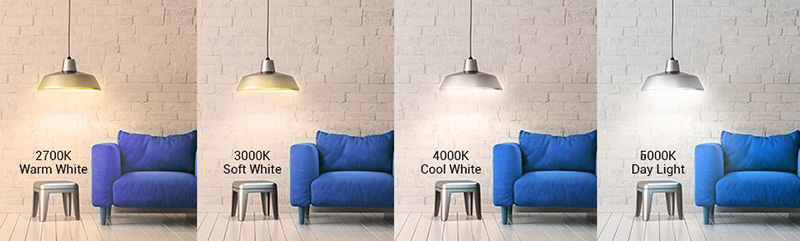
2700K color temperature, 3000K color temperature, 4000K color temperature, and 6000K color temperature are the color temperatures often used in white LED strip lights.
Different locations and atmospheres have different requirements for color temperature. Choose a suitable color temperature for yourself according to the following.
2700K VS 3000K
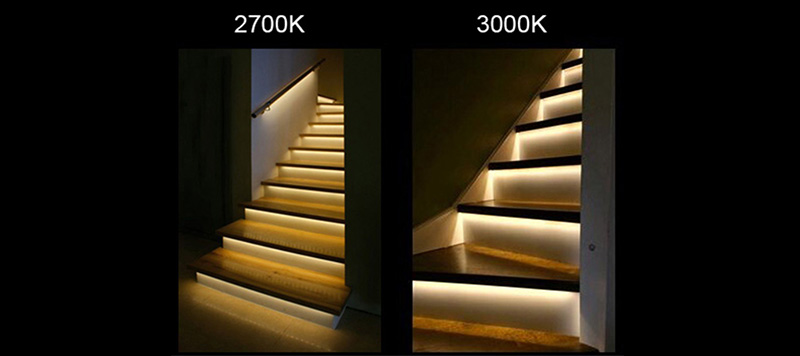
Both 2700K color temperature and 3000K color temperature belong to warm white.
2700K light is similar to the light of an incandescent lamp, giving people a lazy and welcoming atmosphere. It is very suitable for installation in homes (living rooms, kitchens, bedrooms), restaurants, and hotels.
2700K has more yellow tones than 3000K, and 3000K looks brighter than 2700K. If you just create a warm and comfortable atmosphere without considering the lighting, just like bathing in the sunset, 2700K LED strip is the best choice.
3000K is a soft white color temperature. Soft white and warm white are actually the same thing, refer to the same range of white color temperatures 1800K-3200K, and both make people feel warm, relaxing, and comfortable.
Although 3000K LED light is similar to 2700K light, their actual suitable locations are not always the same. 3000K LED strip lights are brighter and more suitable for kitchens, bathrooms, and laundry rooms.
| Warm White (Soft White) - 1800K~3200K Color Temperature Scale | |
| Warm, Comfortable, Welcoming, Relaxing, Peaceful Feeling | |
| 2700K | 3000K |
| More yellow tone, Darker | Less yellow tone, Brighter |
| Suitable for Bedroom, Living Room | Suitable for Kitchen, Bathroom |
How obvious is the difference between 2700K and 3000K?
There is only a slight difference between the two color temperatures. You may not notice this difference when you first look at the 2700K LED strip light and then at the 3000K LED light.
But when the two strips are placed in front of your eyes, you can tell at a glance which is 2700K and which is 3000K.
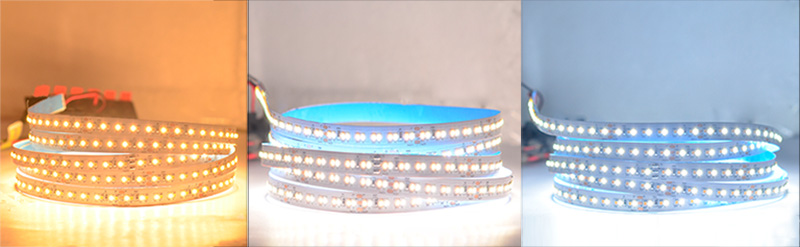
Warm White 3000K VS Natural White 4000K VS Daylight White 6000K
4000K light like moonlight, less yellow and whiter than 3000K, belongs to neutral white, and is a crisp lighting. Requires more precision for lighting objects, 4000K light strips are more suitable for you than 3000K.
6000K LED light is similar to a cloudy sky, and is commonly found in various display cabinets or office areas. The 6000K lighting installed in the jewelry display cabinet can display the beauty of the jewelry without any dead ends. At work, 6000K LED light is refreshing and helpful to work enthusiasm.

Warm White VS Cool White
Warm white light has a low temperature value, and cool white light has a high temperature value.
Warm white LED has a yellow tone, and the higher the color temperature of cool white, the bluer the LED light color.
Different from the warm and comfortable feeling of warm white, cool white helps to improve people's attention and create an atmosphere of distance, more modern.
Enjoy 2700K, 4000K, 6000K
If you want high-brightness LED light, 6000K white LED strip is the first choice. Regarding LED brightness, 2700K LED light < 3000K LED light < 4000K LED light < 6000K LED light.
If you want a warm, comfortable, relaxed, and pleasant atmosphere, you can choose 2700K white light LED strip or 3000K white LED strip lights.
4000K white light is suitable for occasions that require brightness but not high requirements, such as corridors and halls.
I want to have multiple color temperatures on the same LED strip, is this possible? Yes. The tunable white LED strip light has both warm white LED light and cool white light. The light strip can be used with CCT controller to get all the color temperature colors from warm white to cool white, and it can also adjust the brightness of the LED. Click to learn more about tunable white LED strip light products and CCT controllers.
Can't decide? Choose a tunable white LED strip
Different locations and atmospheres need different color temperatures, and sometimes that is the same room. A tunable white LED strip carries both warm white and cool white LEDs. With a CCT controller you get every color temperature from warm white to cool white on one strip, and you can adjust the brightness too.
Wiring one takes three wires (V+, warm white, cool white) and a CCT controller between the strip and the power supply. Step-by-step instructions and diagrams are in How to Wire Tunable White LED Strip Light, and wiring diagram T1 shows the 3-wire connection. SuperLightingLED carries these tunable white families:
Dual White CCT Dimmable LED StripsWarm white and cool white on one strip
3 Wire Tunable White LED StripV+, warm white, cool white
Tunable White COB LED StripTunable white on a COB strip
CCT LED dimmersThe CCT controller a tunable strip needsAlso in the range: warm and cool white LED strip and 2 wire dim to warm LED strip. A 2-wire dim to warm strip uses a plain dimmer instead of a CCT controller: the color shifts with brightness automatically.
Further Reading: How to install Warm White LED light strip?
For white LED strip lights, you need a power supply or a power adapter, and an optional dimming controller can be used to adjust the brightness of the white LED lights.
More knowledge is in "How to Wire Single Color LED Strip Lights", "How to Wire Tunable White LED Strips".
Here is that setup drawn out. These diagrams are drawn by the SuperLightingLED engineering team; wire colors follow our house convention (red V+, black V-/GND). Click a diagram for the full notes in our LED strip wiring diagrams library.
Shop the parts: single color dimmers, DC12V plug-in power adapters, DC12V MW UL-listed power supplies and all LED power supplies. Sizing the supply: how to connect an LED strip to the power supply.
Shop white LED strips by color temperature
Pick the Kelvin number from the chart, then the strip:
2700K Warm White LED StripCozy, inviting: living rooms and bedrooms
3500K Soft White LED StripBetween 3000K and 4000K
5000K Daylight LED Strip LightBetween 4000K natural white and 6000K daylight white
2200K Sunset LED Light StripsWarmer than 2700K warm white
1800K Amber LED Tape LightThe warm end of the 1800K–3200K range
1500K Candlelight LED StripThe lowest Kelvin in our static white range
Static White LED Strip LightsAll our static white LED strips
White COB LED StripWhite light from a COB LED stripWarm white vs cool white FAQ
What Kelvin is warm white?
Warm white is 2700K to 3000K: a warm white/yellow glow with candlelight hues. Soft white is the same thing; both refer to the 1800K-3200K range.
Is 4000K warm white or cool white?
Neither. 4000K (4000K-4500K) is natural or neutral white: a bright white glow like moonlight, less yellow and whiter than 3000K. Cool white means above 7000K, a cold glow with bluish hues.
3000K or 4000K: which is better for a kitchen?
For a warm, comfortable kitchen choose 3000K: it is brighter than 2700K and suits kitchens, bathrooms and laundry rooms. If you need more precision when lighting objects, 4000K suits you better than 3000K.
Which white LED strip is the brightest?
Brightness rises with color temperature: 2700K < 3000K < 4000K < 6000K. If you want high-brightness LED light, a 6000K white LED strip is the first choice.
Can one LED strip give both warm white and cool white?
Yes. A tunable white LED strip has both warm white and cool white LEDs. With a CCT controller you get all the color temperatures from warm white to cool white, and you can also adjust the brightness.
Tell us the room, what it is used for and the length you need, and the SuperLightingLED team will help you choose the color temperature and match the strip, dimmer and power supply. Standard orders such as accessories and controllers ship within 24–48 hours; LED strip orders follow the production lead time shown on the product page. Contact our team



