
Magnetic Track Lighting Pendants
4 products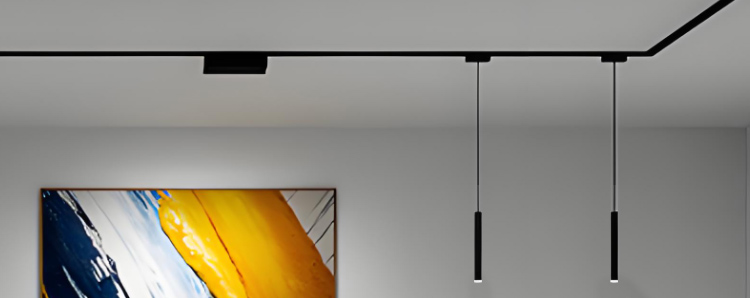
Unlike traditional chandelier lighting or led strip channel pendant lighting, these magnetic LED pendant track lighting fixtures come with a magnetic base that can be drawn directly into the corresponding magnetic track. This magnetic suspension light design not only offers great flexibility and ease of installation, but also avoids the complicated process of wiring traditional chandeliers to the ceiling. Multiple magnetic track light pendants can be placed randomly on the track, allowing users to quickly adjust and reconfigure them according to different needs and scenarios without worrying about the wiring arrangement.
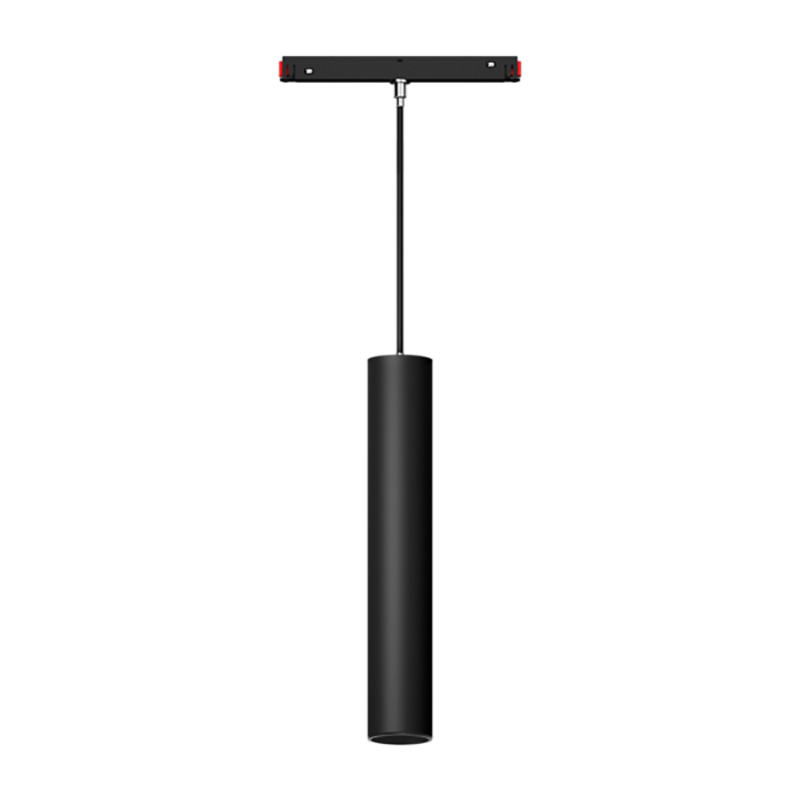
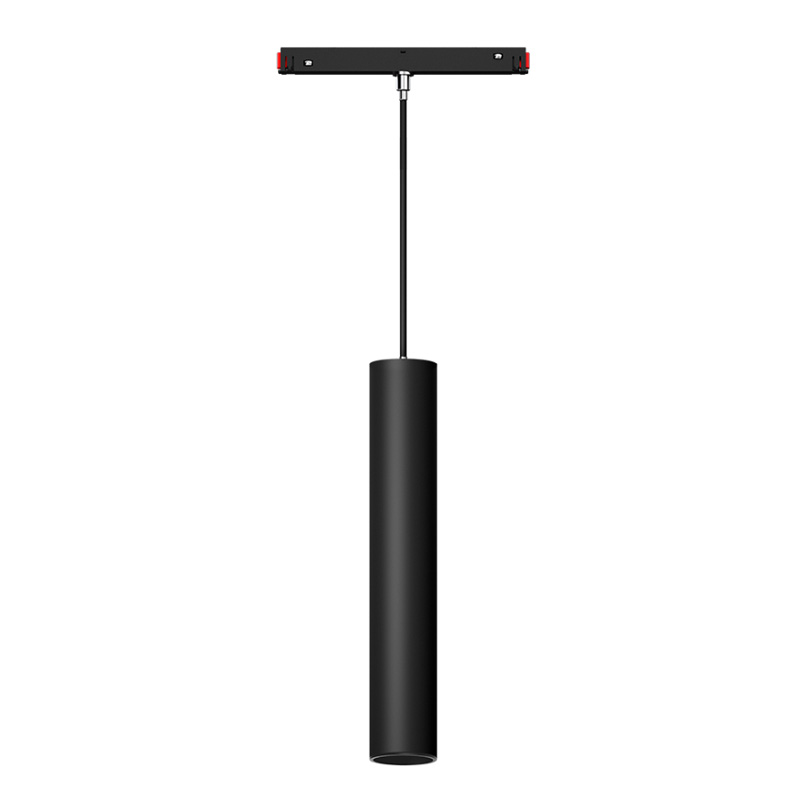
The part of the chandelier hanging magnetic light down consists of 650mm/25.6in of wires and 300mm/11.8in of cylindrical light body. The standard 24-degree narrow beam angle design focuses the light onto a specific area and is suitable for accent lighting, such as highlighting kitchen islands, dining tables, bar counters, wet bars.
The built-in RF and Zigbee control module makes the lighting control of these magnetic track lighting hanging pendants modern and intelligent. Choose any wireless remote control here to perform simple lighting operations of the magnetic LED pendants such as on/off, brightness adjustment, CCT 2700K-6500K color temperature adjustment, RGB color change. The Zigbee modern track lighting pendants are able to connect to home and commercial IoT systems through a Zigbee gateway for more advanced automation and scene setting.

FAQ About Magnetic Track Lighting Pendants
Direct answers on suspension adjustments, beam spreads, 48V power budgeting, and wireless protocols for low-voltage magnetic pendant track systems.
You can snap magnetic track lighting pendants into the rail and reposition them while the circuit is live because the track operates on touch-safe 48V DC. The mechanical safety clips lock the fixture into the channel, while internal neodymium magnets hold the contact shoes firmly against the embedded copper conductors. We recommend supporting the 300 mm cylindrical body with one hand while releasing the dual side latches with the other, so you do not pull against the suspension cable. Once unclipped, relocate the fixture to your new focal point and let the magnetic base click into position.
Choose magnetic track lighting pendants when you need focused illumination dropped closer to task planes, such as kitchen islands, dining tables, and reception desks. On ceiling heights of 3 meters (9.8 ft) or higher, a flush spotlight spreads light too broadly across the floor. Dropping the 24-degree narrow beam on a 650 mm suspension cable brings roughly 680 to 720 lumens right where you prep food or read, cutting glare and keeping light off your eyes.
Sizing the driver for a track light with pendants setup starts by multiplying your fixture count by 9W, then adding a 20% safety headroom so the power supply runs cool. For example, four 9W pendant lights draw 36W total; applying the 1.2 safety factor means you need at least a 45W, 48V DC constant-voltage power supply. If you share the same track with siblings from our catalogue—such as magnetic linear light strips or adjustable track spots—sum every fixture's nominal wattage before sizing the driver. Never load a 48V DC driver past 80% continuous capacity if you want it to survive long commercial operating shifts.
Our magnetic track lighting pendants are built specifically to seat inside 20-style low-voltage magnetic rails with a 20 mm inner track channel width. The copper busbars run along the vertical interior walls of the track profile, mating with the spring-loaded copper pins on the pendant's magnetic base. They are not compatible with older 120V line-voltage tracks, nor will they seat properly in 35-style commercial tracks without an adapter. Always measure the interior channel opening of your rail; if your slot measures 20 mm across, the magnetic base will pull flush and lock mechanically.
You can freely combine magnetic track lighting pendants with linear diffuse lights and accent spotlights on the same led track rail. Because every fixture draws from the shared 48V DC busbars, physical placement does not affect power delivery or voltage stability. A typical layout uses continuous 24W linear modules for ambient room fill, punctuated by two or three 9W pendant downlights over a bar counter or island for targeted accent pools. Just verify that the combined wattage of all heads does not exceed the continuous rating of your 48V power supply.
Select between CCT and RGB+CCT magnetic track lighting pendants based on whether you need strict architectural lighting or dynamic decorative color. If your space is a residential kitchen, gallery, or dining space, the CCT models adjust cleanly from warm 2700K to daylight 6500K with high color rendering. If you are lighting an entertainment venue, bar, or hospitality feature, choose an RGB+CCT model like the MC2-09B-ZR pendant spotlight or its 5-channel RGB equivalents for saturated color washed directly downward.
For an 8-foot (2.4 m) island, three 9W track lighting pendants spaced 600 mm to 750 mm (24 to 30 in) apart deliver balanced light without beam overlap gaps. Because each fixture produces a focused 24-degree cone, hanging them 750 mm to 850 mm (30 to 34 in) above the countertop provides three overlapping accent pools that illuminate the entire food prep surface. Leave roughly 300 mm (12 in) of clearance from the outer edges of the island to the centerline of the end pendants to keep the lighting grounded visually over the counter.
You can control our Zigbee magnetic track lighting pendants without an external smart hub by using a compatible handheld 2.4GHz RF remote or wall panel. Every pendant model in this line integrates dual-mode RF and Zigbee 3.0 firmware. To pair directly to an RF transmitter, cycle the 48V track power off and on, then tap the desired Zone ON button three times within three seconds; the light blinks three times to confirm. To review remote options and multi-zone channel grouping, check our guide on choosing strip controllers for an overview of 2.4GHz addressing and wireless range management.