
CV Power Repeater
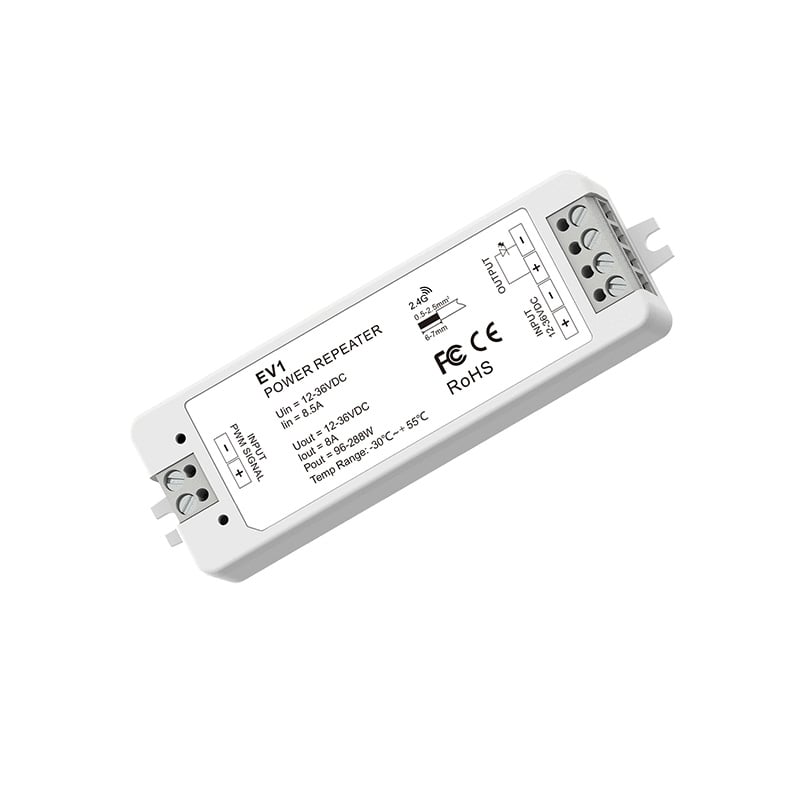
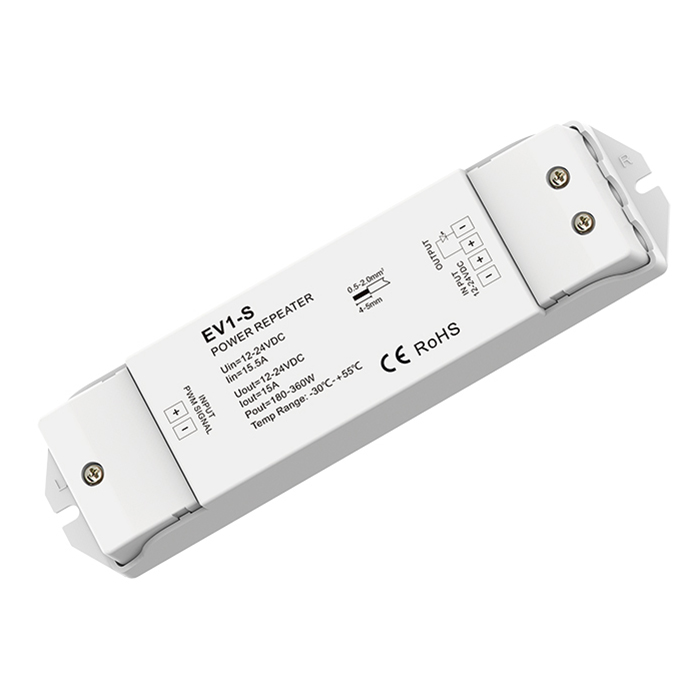
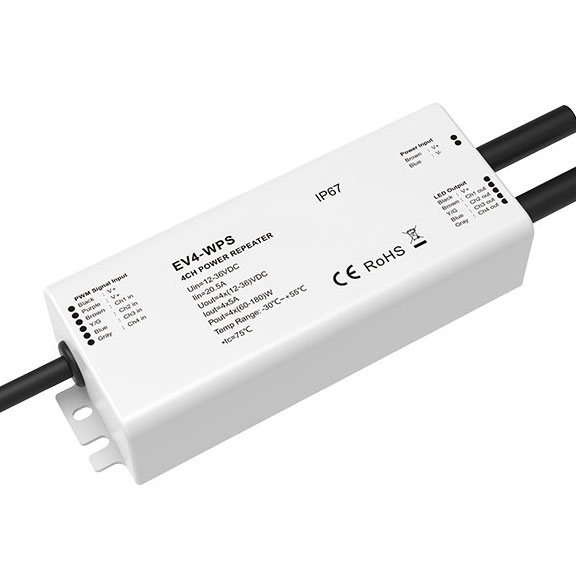
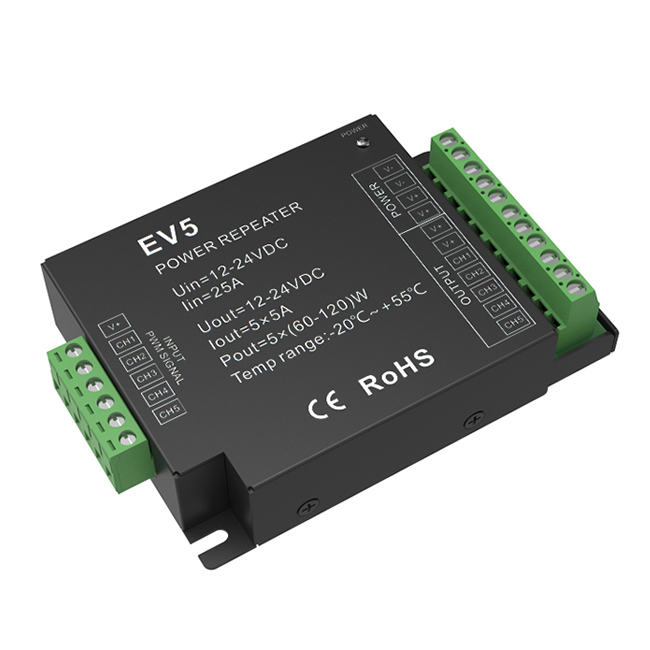
18 productsThe SkyDance CV Power Repeater Series is designed to expand the power capacity of constant voltage LED strips and lighting fixtures, allowing you to control larger lighting loads without overloading your original LED controller or dimmer.
By receiving PWM control signals from the main controller and using an additional power supply to drive the connected LED strip loads, these repeaters reproduce the original dimming and color control signals, keeping multiple LED tape lighting sections synchronized in brightness, color, and lighting effects.
Choose an LED Power Repeater Based on Your LED Strip Colors
Select a compatible CV Power Repeater according to the lighting colors and control channels of your LED strips or fixtures:
- - Single Color LED Strips: Use a 1-channel power repeater to expand brightness control for single-color white or colored LED strips.
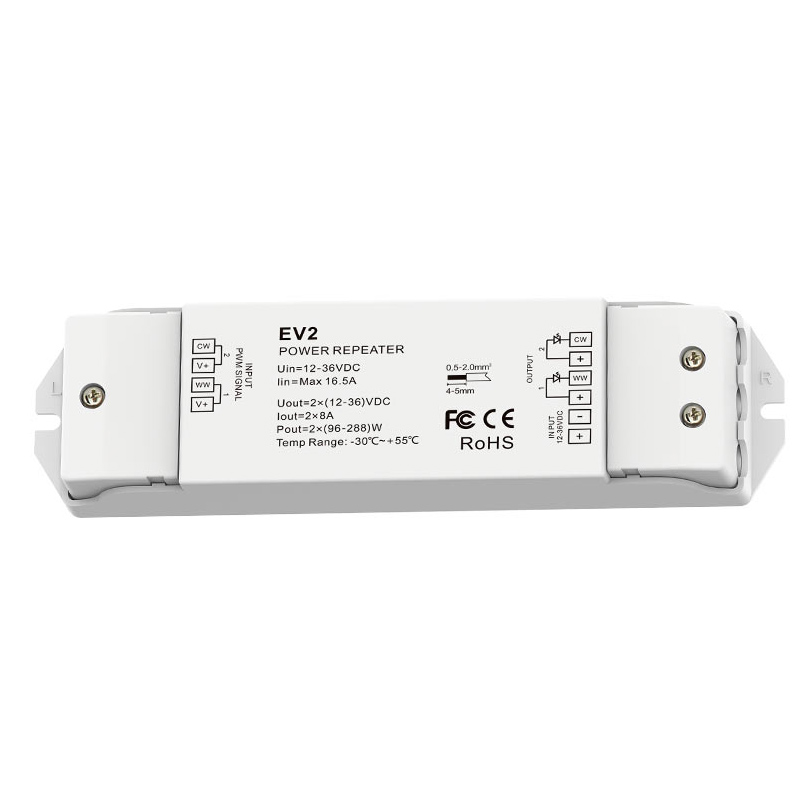
- - Dual White / CCT LED Strips: Choose a 2-channel power repeater to maintain synchronized warm white and cool white adjustment.
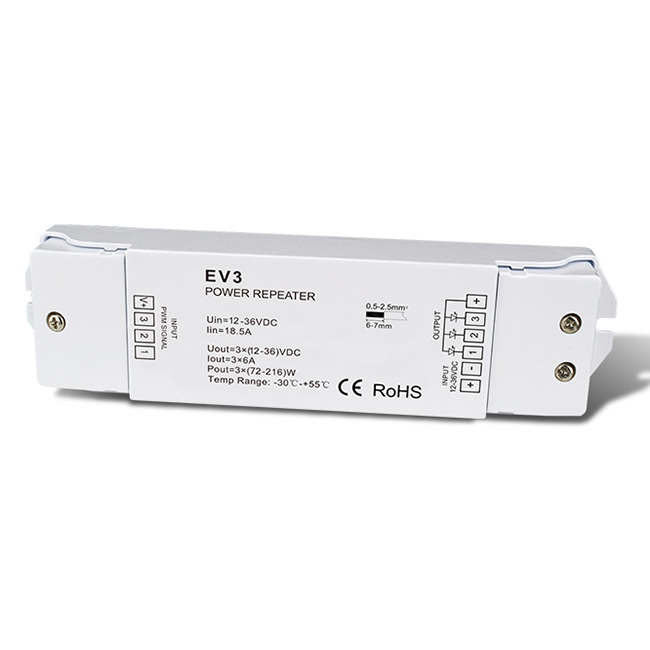
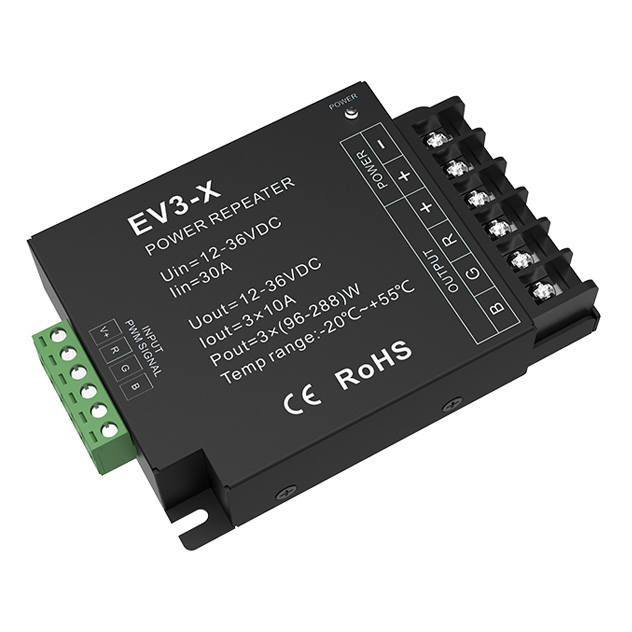
- - RGB LED Strips: Use a 3-channel power repeater for synchronized red, green, and blue color mixing.
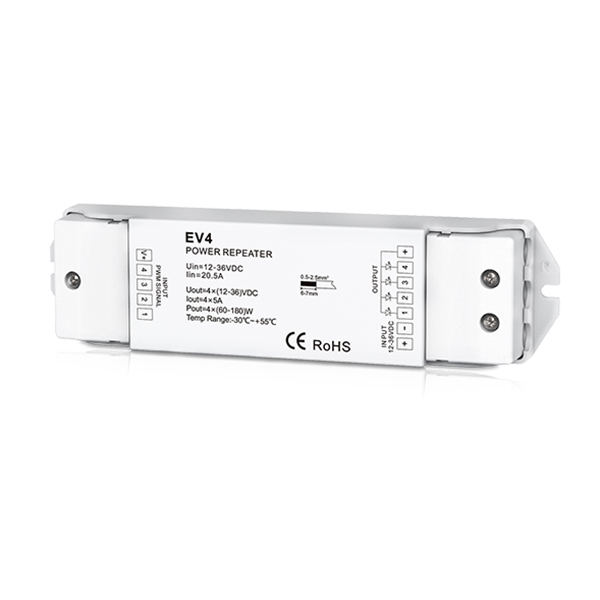
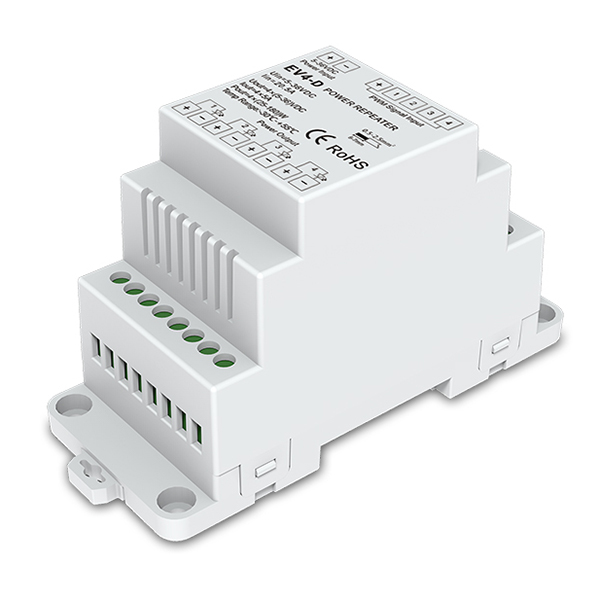
- - RGBW LED Strips: Choose a 4-channel power repeater to control RGB colors and the dedicated white channel.
- - RGB+CCT LED Strips: Use a 5-channel power repeater to expand control of RGB colors, warm white, and cool white channels.
SkyDance CV Power Repeaters support a range of constant voltage LED strip lighting applications. Check each product's compatible input voltage, output current, channel configuration, and power rating to find the right repeater for your lighting system.





FAQ About CV Power Repeaters
Direct engineering answers on wiring, voltage matching, signal latency, and load sizing for constant voltage power repeaters.
A CV power repeater processes PWM dimming signals with less than 1 microsecond of propagation delay, making any latency completely invisible to the human eye. The high-speed 3KV optoelectronic isolators regenerate the switching pulse directly from the master controller without rounding the waveform. You can daisy-chain five or ten units along a 100-meter perimeter cove, and the far end will fade, strobe, and switch at the exact same instant as the first run.
Yes, while conventional units stop at 24V, our CV power repeater models support 36V, and specialized models like the EV3-H and EV4-H handle up to 60VDC. Sibling constant-current models run exclusively at fixed milliamps, but our CV line lets you deploy 36V and 48V long-distance tapes to slash operating current in half. That cuts copper wire gauge requirements and lets you run single continuous feeds up to 20 or 30 meters without mid-line injection.
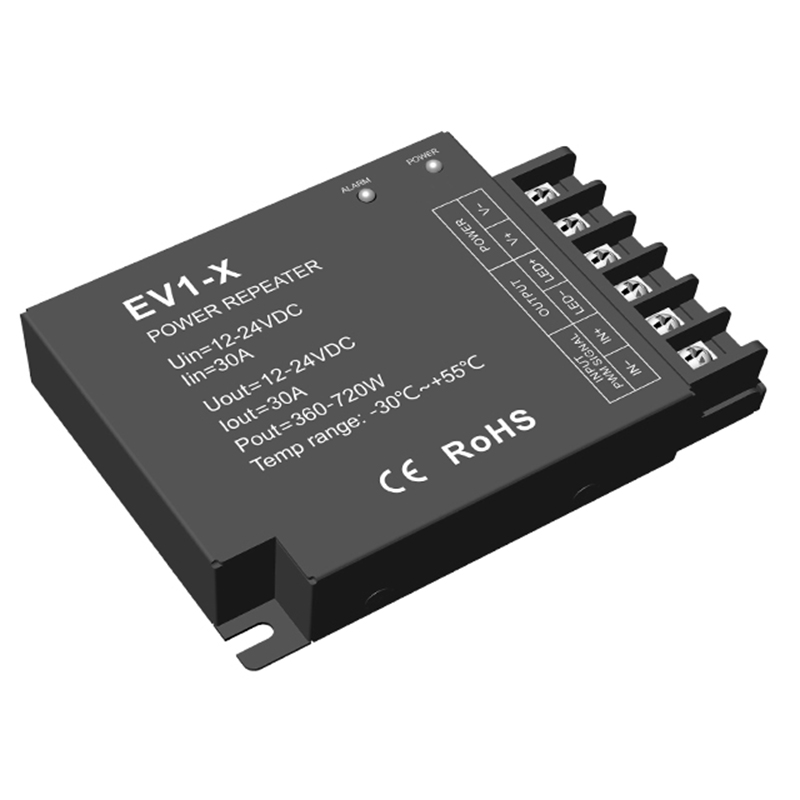
You can parallel the output channels on a multi-channel CV power repeater to power a heavy single-color run, provided you also jumper the corresponding input channels together. For example, pairing two 8A channels on a 12-36V EV2 lets you drive a 16A single-color circuit without overheating a single terminal block. However, if you have a massive 20A to 30A continuous load on a single feed, the EV1-X 30A power repeater is specifically engineered with high-gauge screw lugs to take 30A on one channel safely.
No, a CV power repeater only accepts low-voltage PWM switching pulses and cannot decode 0-10V analog voltages or DALI digital data packets directly. When a building management system outputs DALI, you must place a DALI-to-PWM decoder upstream from the repeater. To tie commercial building automation into high-output strip layouts, contractors wire our DALI series decoders first to translate the protocol into PWM, then feed that signal into power repeaters to scale up wattage infinitely.
Mount your CV power repeater as close to the start of the LED strip lights as possible, keeping the secondary DC load cable under 3 meters (10 feet). Running a 12V or 24V high-amperage line over 10 meters creates steep voltage drop and heat in the wire, whereas the low-current PWM signal wire from your master controller can run 30 meters without measurable loss. Keep the repeater and its dedicated DC transformer close to the LEDs, and run long signal wire instead.
You can power multiple repeaters from one central transformer, provided total wattage draw does not exceed 80% of the driver's rated capacity and the main feed wire is sized for the combined current. Running two 4-channel units pulling 15A each requires a 30A continuous feed, which demands thick 8 AWG or 10 AWG feeder cable to prevent line drop before the repeaters. In distributed architectural layouts, installing a dedicated local transformer beside each repeater is usually cheaper and much simpler to wire.
Wiring the PWM input backward will prevent the downstream LED strip lights from illuminating, but it will not damage the hardware thanks to onboard reverse-polarity diodes and 3KV optoelectronic isolation. The internal optical receiver simply stays inactive when reverse-biased, isolating the fault and preventing back-feed current from burning out your primary controller. Once you correct the polarity on the input screw terminals, normal dimming function resumes instantly without needing a fuse reset.
Calculate your driver capacity by multiplying total LED tape wattage by 1.2 to maintain an essential 20% safety headroom on the repeater circuit. The repeater itself consumes less than 1W of standby power, so your sizing calculation depends strictly on the LED load attached to its output terminals. If your run pulls 180W of 24V tape, pair that repeater with at least a 220W to 240W power supply; review our guide on how to calculate power for LED strip lights for complete amp and headroom charts.