
DMX512 Master
36 productsThe SkyDance DMX512 Master Series is designed to provide convenient and flexible control for DMX512-based LED lighting systems, making professional DMX lighting more accessible to homeowners, electricians, lighting installers, and commercial lighting contractors. Whether you need straightforward wall-mounted control for residential lighting or more advanced computer-based control for commercial lighting projects, SkyDance offers different DMX master solutions to match your application.
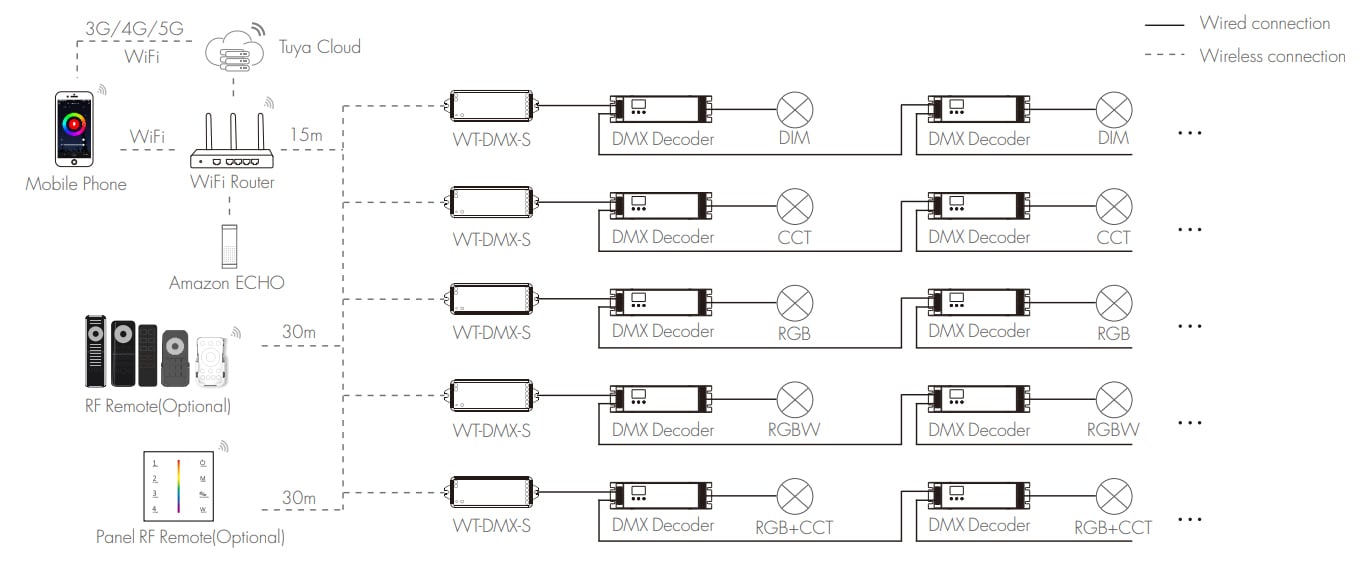
The working principle is simple: a DMX master acts as the central control unit, generating DMX512 control data and transmitting it through the DMX signal lines (A/B) to compatible constant-voltage, constant-current DMX decoders, or high-voltage DMX decoders, or DMX-SPI decoders. The decoders then translate these commands into output signals to control the connected LED strips and fixtures.


T15-S AC DMX Master RGB CCT LED Wall Controller Or RF Remote


DMX512 Rotary Panel T11-K - 85-265VAC 1 Zone Dimming Controller

T11 DMX512 Master 4 Zone Wall Panel - RF 2.4G LED Strip Controller

DMX512 Touch Panel T11-1 - 4 Zone Single Color LED Controller


DMX512 4 Zone RGB Touch Panel T13(IT) - Wall Mounted Master Controller


How Does a DMX512 Master Work?
For everyday lighting applications, DMX wall panels and smart DMX controllers provide intuitive push-button, touch, rotary, or wireless control without requiring users to write DMX programs. They are ideal for homeowners, electricians, and installers who want reliable, straightforward control of DMX LED strips and lighting fixtures.
For more advanced applications, USB-to-DMX Masters connect to a computer for software-based lighting control and programming, making them suitable for lighting designers and professional integrators. SkyDance also offers wireless DMX transmitters and receivers, as well as WiFi and RF DMX masters, providing additional flexibility for installations where wireless control is preferred.
FAQ About DMX512 Master Controllers
Got questions about choosing, wiring, or programming a DMX512 master? Here are clear, jobsite-tested answers from our technical desk.
A DMX512 master is the brain that originates standard USITT DMX512/1990 digital control packets and sends them downstream to receiving decoders. Unlike downstream decoders that translate data into PWM power for the diodes, a master does not power lights directly. It translates your physical adjustments—like turning a wall knob, tapping a glass zone, or sending an app command—into 8-bit channel values (0–255). It transmits those values over shielded cable to addressable decoders, telling each channel how bright to shine.
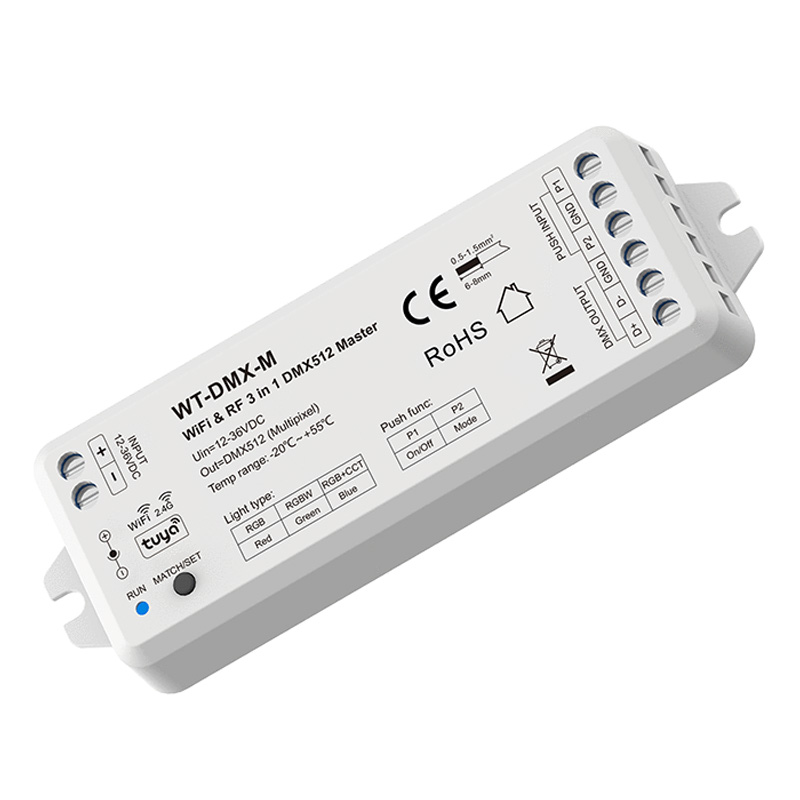
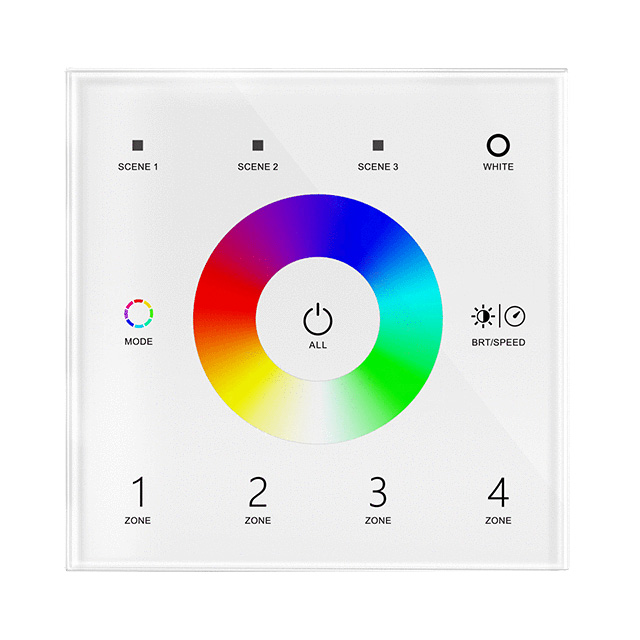
Choosing the right DMX512 master comes down to user preference and physical zoning. Rotary models like the T11-K or T13-K give you tactile, single-zone dimming or color selection with an immediate physical dial, which commercial clients and guests find foolproof. Glass touch panels like the T15 give you independent 4-zone control with scene presets and direct color wheel feedback. If you need smartphone automation or voice commands alongside physical panels, a WiFi and RF master like the WT-DMX-S bridges Tuya cloud control with hardwired DMX lines.
A DMX512 master connects to decoders via a daisy-chained 3-wire RS-485 bus using D+, D-, and GND terminals. Run a continuous shielded twisted-pair cable (such as Belden 9841 or Cat5e/Cat6) from the master's DMX output terminals straight into the DMX input of the first decoder, then jump from its DMX output to the next decoder in line.
Yes, our DMX512 master hardware complies strictly with the international USITT DMX512/1990 protocol, making it universally compatible with any standard DMX decoder, driver, or stage fixture on the market. Whether you run our multi-channel decoders or stage-grade dimmer packs, the master outputs an open 250 kbps RS-485 stream that any standard chip interprets without proprietary handshakes. If you are integrating third-party equipment and want to verify address offsets, review our dmx strip lighting guide for wiring pinouts and setup instructions.
A wired connection directly from a DMX512 master remains the benchmark for commercial reliability because physical copper cable cannot be compromised by radio congestion or structural barriers. However, when trenching conduit or fishing wire across finished plaster is impossible, our 2.4 GHz wireless transmitter and receiver sets (DM-WT and DM-WR) bridge the master output across distances up to 300 m line-of-sight. They transmit with zero perceived latency, automatically hopping across 126 frequency bands to avoid interference from local Wi-Fi networks.
A standard DMX512 master can control pixel lighting, but it cannot connect to pixel data pins directly; it must send its DMX signal through dedicated dmx to spi decoders. The DMX-to-SPI decoder translates standard DMX universe packets into digital SPI chip protocols such as WS2811, WS2812B, or UCS1903. Keep in mind that a single DMX512 universe supports 512 channels, which equals 170 individual RGB pixels (3 channels per pixel), so large pixel grids require multi-universe programmable controllers rather than 4-zone wall panels.