
DMX512 & RDM Decoder
5 productsA DMX512 LED decoder converts digital DMX control signals into PWM (pulse-width modulation) outputs that compatible constant-voltage LED strips can use for dimming and color control. It connects a DMX lighting console or compatible DMX controller to LED strips, allowing individual channels to be adjusted through a centralized lighting control system.
MiBoxer (Mi-Light) DMX512 & RDM decoders are designed primarily for DC 12V–24V or 12V–48V constant-voltage LED strips and lights. They work with a separate compatible DC power supply and a DMX signal source, making them suitable for integrating LED strip lighting into architectural, commercial, entertainment, and other DMX-controlled installations.




Choose the Right DMX RDM Decoder for Your LED Strip
MiBoxer offers 1-channel through 5-channel constant-voltage DMX/RDM decoders, allowing you to match the decoder to the type of LED strip you want to control.
- 1-channel decoder: For single-color LED strips, with one channel for brightness control.
- 2-channel decoder: For dual-white CCT LED strips, with separate warm-white and cool-white channels.
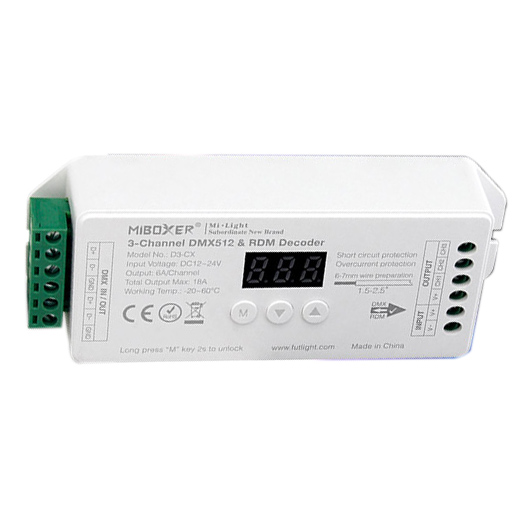
- 3-channel decoder: For RGB LED strips, with separate red, green, and blue channels.
- 4-channel decoder: For RGBW LED strips, with separate RGB color channels and an additional white channel.
- 5-channel decoder: For RGBCCT LED strips, with RGB color channels plus separate warm-white and cool-white channels.
The number of output channels determines which strip configurations can be controlled independently. Always verify the exact model's output voltage, maximum current per channel, total output-current limit, and supported DMX operating modes before installation.
Why Choose MiBoxer DMX512 & RDM Decoders?
MiBoxer decoders combine standard DMX512 control with RDM support on applicable models. RDM (Remote Device Management) allows compatible DMX/RDM controllers to communicate with supported devices for functions such as remote addressing and device configuration.
Depending on the model, additional features may include a digital display for setting the DMX starting address, selectable PWM frequency, adjustable dimming curves, and protection against overcurrent, short circuits, or reverse polarity. These features help simplify setup and allow the decoder to be adapted to different LED strip applications.
Explore More Constant-Voltage DMX LED Decoders
In addition to MiBoxer, SuperLightingLED offers DMX512/RDM decoders from other brands, including Skydance, LTECH, Sunricher, BinColor, and LeyNew, with options for different output-channel counts, voltage ranges, current ratings, and installation requirements.
Whether you are building a simple RGB strip lighting setup or integrating multi-channel LED strips into a larger DMX-controlled installation, choosing a decoder that matches your LED strip and control system is essential for reliable operation.
FAQ About DMX512 & RDM Decoders
Direct answers to wiring, RDM configuration, channel capacity, and PWM frequency questions on constant voltage DMX decoders from our technical support desk.
A dmx to led strip decoder translates standard DMX512 communication packets from a lighting console or architectural panel into low-voltage pulse-width modulation (PWM) that constant voltage LED strip lights can execute. Standard DMX consoles transmit digital control data at 250 kbps, which cannot power LEDs directly. The decoder acts as the bridge: it accepts DC12V or DC24V power from your driver, reads the DMX slot values (0 to 255), and rapidly switches the negative output terminals to dim and blend colors across your LED strip lights.
A dmx-pwm decoder for led strip lights accepts any DC voltage between 12V and 24V, but its output voltage matches whatever power supply you wire into the DC input terminals. If you feed the decoder 24V DC from your power supply, it outputs 24V PWM, so you must connect 24V LED strip lights. Connecting 12V LED strip lights while feeding 24V into the decoder will burn out the LED diodes within seconds. The decoder does not step voltage up or down; it only switches the negative rail of your supply voltage.
Every dmx to led strip decoder in the CX series caps at a total current limit of 20A across all channels. On a 12V system, that yields a maximum continuous load of 240W, while on a 24V system, it supports up to 480W. We recommend applying an 80% safety margin on real jobsites to prevent thermal stress, keeping your continuous run under 192W on 12V or 384W on 24V. When calculating loads for LED strip lights, ensure no single channel exceeds the per-channel amperage ceiling (5A per channel on the 4-channel unit).
Switching the PWM frequency on a dmx-pwm decoder for led strip lights changes how rapidly the circuit switches the LED strip on and off each second. The default 500Hz setting generates less heat inside the decoder and minimizes inductive ringing along long output cable runs, which is ideal for architectural cove runs. The 2000Hz setting switches at 2 kHz, eliminating visible scan lines and rolling shutter flicker when video cameras, mobile phones, or broadcast studio equipment film the illuminated LED strip lights.
You change the starting address remotely by connecting an RDM-compatible lighting desk or handheld RDM programmer to the DMX line, scanning for devices, and editing the decoder's DMX start channel directly in software. You do not need to climb a ladder to physically push buttons on the unit. Remote Device Management (RDM) establishes bi-directional data flow over the standard 3-pin DMX cable. The decoder responds with its unique device ID, reports channel count, and saves the new address into non-volatile memory.
Flickering LED strip lights at low dimming levels usually stem from selecting a linear dimming curve instead of logarithmic, or line noise along an unterminated DMX data bus. Human eyes perceive light logarithmically, so linear dimming bunches low-end brightness steps together, making small PWM steps look like jumps or stutters. Toggle the decoder setting from linear to logarithmic dimming to smooth out low-end fades. If strobing continues, make sure you installed a 120-ohm terminating resistor between Data+ and Data- on the last decoder in the daisy chain.
Logarithmic dimming is the right choice on a dmx to led strip decoder for architectural lighting, coves, and hospitality spaces where smooth visual fades on constant voltage LED strip lights matter most. The logarithmic gamma curve allocates more DMX step values to the bottom 20% of output, preventing harsh pop-on transitions. Choose linear dimming when programming fast chases, strobe effects, or syncing LED strip lights alongside moving head stage fixtures through lighting software, where a 1:1 mathematical match between DMX fader percentages and output duty cycle is necessary.
Swapped colors on your LED strip lights happen when the output channel sequence on the decoder does not match the pinout order on your multi-conductor LED strip lights. Some manufacturers print pins as +RGBW while others use +GRBW or +BRGW. Our CX decoders use a standardized numerical channel terminal block (V+, CH1, CH2, CH3, CH4). For standard RGB, CH1 is Red, CH2 is Green, and CH3 is Blue. Check your strip's solder pads to confirm each color wire lands on its matching terminal.
Under the EIA-485 physical standard, you can daisy-chain up to 32 DMX decoders on a single continuous data run before electrical loading degrades the signal. Keep the total cable distance under 300 meters (1,000 feet) using 120-ohm shielded twisted-pair cable. Always run the DMX line in a daisy chain from DMX OUT to DMX IN; never tee or star-tap the data lines without an isolated DMX splitter.