
DALI Triac AC Dimmer
6 productsAt SuperLightingLED, we offer SkyDance DALI Triac/ELV Dimmers designed to bring AC phase-cut dimmable lighting into centralized DALI lighting control systems. Featuring a single DALI address and one AC dimming output channel, these dimmers provide individual lighting control through compatible DALI masters.
SkyDance DALI Triac/ELV Dimmers receive digital dimming commands from a DALI master controller and translate them into corresponding AC phase-cut output, allowing compatible Triac/ELV dimmable LED lamps, AC LED drivers, DC LED controllers, incandescent lights, and halogen lamps to be controlled through the DALI protocol.
By converting DALI brightness and ON/OFF commands into leading-edge (forward-phase) or trailing-edge (reverse-phase) AC dimming control, they enable conventional AC dimmable lighting fixtures to become part of a unified digital lighting management system.
SuperLightingLED's SkyDance DALI Triac/ELV dimming solutions are ideal for commercial buildings, hotels, offices, conference rooms, retail spaces, hospitality projects, and residential installations where existing AC dimmable lighting needs to be integrated into a DALI-controlled environment.
They are particularly useful for lighting designers, electrical contractors, and building automation integrators who want to manage different types of AC phase-cut dimmable lighting through a centralized DALI network without replacing every existing light fixture or its compatible dimmable driver.


DALI to Triac/ELV Lighting System Wiring
To integrate AC Triac/ELV dimmable lighting into a DALI control system, connect the DALI master controller and a compatible DALI bus power supply to the DALI input terminals of the DALI Triac/ELV Dimmer.
The DALI bus carries digital control commands, including brightness adjustment and ON/OFF instructions, while the dimmer receives a separate AC100–240V mains input through its designated Line (L) and Neutral (N) terminals.
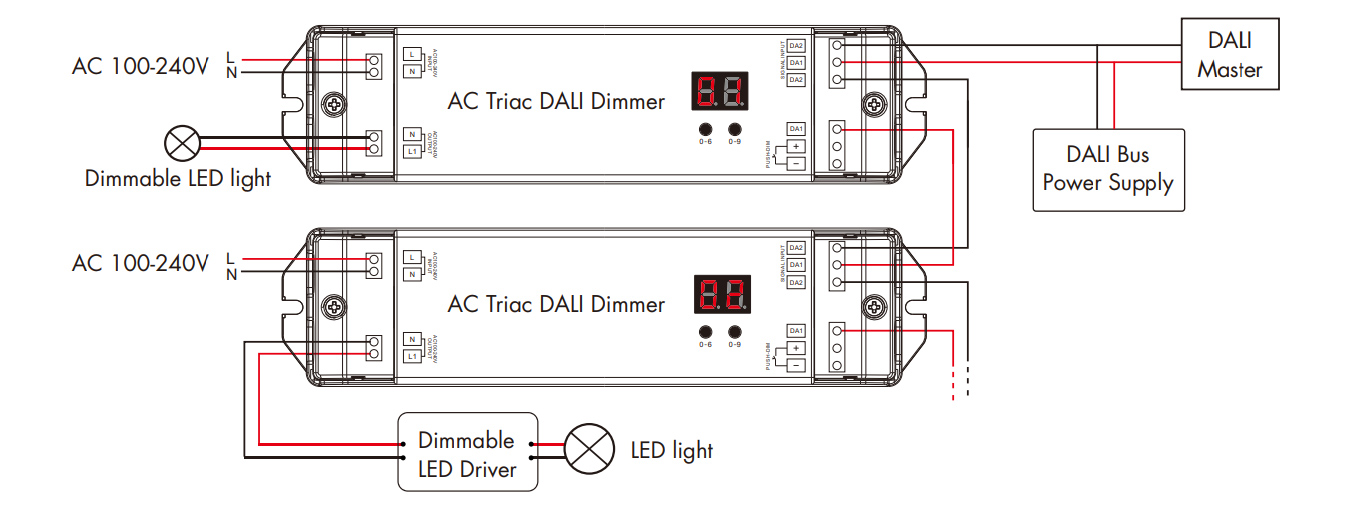
Connect the dimmer's phase-cut AC output to the corresponding input terminals of compatible Triac/ELV dimmable LED lamps or LED drivers. The connected lighting load can then be individually addressed and controlled through the DALI master controller.
For installations using low-voltage DC12V or DC24V LED strips, connect a compatible Triac/ELV dimmable AC-to-DC constant-voltage LED driver between the dimmer's AC output and the LED strips. The dimmer regulates the AC power supplied to the dimmable driver, while the driver converts it into the required low-voltage DC output for the LED strips.
Before installation, verify the DALI dimmer's supported phase-cut mode, input voltage, maximum output current, and compatible load capacity. Always follow the wiring diagram and load specifications of the exact model being installed.
Frequently Asked Questions About DALI Triac AC Dimmers
Direct technical answers from application engineers on phase-cut dimming, wiring methods, load calculations, and DALI bus integration.
A DALI Triac dimmer converts digital DALI bus signals into a variable 100–240VAC phase-cut mains output to control line-voltage lighting. Unlike low-voltage DALI units that output pulse-width modulated DC power, this dimmer sits directly on your AC line to regulate dimmable LED retrofit lamps, AC halogen bulbs, or phase-cut dimmable LED drivers. It translates commands from your central DALI master into standard mains-voltage dimming.
Trailing edge mode is the correct choice for dimmable LED lamps and electronic LED drivers. Leading edge works primarily for inductive loads like traditional magnetic transformers and resistive halogen filaments. Using leading edge on modern LED drivers often causes loud buzzing, rapid heating, and strobing at low levels. On models like our digital display DALI dimmer, you can toggle the internal MOSFET between reverse-phase (trailing) and forward-phase (leading) depending on what your luminaire demands.
Wiring a low-voltage DC tape light straight to a DALI Triac dimmer will instantly destroy the tape because the dimmer outputs 100–240VAC mains power. To dim 12V or 24V LED strip lights with this hardware, you must install a phase-cut dimmable power supply between the dimmer output and your strip. If your project uses standard non-dimmable power supplies, skip phase-cut dimmers entirely and wire a dedicated DALI CV dimmer on the low-voltage DC side instead.
A DALI Triac dimmer continuously modifies the AC sine wave to adjust light levels from 1% to 100%, whereas a DALI AC light switch is a mechanical relay that only turns line voltage completely on or off. Relays handle heavy non-dimmable inductive loads up to 10A or 16A, including ventilation fans and basic floodlights, without altering line waveform. If your luminaires require smooth intensity control rather than raw on/off power switching, you need phase-cut dimming instead of an AC switch.
Every DALI Triac dimmer on this page complies with IEC 62386-102 (control gear) and IEC 62386-207 (LED modules, DT4) for interoperability across worldwide building systems. They interpret broadcast commands, 16 group assignments, and 64 unique short addresses sent by any compliant central gateway. Models carrying certified DALI-2 firmware, like the DT-C, provide rigorous timing adherence and fault reporting, preventing communication dropouts when integrated alongside systems from Lutron, Helvar, or Tridonic.
A DALI Triac dimmer pairs well with line-voltage AC LED strip lights that are explicitly marked as phase-cut dimmable. Because these high-voltage strips run directly on 110V or 220V without an external transformer, trailing-edge dimmers modulate their brightness cleanly down to 1% without stepping. Keep total run length calculated so continuous wattage remains under 1.2A, which accommodates power surges on line-driven diodes and protects the MOSFET output switches.
You can assign the address automatically through your central DALI programming software or manually on the hardware itself. Models featuring an onboard digital display and push buttons let you set addresses from 00 to 63 directly at the panel before closing the electrical enclosure. If you choose automatic commissioning through a master controller, the dimmer responds to standard random address allocation sequences over the bus without requiring manual button intervention.