
DMX512 Signal Amplifier
5 productsA DMX512 signal amplifier becomes essential when a lighting control network exceeds the practical limits of a standard DMX signal line or requires more flexible signal distribution.
In a typical DMX512 system, one signal segment supports up to 32 DMX device loads. As more decoders, DMX fixtures, or lighting controllers are connected, the electrical load on the bus increases and signal quality may deteriorate. Long cable runs, poor-quality cables, and complex wiring layouts can also contribute to DMX signal attenuation and communication instability.
A SkyDance DMX512 signal amplifier helps solve these problems in three common situations:
- Too Many DMX Devices: When more than 32 DMX devices are connected to one signal segment, a DMX amplifier can regenerate the incoming signal and create additional output segments for more devices.
- Long-Distance Signal Transmission: When DMX cables run over long distances, a DMX amplifier can regenerate and reshape the signal before it continues to the next section of the installation.
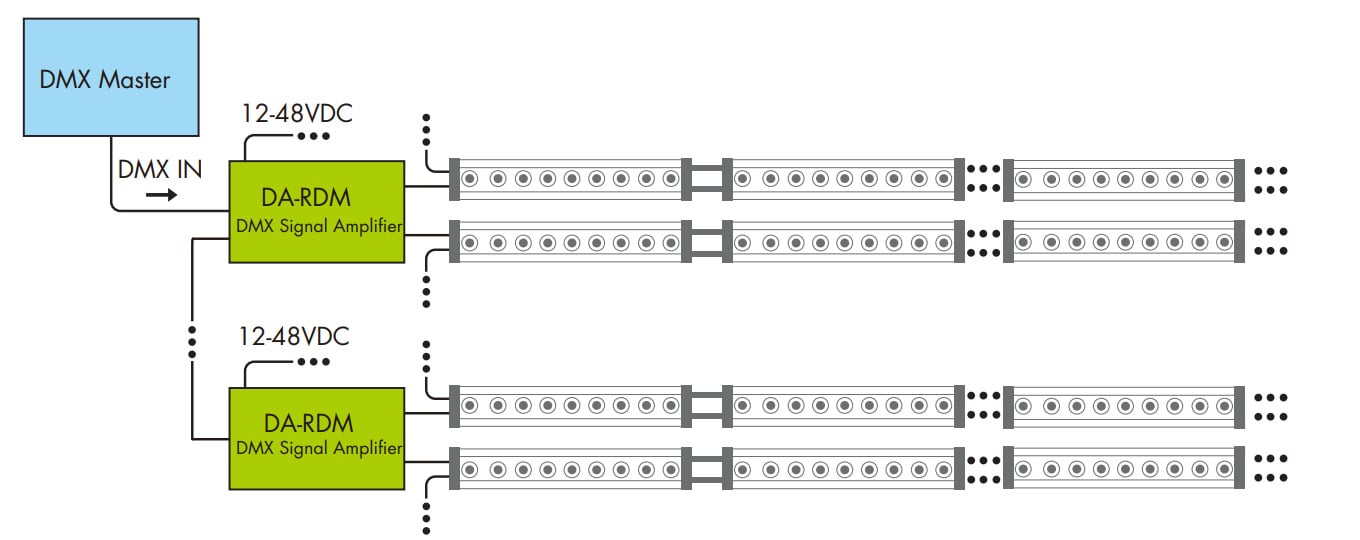
- Multiple DMX Signal Branches: When different lighting areas, building sections, or fixture groups need separate DMX signal lines, a multi-output DMX splitter provides independent signal distribution without relying on passive Y-splitters.
Whether you are installing DMX LED strip controllers, architectural LED wall washers, stage lighting fixtures, or large-scale DMX decoder networks, adding the appropriate signal amplifier can improve system reliability and simplify wiring management.
**Important:** RDM communication requires an RDM-compatible lighting controller, amplifier, and downstream devices throughout the signal path. A standard DMX-only amplifier should not be substituted into an RDM communication path when bidirectional RDM functionality needs to be maintained.
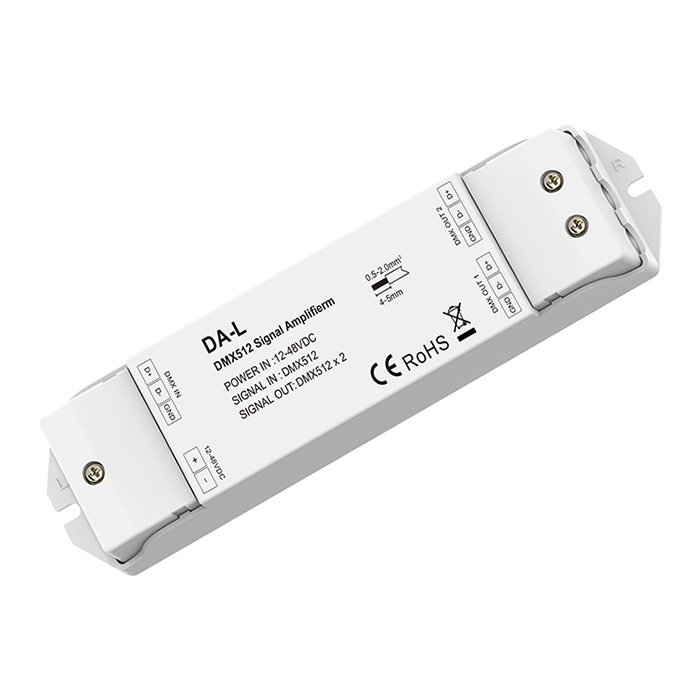
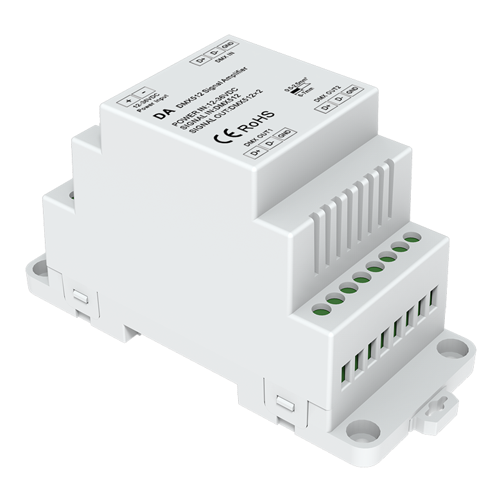
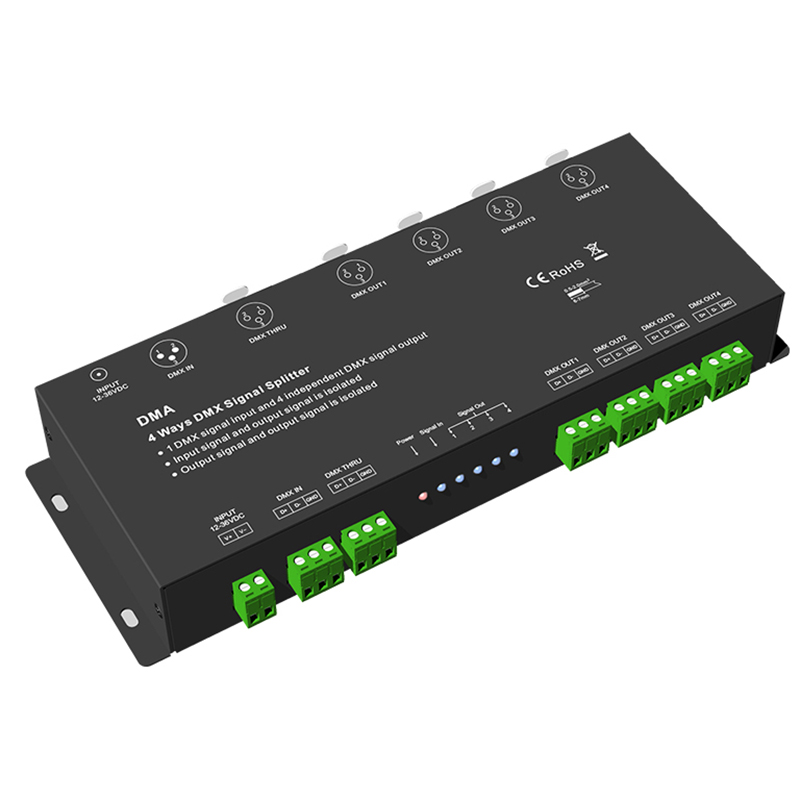
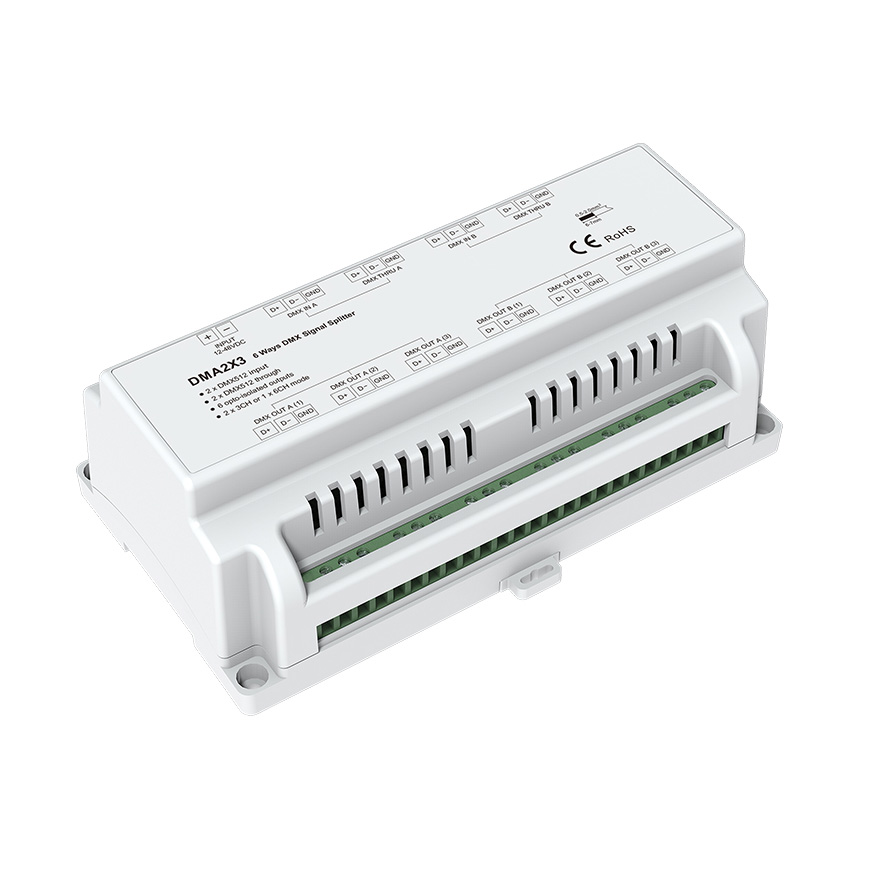
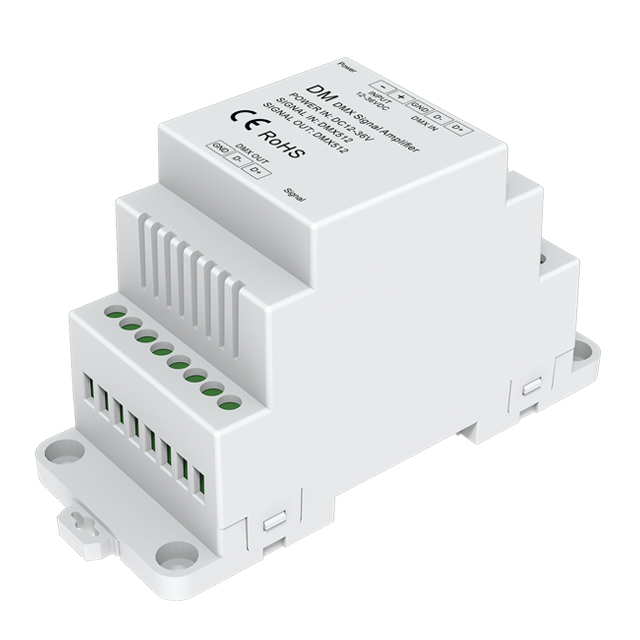
DMX Signal Amplification, Distribution & Optical Isolation
SkyDance DMX512 signal amplifiers do more than simply divide one signal into multiple connections. They actively regenerate incoming DMX512 signals and provide electrically isolated output channels for reliable distribution.
Signal Regeneration: The incoming DMX512 (RS-485) signal is received and reshaped before being transmitted through the output ports. This helps maintain signal integrity across extended lighting networks.
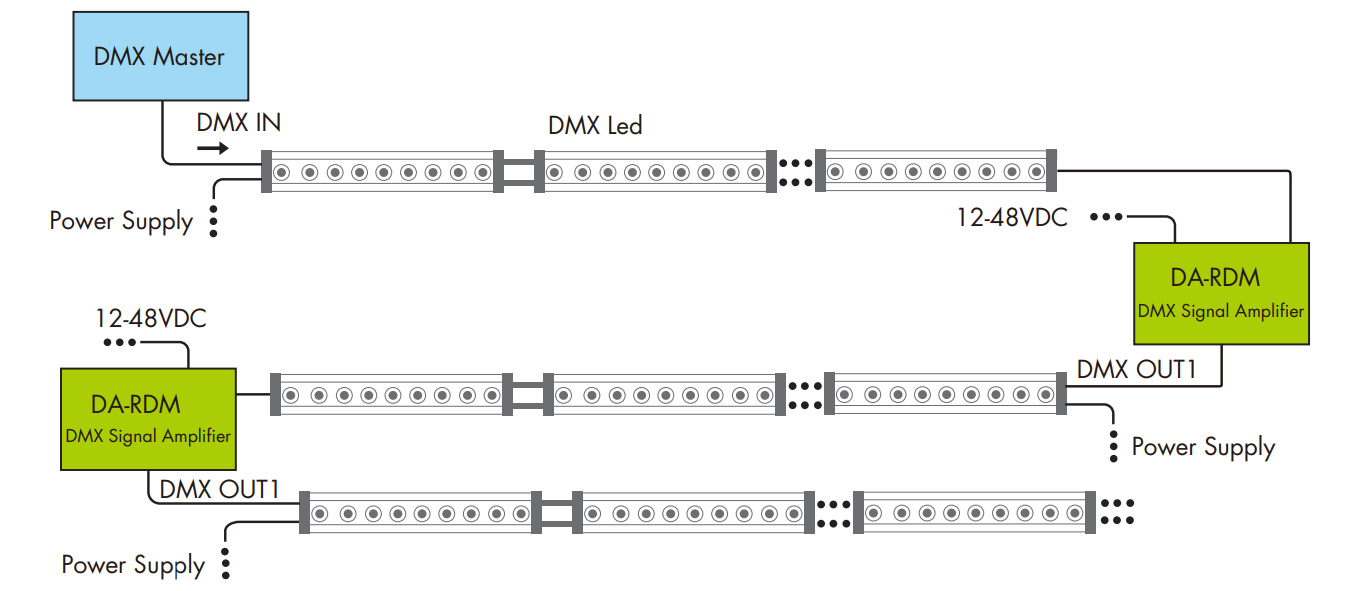
Multi-Channel Signal Distribution: Depending on the model, one or two DMX signal inputs can be distributed into two, four, or six independent output connections. Each output carries the corresponding incoming DMX control data, allowing multiple lighting branches to operate from the same DMX source.
Optical Isolation: Opto-isolated input and output circuits help separate different sections of the DMX network, reducing the risk of electrical interference and protecting connected equipment from certain wiring faults or electrical potential differences.
Independent Output Protection: On models with isolated output channels, an electrical fault or interference on one branch is less likely to affect the other output branches.
It is important to understand that a DMX signal amplifier increases the number of available physical signal branches, not the number of DMX universes or control channels. Each output repeats the DMX data received from its corresponding input.
SkyDance DMX signal amplifiers require an external DC power supply. Connect the DC supply to the amplifier's dedicated power input, separately from the power connections supplying the LED lighting fixtures.
How to Plan DMX Cable Runs, Device Counts & Signal Termination
Correct DMX network planning helps avoid communication errors, signal reflections, and unstable lighting behavior in large installations.
1. Observe Device Limits: Plan for no more than 32 DMX devices on each standard DMX signal segment.
2. Limit Amplifier Cascading: When multiple amplifiers are connected in series to extend a network, follow the manufacturer's recommendation not to exceed five consecutive signal amplification stages.
FAQ About DMX512 Signal Amplifier
Direct answers to common jobsite questions on DMX signal distribution, opto-isolation, wiring limits, and voltage selection.
You need a DMX512 signal amplifier whenever your daisy chain exceeds 32 physical receiver loads or your continuous cable run stretches beyond 300 metres (1,000 feet). Standard RS-485 transceivers inside LED strip decoders draw bus current; past 32 units, signal rise times degrade and fixtures start dropping packets. Placing a DMX512 signal amplifier inline reshapes the square-wave pulses and opens fresh, isolated branches so you can continue adding fixtures without data corruption.
Each independent output port on a DMX512 signal amplifier drives up to 32 standard DMX512 receiver loads. On a 4-channel unit like our DMA, that gives you 128 decoders (4 x 32) running off one input. If you deploy our DMA2X3 6-channel splitter, the two isolated banks distribute signal across 6 outputs, supporting up to 192 decoders across separate cable runs without overloading any single driver chip.
Only a DMX512 signal amplifier with bi-directional circuitry will pass Remote Device Management (RDM) discovery and addressing commands back to your lighting console. Standard uni-directional splitters block reverse data packets, isolating downstream decoders from discovery. If you need remote parameter monitoring and address patching without climbing a ladder, choose an RDM-certified repeater like our DA-RDM, which switches line direction in microseconds according to ANSI E1.20 standards.
Intermittent flashing at the line end happens when signal reflections bounce back from an un-terminated cable or high transceiver loading rounds off the DMX waveform. A missing 120-ohm terminating resistor across Data+ and Data- is the cause nine times out of ten. If termination does not stop the jitter, line capacitance over a long cable run has degraded the square wave, meaning you need to insert a DMX512 signal amplifier halfway through the run to regenerate clean transitions.
Passive Y-splitters should never be used instead of an active DMX512 signal amplifier because splitting an RS-485 differential line creates transmission line stubs that bounce reflections back into the bus. These ghost reflections cancel out data packets, causing strobing and random channel jumps on downstream LED strip decoders. An active DMX512 signal amplifier uses dedicated transceiver chips to isolate each branch, guaranteeing a clean 120-ohm characteristic impedance across every leg.
Most DMX512 signal amplifier units accept a wide DC input between 12V and 36V, while select models in our inventory operate up to 48VDC. This allows you to power the amplifier directly from the same 24V, 36V, or 48V industrial bus running your architectural drivers without adding an extra step-down transformer.
An opto-isolated DMX512 signal amplifier converts incoming electrical signals into light pulses across an optocoupler gap before regenerating the output, completely breaking electrical continuity between sub-circuits. On large venues where fixtures draw power from different phase panels or different building grounds, ground potential differences can reach tens of volts. Optical isolation prevents ground loop currents and transient voltage spikes up to 1 kV from frying your primary lighting console or jumping across branches.
You can split two independent universes using a dual-input DMX512 signal amplifier such as our DMA2X3, which features two isolated inputs feeding two separate sets of three outputs. This eliminates the need to mount two standalone splitters inside tight electrical enclosures. Simply connect Universe 1 from your dmx512 master controllers to Input A to feed three branch runs, and Universe 2 to Input B for three separate branches, keeping the universe addressing fully segregated.
A DMX512 signal amplifier consumes zero DMX channels because it is purely a physical layer (layer 1) hardware repeater, not an addressable receiver. The amplifier transparently reshapes and clones all 512 channel slots across every output port without reading or modifying slot data. Your downstream LED strip decoders retain their programmed start addresses exactly as assigned, meaning an amplifier never subtracts from your available 512-slot universe budget.