
SPI Dream Color Controllers
2 sub-categories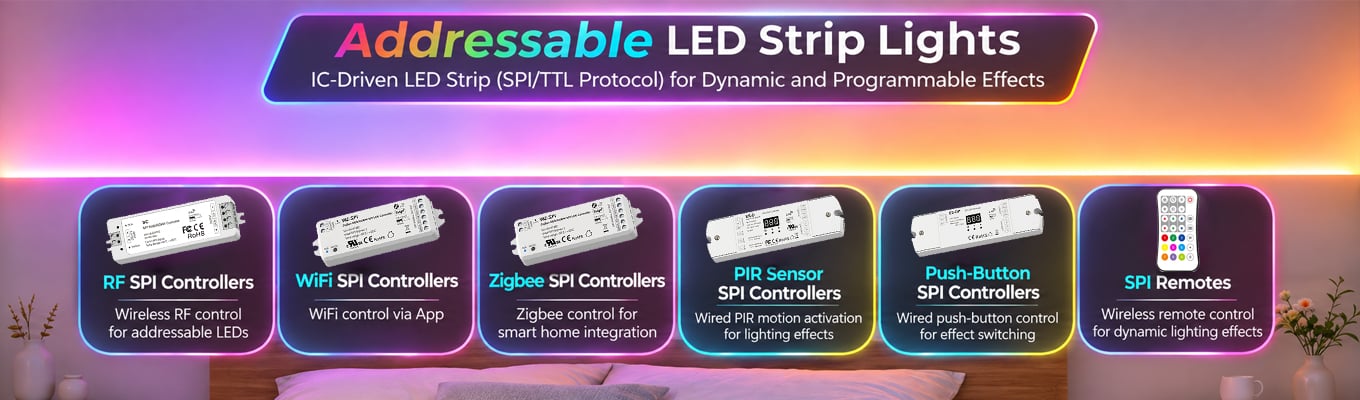
SkyDance SPI Dream Color Controllers are specifically designed for wireless, smart, and automatic control of addressable LED strip lighting. It supports a variety of SPI-controlled lighting applications, including addressable RGB, addressable RGBW, and addressable white LED strips, bringing dynamic color effects, programmable lighting, and flexible control options to pixel-based LED installations.
Multiple Control Options for Addressable LED Lighting
Unlike conventional SPI LED controllers that primarily rely on a single control method, SkyDance offers different control solutions to suit a wider range of applications. Depending on the model, available options include 2.4GHz RF wireless remote control, Wi-Fi app control, Zigbee smart control, dual PIR motion sensor activation, and dual push-button control.
Whether you prefer handheld or panel wireless operation, smartphone app control, smart home connectivity, automatic motion-triggered lighting, or convenient wired push-button operation, you can choose a suitable SPI controller to match your installation and control requirements.
SPI Signal Splitters and Extension Modules for Larger Systems
To support more complex addressable LED installations, the SkyDance SPI series also provides dedicated signal splitters, signal amplifiers, and signal extension modules. These accessories help distribute SPI signals to multiple LED strip branches, extend signal transmission where needed, and build more flexible multi-strip lighting layouts. With compatible signal distribution components, multiple addressable LED strips can operate in synchronization from a common SPI control source.
**Compatibility Note:** SPI compatibility depends on the LED strip's IC type, signal protocol, channel configuration, and color order. Always check the controller's supported IC list and output specifications before connecting your addressable RGB, RGBW, or white LED strips.

SPI Controller Series
The SkyDance SPI Controller Series is designed to control DC5-24V addressable LED strip lights using digital SPI signals (DAT and CLK), supporting a variety of pixel lighting applications, including addressable RGB, RGBW, and white LED strips. These SPI controllers send digital control data to addressable IC chips via buttons, RF remotes, smart APPs, or switch light through PIR sensors, allowing individual pixels or groups of pixels to display different colors, brightness levels, and dynamic lighting effects.
Depending on the controller, you can configure the supported IC type (UCS1903, UCS2903, SK6813, WS2811, WS2812, WS2813, WS2815, SM16703, TM1814 RGBW, SK6812 RGBW, WS2814 RGBW, SM16714 RGBW, WS2801, SK9822, TM1914, GS8206, GS8208, WS2818, etc.), RGB/RGBW color sequence, and pixel count (900, 960, 1000, 1024, etc.) to match your LED strip. Various dynamic effects, such as chasing, flowing, running, and gradual color transitions, allow you to create customized pixel lighting displays for architectural accents, signage, entertainment spaces, and decorative lighting projects.
**Compatibility Note:** SPI controllers are not universally compatible with every addressable LED strip. Check the supported IC types, current load, RGB/RGBW or white output configuration, color order, and maximum pixel capacity of the selected controller before connecting your pixel LED strips.

SPI Signal Splitter
SkyDance SPI Signal Splitters and Amplifiers are designed to distribute digital SPI signals from one controller to multiple addressable LED strip runs. A 1-to-2 SPI signal splitter distributes one group of incoming SPI signals into two output groups, while a 1-to-6 model provides six independent output connections from one input signal.
Because each output carries the same control data, the connected addressable LED strips can display matching colors, animations, and dynamic lighting effects simultaneously. This makes SPI splitters especially useful for installations involving multiple lighting branches, parallel strip runs, display sections, or separated decorative lighting areas that need to follow the same pixel effects.
**Important:** Always select an SPI splitter compatible with your controller's signal type and LED strip configuration, and provide suitable power to each connected digital LED strip according to its actual power requirements. We offer a wider selection of SPI signal amplifiers in addition to SkyDance.
Best-selling SPI Dream Color Controllers
1–14 of 14 products



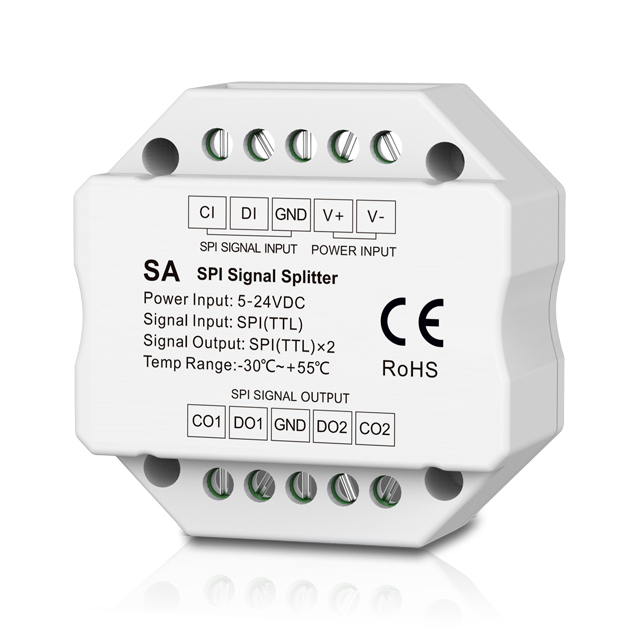
DC5-24V SPI 1 to 2 Signal Splitter Amplifier SA For Addressable LED Light Strip
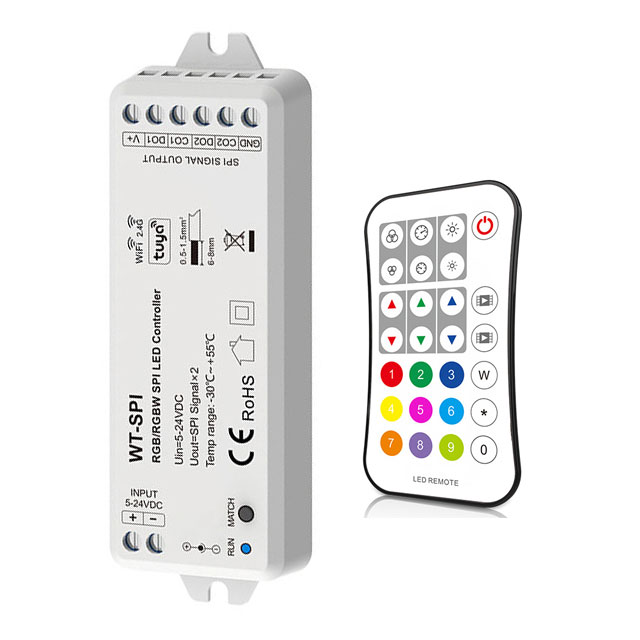
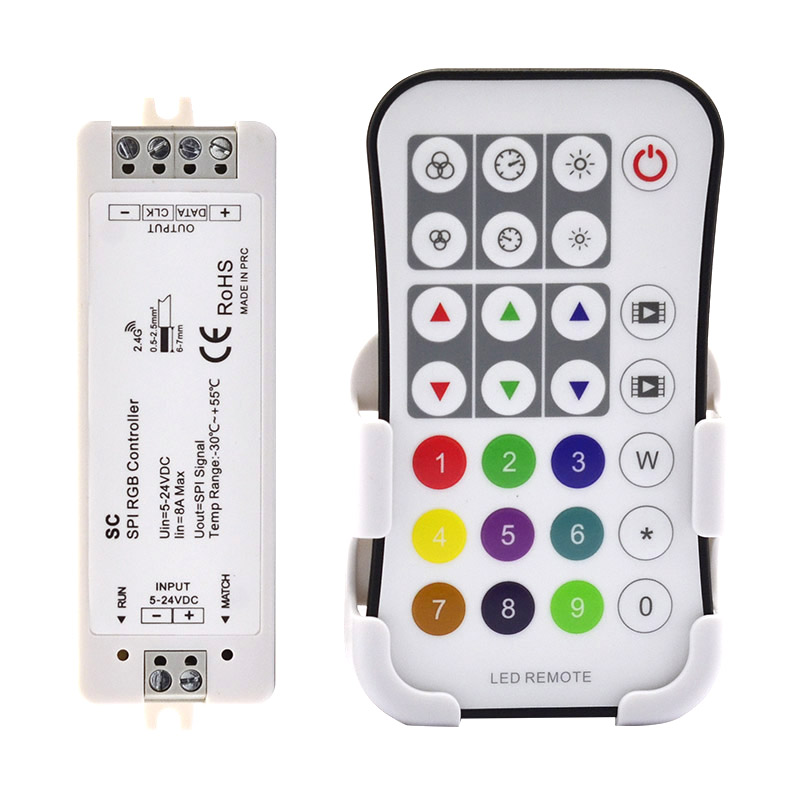
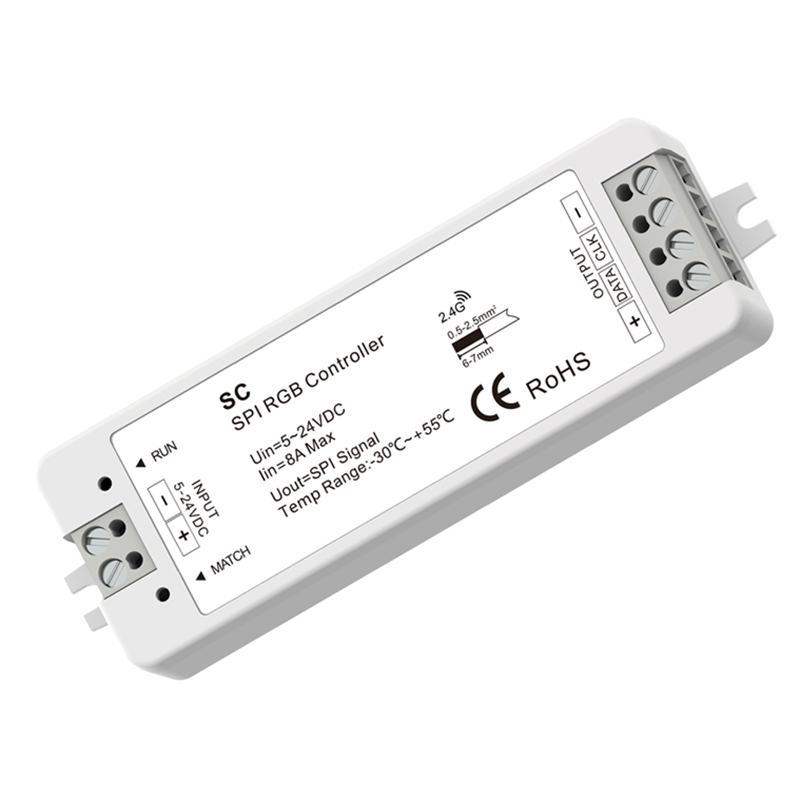


DC5-24V WiFi-SPI+R9 Customize Mode APP Programmable Time Controller For WS2801 WS2812B LPD6803...

WiFi SPI Programmable Time Controller WiFi-SPI For WS2801 WS2812B LPD6803 Addressable Digital LED...
FAQ About SPI Dream Color Controllers
Direct answers to common wiring, protocol, and configuration questions from our bench engineers.
An SPI dream color controller sends digital serial data to individual integrated circuit (IC) chips on an LED strip, telling each LED or pixel node exactly what color and brightness to display independently. Standard RGB controllers use pulse-width modulation (PWM) to dim all LEDs along the entire run at the exact same time. With an SPI controller, you can create flowing chases, multi-color gradients, meteor trails, and segmented animations.
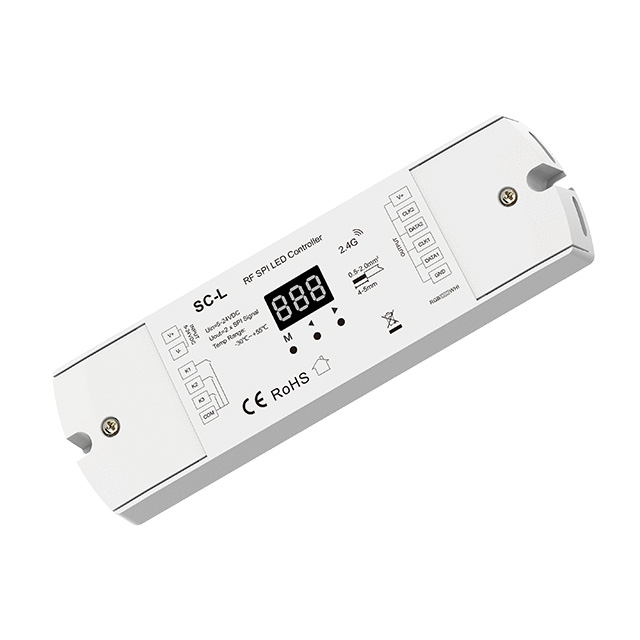
A modern SPI LED controller in our SkyDance range supports between 30 and 47 common digital IC chip protocols directly from its onboard menu or control app. That includes popular single-wire 3-pin protocols like WS2811, WS2812B, UCS1903, TM1804, TM1809, and TM1812, as well as dual-wire 4-pin clock-and-data protocols like WS2801 and LPD6803. If you're wiring common ws2811 led strips, you simply dial the IC code into the digital display on models like the SC-L or select the IC family inside the Tuya app on the WT-SPI so the timing pulses match your silicon.
Random flashing and erratic colors on an addressable LED strip are almost always caused by a floating ground or high data line resistance. The SPI data signal is a 5V TTL logic waveform referenced to 0V ground. If you use a separate power supply for your LED strip and your controller without connecting their negative (V-) terminals together, the data pin has no stable reference plane and interprets stray electrical noise as commands. Run a common negative wire between the controller ground terminal and the LED strip power supply ground, and keep your data run from the controller under 5 m.
Choosing the right SPI dream color controller comes down to how your site manages wireless control signals and local network infrastructure. If you want instant, handheld control without relying on home routers or phone apps, pick an RF 2.4GHz receiver like the SC paired with an R9 remote. If you want phone control and cloud scheduling via 2.4GHz home Wi-Fi without adding an extra bridge, select the WT-SPI or ES-DP(WT). For homes already built on an automated mesh network, the WZ-SPI joins a Tuya Zigbee 3.0 gateway to coordinate scenes with wireless wall switches and sensors.
An SPI dream color controller designed for staircases, like the ES-D, uses dual daylight-sensing PIR motion detectors installed at the top and bottom risers to trigger progressive lighting sweeps. When someone steps onto the bottom tread, the controller senses motion and sequentially illuminates the pixel dots upward at a preset travel speed and hold time, then turns them off behind you. You can set the total step pixel count, travel speed from 1 to 8 levels, and daytime ambient lux thresholds directly on the unit's digital menu buttons so lights stay off when sunlight is adequate.
You cannot simply wire multiple SPI data lines to one terminal without degrading the signal, which is why we use dedicated spi signal splitters to mirror pixel animations. Tying three or four high-speed digital lines to a single screw terminal creates impedance mismatches and drops signal voltage below the TTL high threshold. An active module like the SA 1-to-2 or SA6 6-way splitter isolates and regenerates the incoming data wave into separate, synchronized output lines. Each branch can run an identical strip run without data corruption or frame lag across fixtures.
Wrong colors occur when the color sequence on the addressable LED strip doesn't match the output order configured on the controller. Different chip factories build LED silicon with varying channel routing, including RGB, GRB, BRG, or BGR. If your controller outputs RGB data to a strip factory-wired for GRB, pressing red makes the tape turn green. On controllers like the SC-L or WT-SPI, you enter the system settings menu to toggle through the 6 color order combinations until the strip matches your remote buttons exactly.
Yes, models like the SC-L and WT-SPI are equipped to output both single-signal (DAT) and dual-signal (DAT plus CLK) SPI commands. Single-line ICs like WS2812B use internal precision clock timing and only require a data pin and ground. Dual-line ICs like WS2801 or LPD6803 use a dedicated clock wire to synchronize high data rates and eliminate timing jitter over long runs. Units with dual SPI terminals output either two groups of Data+Clock signals or four independent groups of single Data signals, depending on the IC profile selected in the configuration menu.
If your strip dot count exceeds the maximum limit of an SPI pixel controller, any LEDs past that threshold will either freeze, mirror earlier pixels, or remain dark. Most compact SkyDance SPI units handle up to 1024 or 2048 pixel dots per channel. For example, on a 60 LED/m 5V WS2812B strip, 1024 pixels translates to roughly 17 meters of individually addressable lighting. If you connect 25 meters without expanding the pixel limit setting, the controller stops transmitting shift registers after pixel 1024, leaving the tail end unaddressed. Check your strip pixel density and multiply by length before calculating controller hardware requirements.
When a commercial project is wired for centralized DMX consoles rather than an RF or Tuya SPI LED controller, standard SPI units will not talk directly to the 3-pin XLR or RJ45 bus. Instead of forcing consumer wireless controllers into commercial racks, you can route your signal through our dmx512 control systems, where we offer models including DMX-to-SPI pixel decoders. These units take universe data from your console, decode up to 512 DMX channels, and convert them directly into SPI TTL data for your addressable strips, giving your lighting board individual control over every pixel node.