
RGBW Fiber Optic Engine
33 productsIf you want your fiber optic cables to be colorful lights, then you need an RGBW light source. Our RGBW fiber optic light engines are available with RF remote control, Bluetooth APP control, and Tuya WiFi Alexa control. View these multiple types of illuminators with different powers and coupling heads.

50W Dual-Head Dynamic RGBW LED Star Roof Light Source For Fibers

4-Port Independent Color Changing RGBW Fiber Optic Light Source 36W

Bluetooth 20W RGBW Dual Color LED Twinkling Starlight Fiber Optic Lights Illuminator

10W Bluetooth+RF Music Twinkle RGBW LED Fiber Optic Light Engine


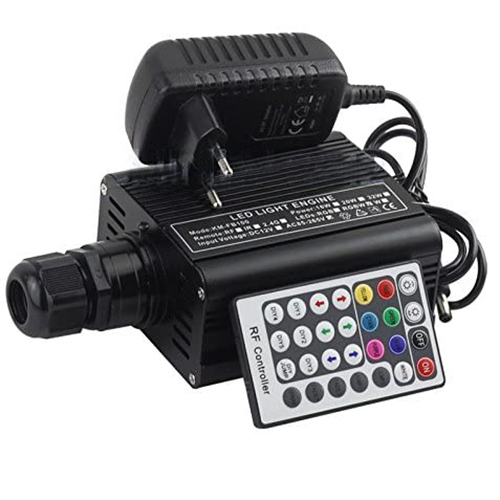

16W Bluetooth APP & RF Twinkle RGBW LED Star Fiber Optic Light Source


16W WiFi Tuya RF RGBW LED Fiber Optic Light Source Engine


32W Bluetooth APP & RF Music Twinkle RGBW LED Fiber Optic Light Source
FAQ About RGBW Fiber Optic Engines
Direct technical answers on port capacities, 4-channel wiring, pure white diode binning, and multi-port control from our pre-sales engineering desk.
An RGBW fiber optic engine carries a dedicated fourth white emitter chip on the LED package alongside red, green, and blue dies. When standard RGB systems attempt white, they mix all three color channels, which burns maximum power and produces a noticeable cool blue or violet cast around 7000K to 8000K. In contrast, our models with RGBW diodes project a clean, natural 3000K warm white or 6000K daylight white into the fiber bundle without tinting the optical plastic. To see how separate white dies change color rendering across architectural setups, read our guide on RGB and RGBW color mixing.
Natural starlight requires true white rather than composite pastel blue, which is why pure white chips are essential in rgbw led lights. A dedicated white channel delivers genuine 6000K or 4000K pinpoints that match astronomical stars, while letting you dial in subtle blue or amber tints on secondary fiber bundles. Running composite RGB white also forces three diodes to run at 100% duty cycle, generating excess junction heat inside an enclosed ceiling. A dedicated white chip pulls only one-quarter of the thermal load while producing crisper, brighter fiber tips.
A 20mm aperture on an RGBW fiber optic engine accepts roughly 600 strands of 0.75mm fiber, 300 strands of 1.0mm fiber, or 130 strands of 1.5mm optical cable. The exact calculation depends on packing density: multiply total fiber cross-sectional area by 1.25 to account for the empty space between circular strands. If your layout requires 1,000 or more stars, step up to a 30mm coupling port or choose a dual-head engine like our 32W and 50W models to split the harness load across two separate optical ports.
Power an RGBW fiber optic engine in a car by landing the positive red lead onto an accessory fuse tap and grounding the black lead to unpainted chassis metal. Never tap directly into an unswitched battery line, or the standby current from the RF receiver and Bluetooth module will drain your vehicle battery over several days. Our 12V engines accept 10V to 15V DC automotive voltage swings directly, but if your vehicle alternator spikes above 15.5V, install an inline 12V DC buck regulator to protect the internal PWM driver board.
Yes, you can control an RGBW fiber optic engine via DMX512, provided the illuminator has dedicated XLR or RJ45 DMX input terminals. In our range, DMX-ready models assign 4 distinct DMX addresses: channel 1 for red, channel 2 for green, channel 3 for blue, and channel 4 for white, with optional channels 5 and 6 governing the built-in mechanical twinkle wheel speed. If your project demands centralized stage or architectural automation alongside DMX fiber illuminators, set the starting base address using the DIP switches or digital display on the chassis side.
An RGBW fiber optic engine with independent multi-port control can output completely different colors and chase patterns from each port simultaneously. While standard dual-head models split a single LED board across two coupling collars, specialized multi-port engines like our 36W 4-port model feature four isolated RGBW LED modules. That lets you drive deep blue shooting stars from port 1, warm white background stars from port 2, and slow-cycling cyan or magenta nebula clusters from ports 3 and 4 without buying four separate power enclosures.
An RGBW fiber optic engine places all electrical connections, heat sinks, and maintenance points inside a single accessible equipment closet, whereas RGBW LED strip lights distribute voltage and diodes directly along the architectural cove. Optical fibers carry zero voltage, zero current, and zero heat, making them safe for saunas, steam rooms, and submerged fountain niches where running line-voltage or low-voltage copper poses moisture risks. However, for continuous linear washing across a drywall tray ceiling, conventional linear strips deliver higher raw lumen density per linear foot at lower equipment cost.
Our RGBW fiber optic light engines operate on either 12V DC, 24V DC, or universal 85V to 265V AC, depending on the model chosen. Fourteen models in our catalog run natively on 12V DC for automotive headliners and off-grid battery banks, while heavy-duty commercial units like our 50W 4-channel DMX model run on 24V DC or include an internal AC-to-DC switching driver with a standard wall plug. Always check the chassis label: plugging 120V AC house current straight into a bare 12V DC terminal barrel will destroy the internal PWM motherboard instantly.
A twinkle-capable RGBW fiber optic engine uses an internal stepper motor to spin a perforated cutout wheel between the LED emitter and the fiber bundle. As the patterned wheel rotates, it mechanically blocks and exposes different optical strands in sequence, creating an authentic starlight flicker. Because the dimming is mechanical rather than electronic PWM throttling, the light engine maintains constant diode drive current, preventing the white color temperature from shifting hue while running dynamic sparkling modes alongside twinkle fiber optic illuminators.
You can synchronize multiple RGBW fiber optic light engines across large rooms by linking them via DMX daisy-chain cables or grouping them within the smartphone app. For DMX setups, wire the DMX-Out port of the primary unit into the DMX-In of the secondary engine using 120-ohm shielded twisted-pair wire, setting identical dip-switch addresses so both run matching color fades. For app-based installations, assign all engines to a single room zone in the Tuya Smart or BLE mesh interface to switch static rgbw lights and animations simultaneously across your ceiling.