
Twinkle Fiber Optic Engine
18 products
Twinkle Fiber Optic Light Engines are specialized LED light source machines designed to create dynamic starry sky lighting effects through fiber optic cables. By transmitting RGB, RGBW, or white LED light into bundles of optical fibers, these illuminators transform individual fiber ends into brilliant points of light, recreating the appearance of a sparkling night sky across ceilings, car headliners, home theaters, and decorative installations.
Depending on the selected model, built-in optical flicker mechanisms, sequential lighting channels, color mixing, and music-responsive functions can produce everything from subtle twinkling stars to dynamic shooting meteor effects.
Whether you are designing a residential star ceiling or a professional decorative lighting installation, SuperLightingLED twinkling fiber optic light generators offer versatile solutions for creating immersive atmospheric lighting.

50W Dual-Head Dynamic RGBW LED Star Roof Light Source For Fibers

4-Port Independent Color Changing RGBW Fiber Optic Light Source 36W

Bluetooth 20W RGBW Dual Color LED Twinkling Starlight Fiber Optic Lights Illuminator

Bluetooth RF RGB/White Shooting Star Fiber Optic Light Engine

10W Bluetooth+RF Music Twinkle RGBW LED Fiber Optic Light Engine


16W Bluetooth APP & RF Twinkle RGBW LED Star Fiber Optic Light Source


32W Bluetooth APP & RF Music Twinkle RGBW LED Fiber Optic Light Source

Car & Bedroom Twinkle RGBW LED Fiber Optic Star Light Illuminator

45W RGBW 28key RF Remote LED Fiber Optic Light Engine

Commercial 45W DMX Fibre Optic LED Starry Ceiling Light Machine


90W (45W+45W) RGBW Twinkle AC Plug Fiber Optic Light Generator
What Is a Twinkle Fiber Optic Light Engine?
A Twinkle Fiber Optic Light Engine, also known as a Fiber Optic Light Source or Star Ceiling Illuminator, is the central light-generating unit of a fiber optic lighting system.
It uses high-output LED emitters to send light into a connected bundle of optical fiber cables, which distribute the illumination to individual points throughout the installation.
Since light travels through the optical fibers rather than electrical power, the fiber strands themselves do not require individual electrical connections. This remote light-source design provides considerable flexibility for creating starry ceilings and decorative lighting effects in spaces where conventional LED fixtures are difficult to install.
How Does the Twinkling Star Effect Work?
A complete twinkle fiber optic lights star ceiling system typically consists of three main components: a twinkling LED fiber optic illuminator, a bundle of end-glow fiber optic cables, and a compatible power supply and control system.
The illuminator is usually concealed in an accessible location, while the fiber strands are routed through the ceiling, headliner, or decorative panels, with their illuminated ends forming the visible star points.
The defining feature of a twinkle fiber optic engine is its ability to create continuously shimmering star points rather than keeping all fiber ends steadily illuminated. This effect can be generated by an internal rotating flicker disc or optical shutter that repeatedly interrupts the light path between the LED source and the fiber bundle.
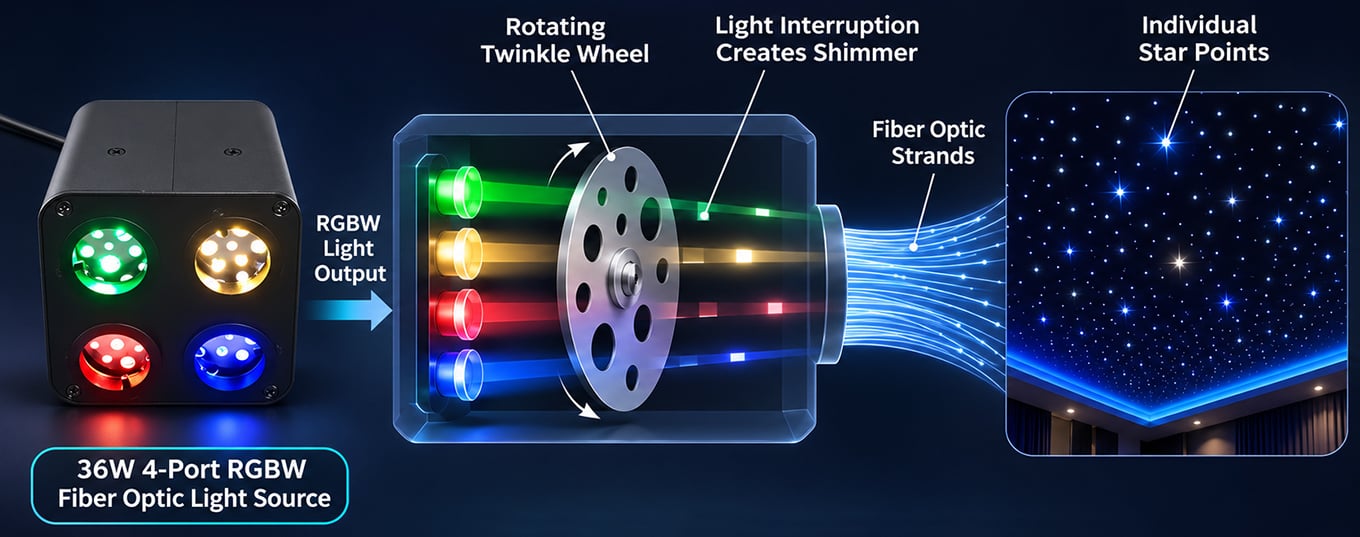
As the mechanism rotates, different portions of the light beam are intermittently blocked, producing variations in brightness throughout the fiber optic star field. The result resembles the natural scintillation of distant stars, with subtle changes in intensity that make a ceiling appear more lively and realistic.
Unlike basic flashing effects, which switch an entire light output between bright and dark states, a dedicated twinkle mechanism is designed to produce a more detailed and atmospheric shimmering appearance.
Build a Stunning Fiber Optic Star Ceiling Twinkle for Homes, Cars, and Theaters
Fiber optic star lighting is widely used to create decorative ceiling effects in residential and commercial environments. By distributing hundreds of tiny optical fiber points across a ceiling surface, installers can recreate the appearance of a star-filled night sky with customizable star density and placement.
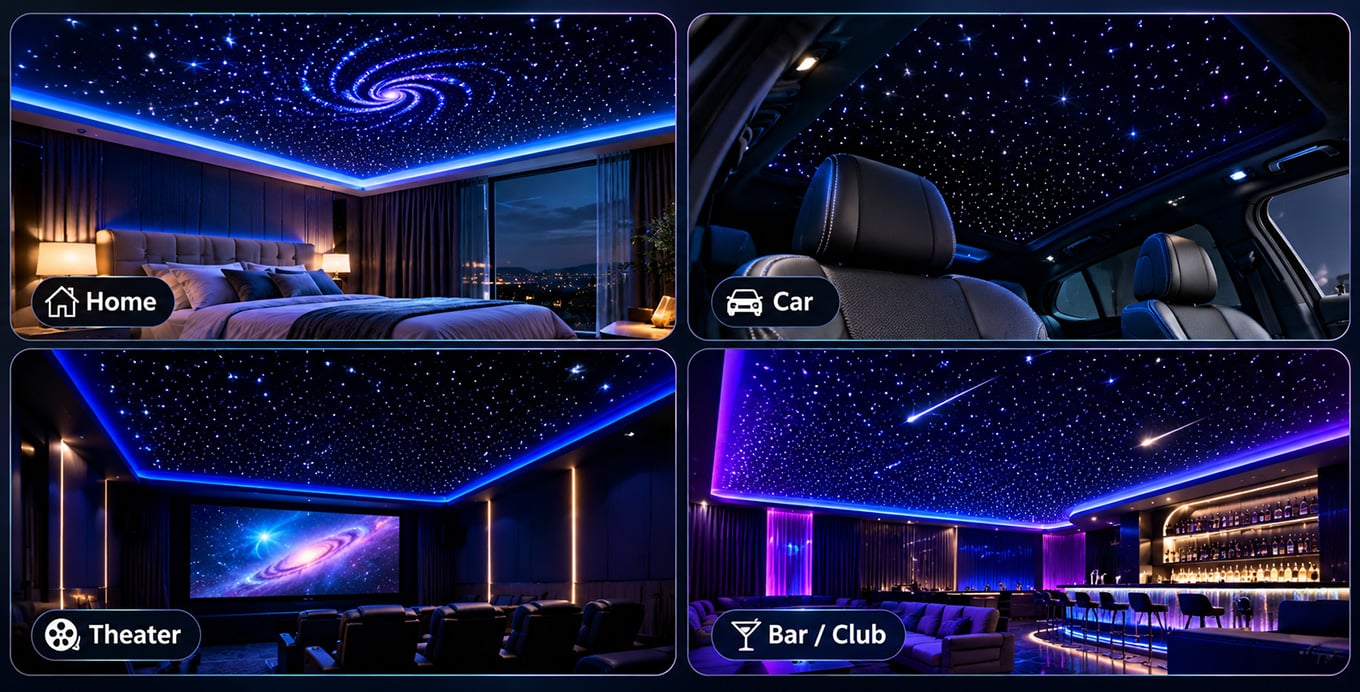
In bedrooms and living rooms, subtle twinkling stars create a relaxing ambient atmosphere. In home theaters, media rooms, and entertainment spaces, RGBW color changes and shooting meteor effects provide a more immersive visual experience.
Compact fiber optic illuminators are also popular for automotive headliner installations, where fiber strands can be routed through the vehicle roof lining to create a personalized starlight ceiling. Commercial applications include hospitality interiors, themed rooms, decorative ceilings, and other architectural lighting projects.
Twinkle Fiber Optic Light Illuminator presents a dynamic lighting effect that is used to simulate the twinkling state of the stars. Use these twinkle light sources to illuminate your fiber optics and add a super ambient starry sky ceiling to your room and home theater.
Frequently Asked Questions About Twinkle Fiber Optic Engines
Get direct engineering answers on twinkle fiber optic engine specifications, bundle capacities, driver wiring, and star ceiling installation.
A twinkle fiber optic engine produces shimmering stars using an internal motorized slotted wheel that intermittently breaks the beam before light reaches the fiber bundle. As the disk spins between the LED emitter and the coupling head, cutouts of varying shapes pass across the fiber ends. Some strands receive full light while others are partially or completely blocked, producing an organic scintillation rather than a uniform electronic blink. Because this happens mechanically, each fiber strand twinkles independently across your ceiling, creating realistic fiber optic lighting star fields with zero digital stepping.
Twinkle lumen measures the actual usable light output entering your fiber light led bundle while the engine's perforated shutter wheel rotates. When a solid white LED emits 1,000 raw lumens, inserting an internal twinkle disc blocks between 30% and 55% of that continuous beam depending on the hole pattern. That leaves a net output of roughly 450 to 700 twinkle lumen at the optical port. Accounting for this rotational light reduction ensures your led fiber light points don't appear washed out when installed alongside bright perimeter cove lighting.
A 16w twinkle fiber optic light engine fits standard residential star ceilings and headliners running between 300 and 600 fiber strands. It serves as an ideal led fiber optic light source that delivers approximately 800 to 1,200 twinkle lumen output at the coupling port, which provides crisp pinpoints without blinding passengers in an automotive cabin. If you are illuminating a commercial auditorium or running runs exceeding 5 meters with thicker 1.0mm or 1.5mm fiber, step up to our 32W or 50W models to overcome transmission attenuation and maintain punchy star points.
Yes, an integrated twinkle fiber optic light engine pairs a motorized twinkle wheel on the primary port with dedicated sequential channels for meteor effects. Our 12W twinkle and shooting star model combines a main RGBW twinkle head for background ambient stars alongside a separate 12-port electronic chasing block that fires shooting star sequences at programmed intervals. That gives you dual celestial effects from a single chassis, eliminating the need to mount two separate power supplies and receivers in your ceiling cavity—a standard for home theater fiber optic lighting installations.
The optical coupling port on a twinkle fiber optic engine dictates how much led light fiber you can pack into the machine. A standard 20mm coupling port accommodates up to 550 strands of 0.75mm optical fiber, around 310 strands of 1.0mm, or roughly 135 strands of 1.5mm fiber. If you need greater density, step up to a 30mm port model which holds roughly 1,100 strands of 0.75mm fiber. Packing fibers beyond 85% of the aperture area pinches the bundle and prevents light from entering outer strands evenly.
Most 12V models in our twinkle fiber optic engine range include both an AC wall adapter for 110V/220V household outlets and a 12V DC car adapter plug. For automotive installs, you can tap straight into an accessory fuse circuit using a 5A inline fuse; our DC-fed engines tolerate typical vehicle voltage swings between 11.5V and 14.4V without burning the motor. For home installations, our app-controlled fiber engines run on standard 12V desktop switching supplies that plug directly into any standard wall outlet.
Unlike static illuminators in our rgbw fiber optic engine lineup, every unit in this twinkle fiber optic engine range includes a built-in motorized optical wheel designed to break light patterns mechanically. A static engine can fade, flash, or shift colors via its LED driver, but all connected fibers brighten and dim simultaneously. A twinkle engine keeps the LED at constant power while the mechanical wheel varies brightness per individual strand, delivering dynamic led fiber optic lights instead of static points. 16 of our 18 live models feature dedicated RGBW emitters for true warm and pure whites.
Select commercial models in our fiber led lights range feature built-in DMX512 terminals to control LED color, master dimmer, and twinkle motor speed across 5 or 6 DMX channels. Connecting standard 3-pin XLR or terminal block cables directly to our dmx fiber optic engine allows your console to separate color mixing from rotation speed. Channel 1 through 4 handle Red, Green, Blue, and White dimming, while Channel 5 dials the motor from a slow 0.5 RPM crawl up to 15 RPM, or stops rotation entirely on a static star field.
A clicking or grinding sound from an led fiber light illuminator almost always points to the twinkle wheel catching against internal wire leads or an off-center motor shaft. In compact 16w twinkle fiber optic light engine models, transport vibrations or severe bundle tension can shift the internal motor mount a fraction of a millimeter. Power off the engine, loosen the fiber bundle collar, and inspect whether the fiber tips are inserted too deeply and making contact with the spinning wheel. The fiber harness face should sit 2 mm clear of the rotating disc.