
SPI Signal Splitter
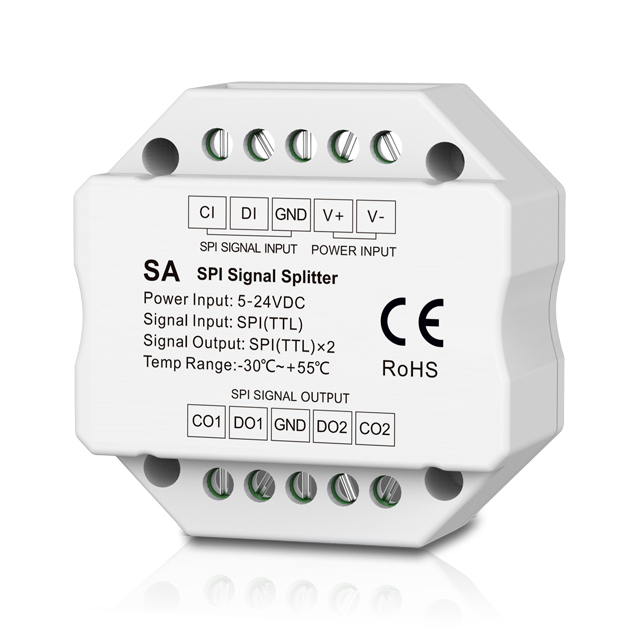
2 productsSkyDance SPI Signal Splitters and Amplifiers are designed to distribute digital SPI signals from one controller to multiple addressable LED strip runs. A 1-to-2 SPI signal splitter distributes one group of incoming SPI signals into two output groups, while a 1-to-6 model provides six independent output connections from one input signal.
Because each output carries the same control data, the connected addressable LED strips can display matching colors, animations, and dynamic lighting effects simultaneously. This makes SPI splitters especially useful for installations involving multiple lighting branches, parallel strip runs, display sections, or separated decorative lighting areas that need to follow the same pixel effects.
**Important:** Always select an SPI splitter compatible with your controller's signal type and LED strip configuration, and provide suitable power to each connected digital LED strip according to its actual power requirements. We offer a wider selection of SPI signal amplifiers in addition to SkyDance.

FAQ About SPI Signal Splitter
Direct answers to the most common technical questions about splitting, amplifying, and wiring addressable SPI data signals on job sites.
An SPI signal splitter takes a single TTL digital data and clock stream from an addressable controller and actively isolates, amplifies, and clones it across multiple output ports. Passive splitting by twisting wires drops voltage logic levels and causes severe signal reflections, turning clean 800 kHz square waves into corrupted pulses. A dedicated splitter reads the incoming pulse stream and reconstructs fresh 5V logic output signals on each branch, letting you drive multiple runs of digital LED strip lights synchronously with zero signal degradation.
An SPI signal splitter cannot output independent animations or distinct pixel addresses across its channels. Because it functions as a hardware signal duplicator, every connected WS2811 LED strip or pixel run receives the exact same data packets at the exact same microsecond. If you send a green chasing dot from pixel 1 to 100, that identical green dot will march down every connected strip simultaneously. When an installation demands unique, independent sequences on each run, you need a multi-universe controller rather than a signal splitter.
An SPI signal splitter works with almost all standard single-wire and dual-wire IC protocols used in addressable lighting. That includes common single-data chips like WS2811, WS2812B, WS2814, UCS1903, and SK6812, alongside dual-wire ICs requiring both data and clock lines like WS2801 and LPD8806. Because the unit acts at the physical TTL electrical layer rather than decoding the raw lighting packets, it simply buffers high-speed pulses up to standard transmission frequencies without needing firmware updates for new chip variants.
Selecting an SPI signal splitter comes down to port count and jobsite physical layout. We list 2 specialized models in this category, engineered to handle 5V to 24V installations. For two parallel runs branching off a single feeder line, our compact 2-way SA unit handles input-to-dual-output distribution cleanly. When you are centralizing distribution inside an equipment rack or feeding radiating architectural lines, the SA6 6-way splitter clones one SPI input across six isolated outputs from a single terminal bank, cutting down enclosure wiring clutter.
An SPI signal splitter requires DC power because its internal high-speed operational amplifiers and buffer ICs actively regenerate the signal. The splitter operates across a wide 5V to 24V DC range, and its supply voltage must share a common ground (GND) reference with both the controller and the downstream LED strip lights. Without a solid ground plane, the 0V reference drifts, causing floating logic thresholds and erratic flashing on the first ten pixels.
Mirroring identical dynamic chases across multiple architectural columns is the primary application scenario for an SPI signal splitter. Instead of running a continuous data line from column to column—which eats up controller address budgets and forces complex reverse-mapping in software—you feed one splitter centrally. Each column connects to its own isolated output port, running upward in perfect synchronization from ground level to cap without timing lag.
An SPI signal splitter reduces effective channel strain without consuming extra pixel memory on your controller. If your controller has an output limit of 1024 pixels, connecting an SA6 splitter allows you to run six separate 1024-pixel LED strip lights—totaling 6144 physical pixels across the room—while the controller processor still only computes and transmits 1024 addresses. This allows massive visual installations without purchasing expensive multi-universe hardware, provided you want synchronized effects.