
Pixel Controller
5 productsBinColor SPI Pixel Controllers for Addressable RGB & RGBW LED Strips
The BinColor Pixel Controller Series offers two main control methods for generating SPI/TTL data signals to drive addressable LED pixel light strip systems:
1. Built-in Program Control: These pixel controllers generate SPI/TTL signals using their own built-in operating modes, allowing users to control addressable LED strips with preset colors, patterns, and dynamic lighting effects without requiring an external master.
When the SPI/TTL signal needs to be strengthened or repeated for longer cable runs or additional LED sections, a compatible SPI signal amplifier can help regenerate and distribute the signal to downstream addressable LED strips.
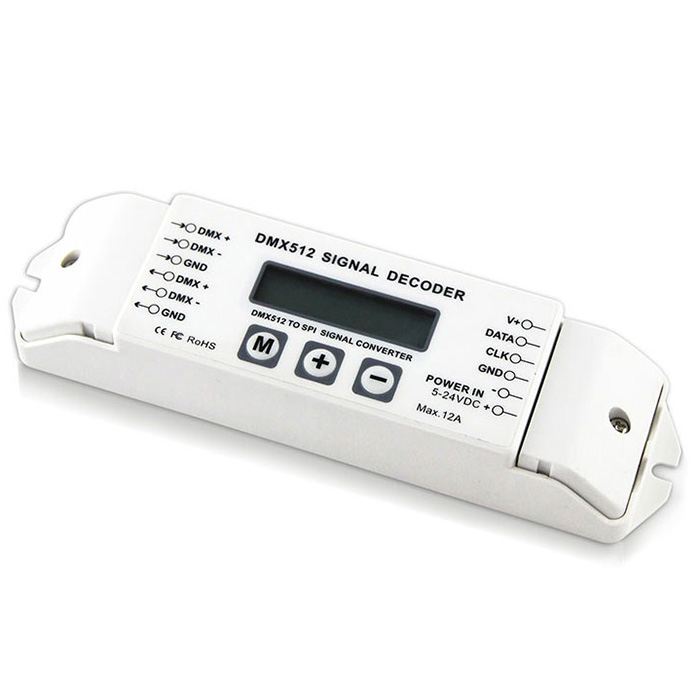
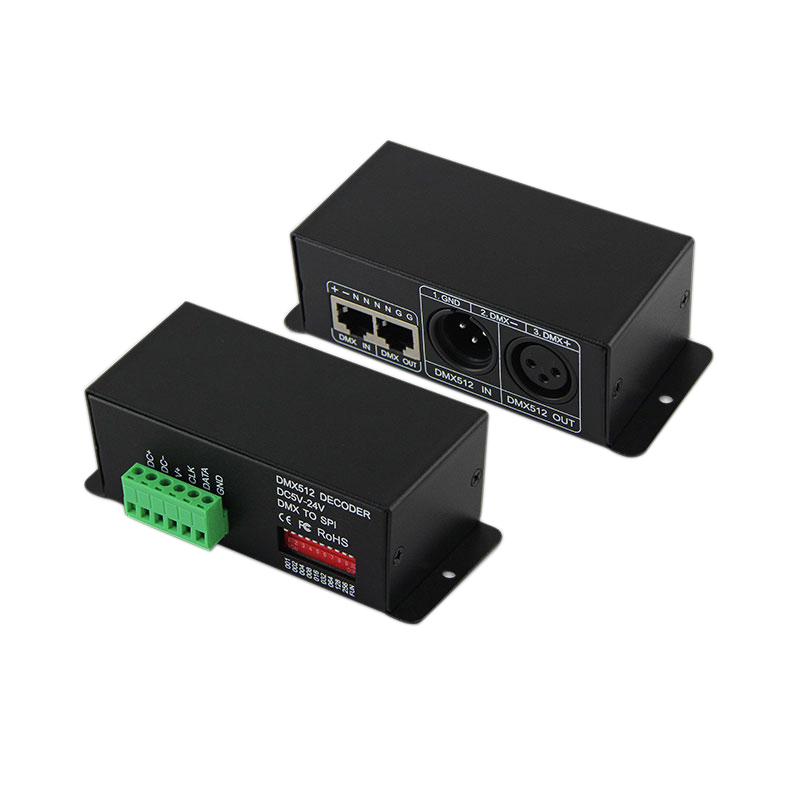
2. DMX Master Control: These controllers receive DMX512 commands from an external DMX master and convert them into SPI/TTL data signals, enabling centralized control of addressable LED pixels through a DMX lighting control system. A single decoder can support up to 170 RGB pixels or 128 RGBW pixels per 512-channel DMX universe.
Both types of BinColor Pixel Controllers are primarily designed for addressable RGB and RGBW LED ICs, supporting various commonly used chip types, including 2811/1809 (UCS1903, UCS2903, WS2811, etc.), WS2801, 2904 (SK6812 RGBW, UCS2904 RGBW), 1814 (TM1814 RGBW). Actual IC compatibility depends on the specific controller model and its supported signal protocol.


BC-LR01 Mini LED SPI Signal Remote Transmitter And Receiver

Frequently Asked Questions About Pixel Controllers
Direct engineering answers on wiring, IC compatibility, DMX conversion, and SPI distance limits for BinColor addressable LED pixel controllers.
To wire an addressable LED strip to a pixel controller, connect DC positive (V+) and DC ground (GND) from your power supply to the controller's power terminals, then connect the LED strip's DATA line to the DATA output terminal and bond the strip's ground to the controller's GND terminal. If your led pixel lights operate on 5V, feed 5V DC into the controller; if your strip runs on 12V or 24V, use a matching 12V or 24V driver. Never power a 5V digital LED strip using a 24V supply through the controller. Always bond all DC grounds together across every auxiliary power injection point, or floating ground voltage will corrupt the SPI data and cause random strobing.
When running addressable LED tape lights from a DMX console, a DMX to SPI pixel controller converts standard DMX512/1990 packet data into high-speed digital SPI/TTL microchip protocols. For example, our BC-802 DMX512 signal decoder decodes 510 DMX channels per unit, which translates directly to 170 individual RGB pixels (510 / 3) or 127 RGBW pixels (508 / 4). The console addresses each led pixel led node as an independent fixture channel, letting you run complex media server matrices, stage cue sequences, and architectural chases across standard addressable LED strip runs without writing custom Arduino firmware.
Dull yellow or reddish tinting at the far end of an addressable LED strip is the classic sign of severe voltage drop, not a failing pixel controller. When all three color dies (Red, Green, Blue) fire simultaneously to produce clean white light, the strip draws maximum current; because red dies require only 1.8V to 2.0V forward voltage while blue and green require 3.0V to 3.2V, the blue and green dies drop out first as voltage sags along the trace. On a 12V strip pulling 14.4W per meter, you will see color shift past 5 meters unless you run parallel 16 AWG or 14 AWG bus wires from your power supply to inject fresh DC power directly into the tail end of the LED strip.
Choose the standalone BC-201 LED pixel light controller when your installation requires dynamic chasing and dream-color effects without an external DMX lighting board or computer running software. The BC-201 includes an integrated digital display, on-board push buttons, and an RF wireless remote to select from built-in speed, pattern, and color presets, driving up to 2,048 pixels directly across WS2811, WS2801, and UCS1903 strips. If your lighting cues must synchronize with architectural wall stations, moving head stage fixtures, or building-wide show schedules, select a dedicated DMX decoder like the BC-802 or BC-820 instead.