
RF Signal Repeater
1 productsRF Signal Repeaters, also known as RF Range Extenders, RF Remote Control Repeaters, or 2.4GHz RF Repeaters, are designed to extend the wireless communication coverage of existing RF lighting control systems.
When an RF remote control or transmitter is too far from the receiving devices, or wireless signals are weakened by walls and other physical obstacles, an RF repeater can receive the original RF signal and retransmit it to extend communication to areas with weaker coverage.
Operating on the same 2.4GHz RF frequency as compatible SkyDance wireless lighting products, these repeaters help improve signal reception and control reliability across larger installations.
They provide a practical solution for extending the operating range of existing RF LED controllers, wireless dimmers, and RF dimmable LED drivers without changing the original lighting control protocol or adding wired signal connections.

What Is an RF Signal Repeater or RF Range Extender?
An RF Signal Repeater is a wireless device that receives and retransmits RF control signals to extend the communication range between a remote controller and its receiving devices.
Unlike an RF-to-WiFi, RF-to-Bluetooth converter, or RF-to-Zigbee bridge, an RF repeater does not translate signals between different wireless technologies. Instead, it works within the existing RF communication system, repeating the original wireless control signals so compatible receivers located farther away can receive control commands more reliably.
It is particularly useful for lighting installations where a single RF remote or control panel needs to operate devices across multiple rooms, larger spaces, or areas with wireless signal obstructions.
Before choosing an RF signal repeater, verify that it operates on the same RF frequency and supports the wireless communication protocol used by your existing controllers, remotes, and dimmable drivers.
How Does a 2.4GHz RF Repeater Work?
A 2.4GHz RF Repeater works as an intermediate wireless communication point between an RF transmitter and remote receiving devices. When the repeater receives a compatible 2.4GHz RF command from a remote control or RF transmitter, it retransmits the signal to help reach RF receivers outside the original transmitter's reliable coverage area.
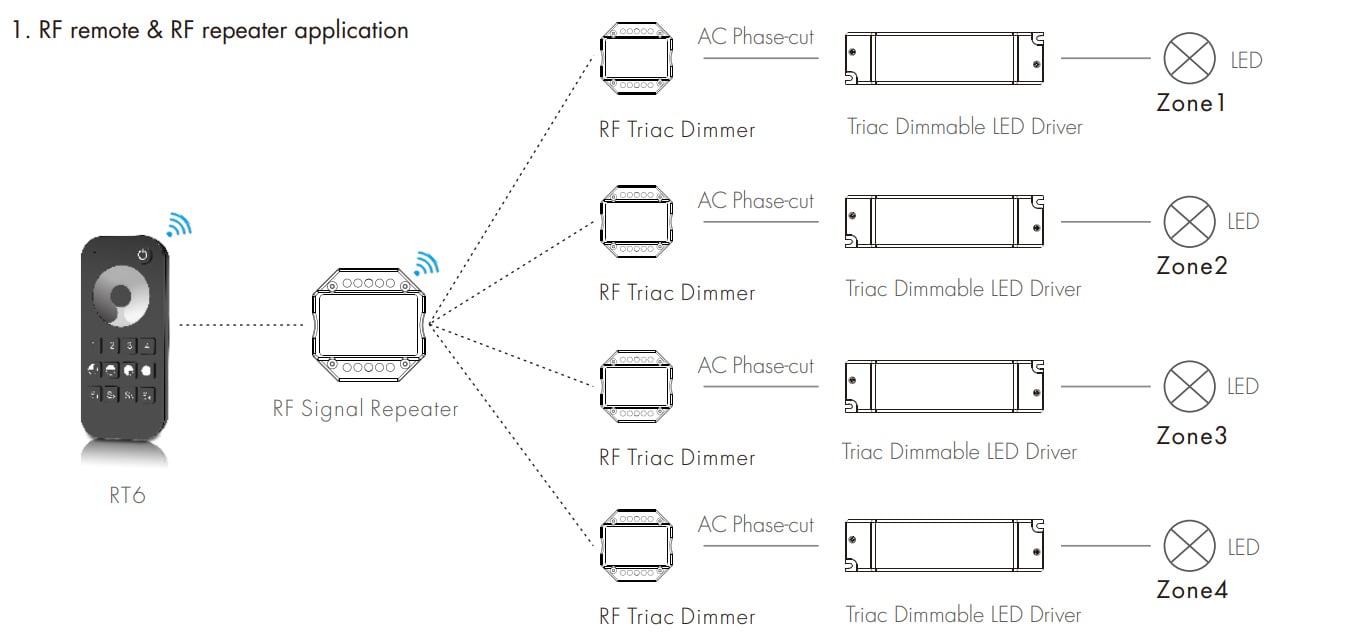
For example, when an RF remote is located in one room and an LED controller is installed farther away behind walls or other obstacles, a strategically positioned repeater can help relay the wireless command toward the remote controller.
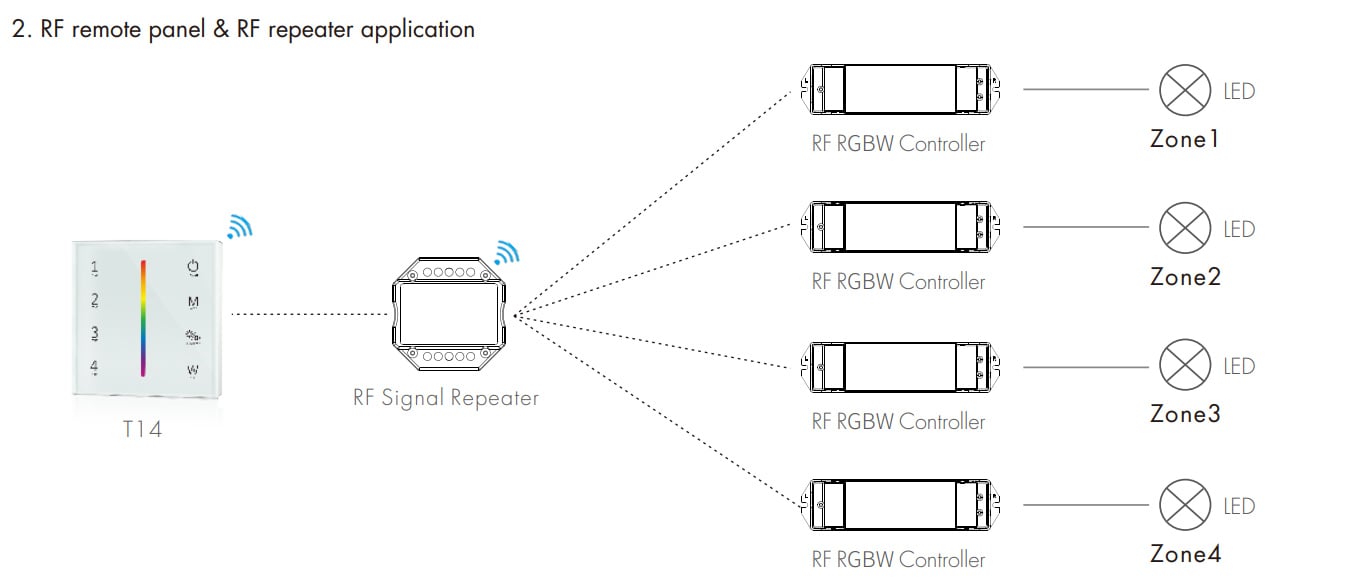
The typical communication path is: RF Remote Control → RF Signal Repeater → Compatible RF LED Controller or Driver → LED Lighting Strip. By extending the wireless communication path, the repeater can help reduce weak-signal areas and improve the responsiveness of compatible RF lighting devices.
How to Install and Position an RF Remote Control Repeater
Installing an RF repeater is generally simpler than extending a wired lighting control system. First, select a suitable power source according to the repeater's rated input voltage. The SkyDance SK-RA supports either AC100-240V or DC12-24V power input.
Next, install the repeater at a suitable position between the RF transmitter and the receiving devices, where it can still receive a reliable RF signal while helping reach areas with weaker wireless coverage. Avoid placing the repeater in locations heavily obstructed by metal structures or other objects that may interfere with wireless communication.
Once powered and installed according to the product instructions, it can receive and retransmit compatible RF signals without requiring additional wired control connections to the LED controllers or lighting loads. For the best results, test remote operation from the actual installation locations.
FAQ About RF Signal Repeater
Direct engineering answers on extending 2.4GHz wireless range, dual-voltage wiring, receiver capacity, and eliminating signal dropouts across large LED strip installations.
An RF signal repeater extends the 2.4GHz wireless control range between your handheld remote or wall panel and your distant LED strip controllers. When drywall, brick, structural steel, or sheer physical distance degrades your wireless signal, LED strip controllers can miss dimming commands or fail to switch in sync. The repeater picks up the incoming 2.4GHz radio frequency packet, reconstructs the data payload, and broadcasts it another 30 meters in open space. It requires no physical data cabling back to the transmitter, keeping your wireless lighting layout clean and responsive.
You can power an RF signal repeater using either line-voltage AC100-240V or low-voltage DC12-24V through its dual-input screw terminals. Unlike sibling signal converters that strictly mandate low-voltage DC feeds, this unit features internal AC mains conversion alongside standard DC terminals. If you mount it inside a drywall ceiling cove near an AC junction, connect line and neutral directly to the high-voltage ports. If you place it inside a cabinet next to a secondary LED driver, wire 12V or 24V from the DC bus into the low-voltage ports instead. Do not wire both inputs simultaneously.
This RF signal repeater works with compatible SkyDance 2.4GHz handheld remotes, wireless wall touch panels, and matching LED strip receivers. It is protocol-matched to 2.4G wireless dimming transmitters running single-color, tunable white CCT, RGB, RGBW, and RGB+CCT formats. It operates specifically on matching modulation protocols, meaning third-party 433MHz remotes, 315MHz garage openers, or unbranded infrared transmitters will not trigger it. If your system already uses SkyDance wireless receivers or RF dimmable LED drivers, this repeater integrates with your existing hand remotes without requiring firmware modifications.
Mount the RF signal repeater at the midpoint between your transmitter and the furthest LED strip receiver, rather than right next to either device. If a handheld remote transmits reliably up to 25 meters through clear interior space, place the repeater at roughly the 20-meter mark. It captures a strong incoming transmission and re-broadcasts another 30 meters onward to the far receiver. Never enclose the repeater inside a grounded metal electrical panel or behind foil-faced insulation, as metallic enclosures block 2.4GHz radio propagation and drastically cut your effective control radius.
One RF signal repeater handles an unlimited number of paired 2.4GHz LED strip receivers within its 30-meter open-air broadcast radius. Because 2.4GHz RF communication uses broadcast packets rather than point-to-point paired connections, the repeater does not store receiver addresses or run out of client memory. Any compatible receiver set to the same zone code picks up the retransmitted signal instantaneously. For sprawling architectural jobs, commercial banquet halls, or multi-story homes, multiple receivers spread across distinct rooms will all track your commands simultaneously from a single retransmitted burst.
A single RF signal repeater adds less than 20 milliseconds of latency, which is imperceptible to the human eye when dimming LED strip lights. The internal logic circuit buffers the 2.4GHz transmission packet and fires it immediately. To avoid signal collision loops, SkyDance protocols handle packet identification so the repeater does not echo its own signal endlessly. However, we advise against stringing more than two repeaters in series down a single line of sight. Chaining too many hops can introduce microsecond timing variance that causes distant LED strip lights to ramp brightness slightly behind nearby fixtures.
Pairing an RF signal repeater takes two seconds by pressing the match key on the repeater housing and immediately tapping any zone button on your remote. When you press the match key, the onboard run indicator flashes to confirm it has entered learning mode. Tapping your remote zone key pairs the transmission address, and the indicator blinks rapidly to verify completion. To clear an existing remote pairing—such as when reassigning hardware during a renovation—press and hold the match key for 5 seconds until the LED flashes 5 times. That resets the unit to factory unlinked status.
An RF signal repeater carries an IP20 rating for indoor dry locations, so outdoor jobs require a non-metallic, weatherproof NEMA junction box. Never house the unit inside a cast aluminum or stainless steel outdoor enclosure, because metallic walls act as a Faraday cage that kills the 2.4GHz wireless signal. Use an IP66 or IP67 polycarbonate, ABS, or fiberglass enclosure instead. Seal your cable glands with silicone, verify that ambient enclosure temperatures remain between -30°C and +55°C, and keep the enclosure elevated away from standing water or ground moisture.
An RF signal repeater retransmits all 2.4GHz RF commands across all programmed zones simultaneously without stripping zone IDs or scene data. If you operate a 4-zone or 8-zone SkyDance remote controlling separate rooms—such as living room cove lighting on Zone 1 and hallway baseboards on Zone 2—the repeater relays the complete command burst intact. Downstream receivers only execute commands addressing their assigned zone. For system design tips on setting up multi-zone wireless networks without signal conflicts, consult our LED strip controller guide for wiring and zoning practices.