
DMX CV Decoder
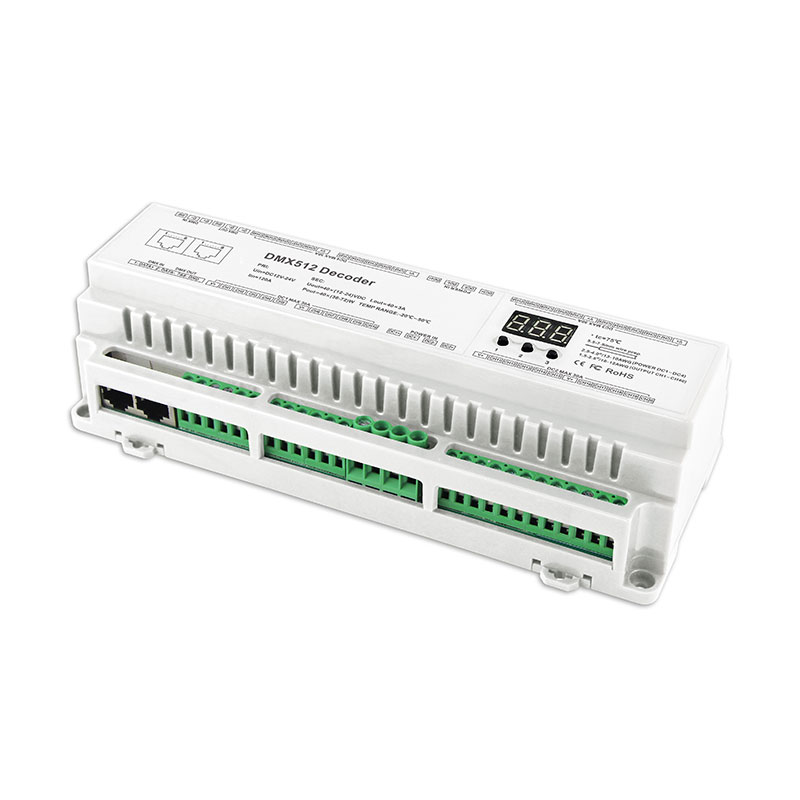
24 productsBinColor DMX Constant Voltage (CV) Decoders – DMX to PWM LED Strip Control
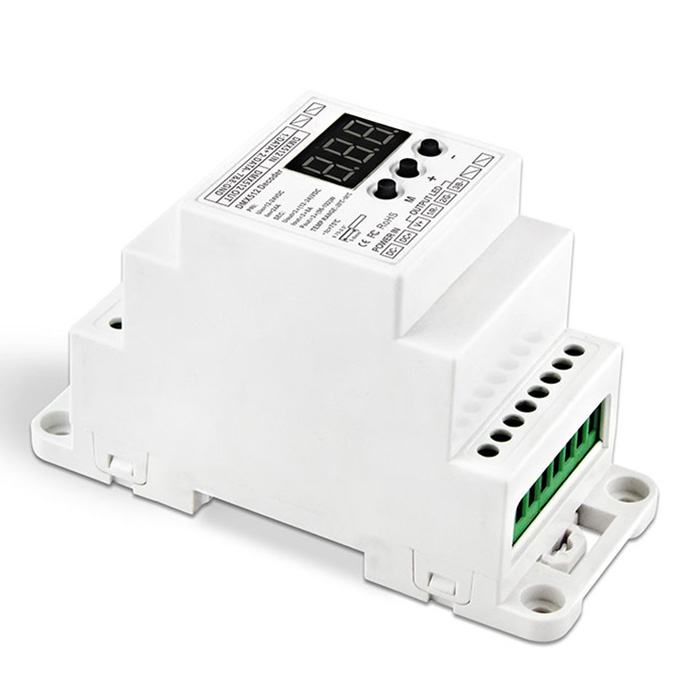
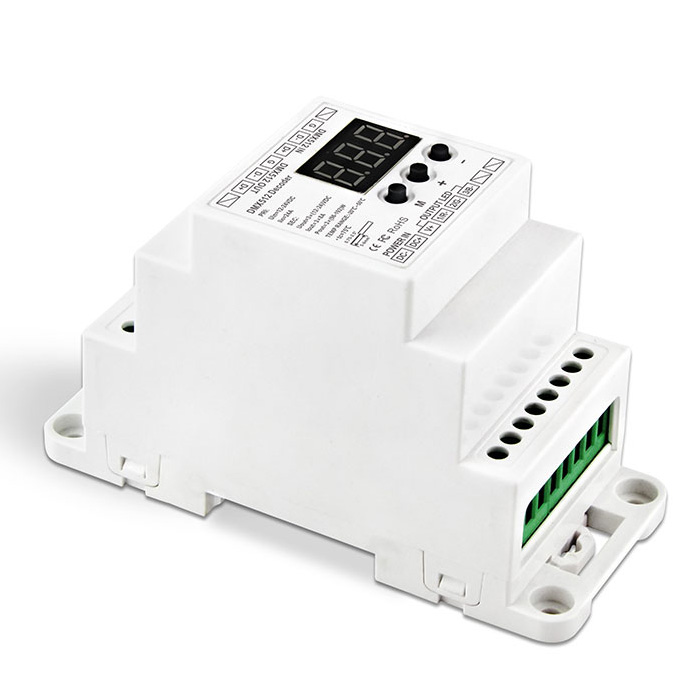
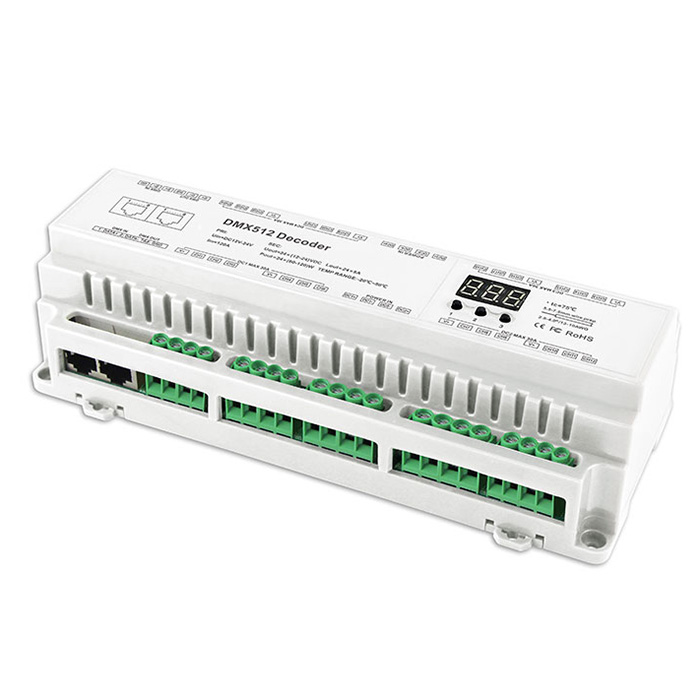
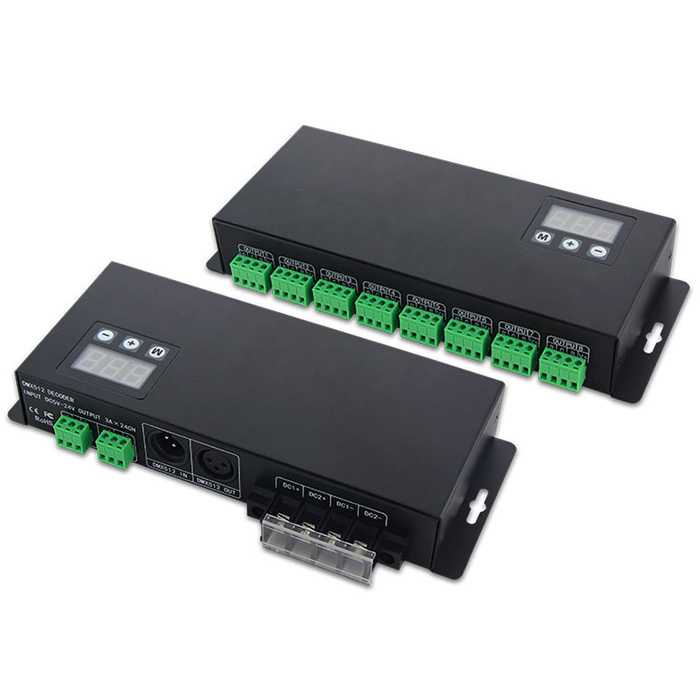
The BinColor DMX CV Decoder Series receives standard DMX512/1990 digital control signals from a DMX master controller and converts them into PWM signals required by LED strip lights and constant-voltage lighting fixtures. This allows flexible LED strips to be integrated into a centralized DMX lighting control system for synchronized dimming, color adjustment, and multi-channel lighting control.
Depending on the model, output channel configuration, and load capacity, a single BinColor DMX CV Decoder can connect to and control multiple LED strip runs, supporting configurations such as:
- 1–40 Runs of Single-Color (DIM) LED Strips: For independent or synchronized brightness control.
- 1–20 Runs of Dual-White (CCT) LED Strips: For warm white and cool white adjustment.
- 1–8 Runs of RGB LED Strips: For full-color mixing through red, green, and blue channels.
- 1–8 Runs of RGBW LED Strips: For RGB color mixing with a dedicated white channel.
- 1–8 Runs of RGBCCT LED Strips: For RGB colors combined with warm white and cool white channels.
The actual number of connectable LED strip runs depends on the DMX decoder's output configuration, current rating per channel, total power capacity, and wiring arrangement. Multiple lighting strips connected to the same output channel will operate together rather than as independently addressable zones.
Most BinColor DMX CV Decoders are designed for DC12V–24V LED strips and fixtures, some can also support wider voltage ranges such as DC5V–24V and DC12V–36V, providing more flexibility for different low-voltage LED lighting installations. Always match the DMX decoder's working voltage with the rated voltage of your LED strips and power supply.







LED Strip Configuration & DMX Control Settings
Configure the BinColor DMX decoder according to your LED strip type and DMX control requirements. Depending on the model, settings can be adjusted through onboard buttons and digital displays, DIP switches, or an RDM-compatible DMX master console. Available configuration options include DMX starting address, output channel mode, PWM frequency, dimming resolution, and dimming curve. Some also support adjustable PWM output frequencies, helping users choose a suitable frequency for their LED strips and lighting applications.
Flexible Installation: Standard Mounting & DIN Rail Mounting
BinColor DMX CV Decoders offer both conventional mounting and DIN rail mounting options to suit different installation environments. Standard models are suitable for general lighting installations, while DIN rail versions provide a more organized and convenient solution for electrical cabinets, distribution boxes, and centralized lighting control panels.
Choose the right BinColor DMX CV Decoder according to your LED strip color configuration, operating voltage, number of output channels, installation method, and DMX control requirements.
FAQ About DMX CV Decoders
Direct answers to real jobsite wiring, sizing, and configuration questions from our technical support desk.
A DMX CV decoder translates standard USITT DMX512 digital packets from your control console into pulse-width modulation (PWM) signals that adjust the brightness of constant-voltage LED strip lights. The console sends an 8-bit or 16-bit digital value between 0 and 255 (or 0 to 65,535) for each channel, and the decoder switches the negative DC output line thousands of times per second to dim the light smoothly. You supply DC power to the decoder's input, hook up your DMX data line to D+, D-, and ground, and connect the positive and negative leads of your LED strip directly to the output screw terminals. For a deeper breakdown of system topologies, check our DMX strip control guide.
An LED DMX decoder handles wattage based entirely on its rated amperage per channel multiplied by your DC input voltage, minus a 20% safety margin. For example, our 4-channel BC-834 decoder delivers up to 5A per channel (20A total). On a 12V power supply, that yields 240W total (60W per channel), but stepping up to a 24V supply doubles that capacity to 480W total (120W per channel) without increasing heat or amperage inside the unit. Never size your power supply or decoder right at 100% continuous load; running at 80% maximum capacity prevents thermal throttling during all-white, full-brightness scenes.
Camera flicker happens when your DMX CV decoder operates at a PWM switching frequency lower than the camera shutter speed, creating visible scan bands. Standard entry-level decoders pulse at 200 Hz to 500 Hz, which looks stable to the human eye but stutters severely on 60 fps or 120 fps video. High-spec models like our BC-632-DIN feature selectable high-frequency PWM modes up to several kilohertz alongside 65,536 gray scales (16-bit dimming resolution). Raising the PWM frequency eliminates rolling shutter artifacts in broadcast studios, retail displays, and film production setups.
Yes, an LED DMX decoder with 5 physical output channels controls RGBCCT LED strip lights seamlessly by assigning each color chip an independent DMX address. You wire the common positive lead of the strip to the decoder's V+ terminal, then land Red, Green, Blue, Warm White, and Cool White on channels 1 through 5. Setting your starting DMX address to 001 maps the console's faders 1 to 5 to those colors, giving you full-gamut RGB color mixing alongside independent Kelvin temperature tuning from 2700K to 6500K.
Standard DMX CV decoders carry an IP20 rating and must stay inside a sealed NEMA enclosure, but dedicated waterproof models like our BC-804-WP are engineered specifically for IP67 outdoor exposure. The BC-804-WP uses a potted aluminum housing with waterproof cable glands to block moisture ingress around terminal leads in garden, patio, and facade installations. Pair it with sealed weatherproof 24V power supplies to ensure the entire power and signal path withstands driving rain and high ambient humidity.
An LED DMX decoder with 8-bit resolution splits the dimming range into 256 discrete brightness steps, whereas a 16-bit decoder uses two DMX channels per color to deliver 65,536 steps. The difference is imperceptible above 50% brightness, but between 0.1% and 5% brightness, 8-bit decoders produce visible micro-stepping jumps during slow architectural crossfades. Our high-channel DIN units feature 16-bit micro-stepping curves, ensuring that theatrical fades, hospitality scene transitions, and slow night-time dimming ramps transition without visible stepping.
If you short the positive and negative output leads on a DMX CV decoder, modern onboard protection circuits immediately clamp the output channel to prevent MOSFET destruction. Once the physical short circuit or pinch in the LED strip light is located and repaired, the decoder automatically recovers and resumes normal dimming without blowing an internal fuse or requiring a hard factory reset. However, sustained external overcurrent can cause localized overheating; always verify that your total connected wattage does not exceed the printed channel amp rating.
You can manage 40 independent single-color LED strip zones by deploying our high-density BC-640-DIN 40-channel decoder, which addresses 40 separate DC channels within a single DIN-mount footprint. Setting the BC-640-DIN to 1-channel DMX mode assigns consecutive DMX addresses 001 through 040 to each terminal, allowing your console to independently dim 40 display cases, cove segments, or stair risers without stacking a dozen separate decoders.