
RF LED Controller
4 sub-categoriesThe MiBoxer (Mi-Light) RF LED Controller series is primarily designed to control LED strip lights. These wireless LED controllers use 2.4 GHz signals and can communicate with each other within a 30-meter range, making them ideal for indoor multi-zone lighting projects.
A key feature of the MiBoxer (Mi-Light) product line is that a single LED strip controller can support different color control modes, such as:
- A 2-in-1 controller can control single-color LED strips in single-color mode and adjustable white LED strips in dual-color mode;
- A 3-in-1 controller can control RGB strips in RGB mode, RGBW strips in RGBW mode, and RGBCCT strips in RGBCCT mode.
SuperLightingLED is always committed to providing our customers with the best LED strip lighting solutions.

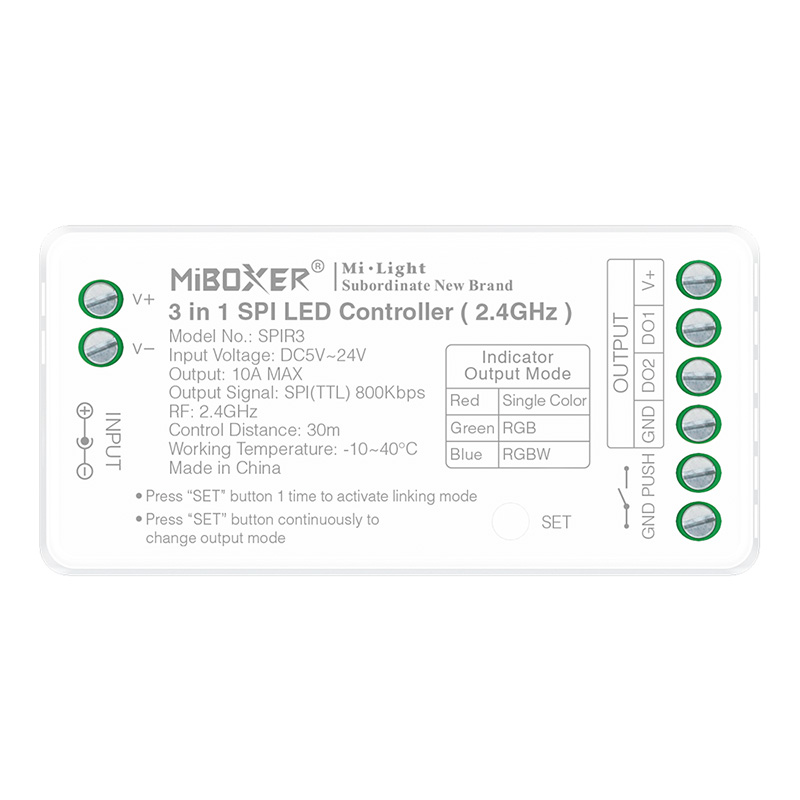
Addressable SPI RGBIC LED Strip Controller
Miboxer SPI LED controller is designed for controlling pixel addressable led strip including single color, RGBW, RGB addressable LED strip. High-density Pixel Dots can be managed by addressable RGB LED controllers, which is supports single color (2048), RGB (1536), and RGBW (1024) configurations. SPI RGB LED controllers transmit the SPI signal to the compatible IC chip of the SPI LED strip to realize the control of addressable LED rope. The compatible chips include TM1809, SK6813, UCS1903, UCS1909, WS2811, WS2813(RGBW), WS2814(RGBW), etc. Adopting 2.4GHz RF wireless transmission technology, Miboxer SPI Pixel controller is compatible with Miboxer SPI remote control to adjust mode, color, brightness, on/off time and edit dynamic mode of led pixel strip within 30 meters control distance.

Wireless LED Controller
These Mi-Light RF Series Controllers cover a wide range of color options for low-voltage DC12-24V or DC12-48V LED strips, from single color to adjustable white to RGB to RGBW to RGBCCT. Choose the corresponding controller type based on the color of your light strip.
Product spec sheets & downloads

LED Controller Set
Smart (set) LED strip control system is our Mi-light developed high-end LED controller controlled by wireless remote controller, also with smart phone control and 4G long distance control(2.4GHz gateway is needed). The controller has auto-transmitting and auto-synchronizing function and with RGB,RGBW and RGB+CCT output mode.
This controller adopt the widely used 2.4GHz wireless technology with the features of low power consumption, long signal transmitting and strong anti-interference, etc. One compatible remote control many controllers at the same time. Widely used on the controlling of hotel lighting and home lighting.
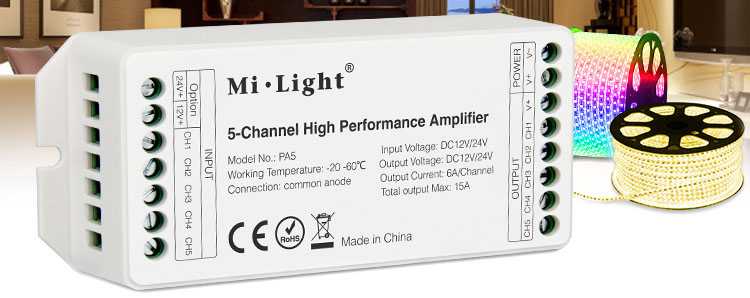
LED Strip Amplifier
Low voltage LED strip lights are often affected by voltage drop and signal attenuation, especially when the LED strip length is long. This normally leads to signal weakening, making the LED lighting effect uneven or out of control. In this case, we need to use LED strip light amplifiers.
MiBoxer Mi-Light led light strip amplifier adopts a high-speed optical coupler with a 10Mbps output rate; it can output the signal of the main controller completely and synchronously. These high-performance led strip amplifiers work on all PWM series LED controllers in the market.
Made from the big current MOSFET to assure the high rate output. Every time you add one more led strip amplifier, you can connect twice as many as LEDs. Theoretically, it can connect countless amplifiers, input and output are with optoelectronic isolation. Working with the main controller can satisfy the application requiring large power, wide range, and synchronization area.
Best-selling RF LED Controller
1–20 of 178 products
APP Home Matter Controller For LED Strip Lights (WiFi + RF)


 (1)


Important Compatibility Notes for X-in-1 LED Controllers
Supporting multiple lighting modes does not mean that one controller can operate different types of LED strips simultaneously. A single LED strip controller cannot be connected to both single-color and adjustable white or other colors lights simultaneously.
Each controller must be configured for the correct mode and connected to the corresponding LED strip type. Always check the individual product specifications before choosing your controller.
Designed for Compatible MiBoxer (Mi-Light) 2.4GHz RF Remotes
To ensure reliable pairing and operation, these controllers are designed to work with compatible MiBoxer (Mi-Light) 2.4GHz RF remote controls. **Not every 2.4GHz remote is compatible**—sharing the same wireless frequency does not necessarily mean that two devices use the same communication protocol.
When selecting a remote, make sure it is listed as compatible with your specific controller model. For multi-zone lighting projects, check the supported zones, pairing instructions, and wireless transmission or signal-retransmission specifications to build a practical and reliable control system.
Product spec sheets & downloads
Frequently Asked Questions About RF LED Controllers
Direct answers to common wiring, pairing, and sizing questions on 2.4 GHz RF LED controllers from our technical support desk.
An RF LED controller receives radio frequency signals at 2.4 GHz from a handheld remote or wireless wall panel to adjust brightness, color temperature, or RGB color on low-voltage LED strip lights. Unlike older infrared controllers that need direct line of sight, 2.4 GHz radio signals pass through standard building materials like drywall, cabinet timber, and glass up to 30 metres away. The controller sits between your constant voltage power supply (typically 12V, 24V, or 48V) and your LED tape light, regulating the output using rapid pulse-width modulation (PWM).
No, sharing the 2.4 GHz wireless frequency does not mean two devices use the same transmission protocol. A miboxer/mi light RF controller only responds to remotes and wall panels encoded with MiBoxer's specific RF protocol. Third-party 2.4 GHz remotes, generic Tuya remotes, or wireless mice operate on different data packets and will not link. Always verify the remote compatibility chart on the receiver's spec sheet before ordering, or pick a matching pre-bundled set.
One RF LED controller can power as many metres of LED strip lights as its rated amperage allows, which depends strictly on the strip's wattage and working voltage. Take a standard 12A controller on a 24V system: that gives you 288W of total headroom. If your LED tape light draws 14.4 W/m, you can run roughly 18 to 19 metres total before maxing out the receiver terminals. When your layout exceeds the controller's current ceiling, do not overload the terminals; splice in LED strip amplifiers to extend capacity safely across multiple feeds.
Three slow flashes when you apply DC power simply indicate that the receiver successfully linked to a paired remote or wall panel. If the connected LED strip lights flash rapidly or shut down repeatedly, that is the controller's built-in overcurrent or low-voltage protection tripping. Check your DC power supply voltage with a multimeter under load; if a 24V strip pulls the supply down below 21V, the controller reboots continuously to protect its internal circuitry.
When multiple RF LED controllers are set to the same zone, each receiver automatically retransmits the remote's 2.4 GHz command to any neighboring receiver located within 30 metres. This creates an automatic wireless daisy chain across long commercial hallways or multi-room perimeters without requiring extra signal repeaters. Controllers in the same zone also use auto-synchronization on dynamic modes, meaning color-chasing fades stay locked in step even when running across dozens of separate physical units.
A miboxer/mi light RF controller displays reversed colors when the output mode does not match your strip's pinout or the channel leads are swapped. Power off the system, confirm that the common positive lead sits in the V+ terminal, match each color channel to its labelled terminal (R, G, B, W, etc.), and tap the controller's mode switch to confirm it is operating in your color.
Audible buzzing from an RF LED controller usually happens when the pulse-width modulation frequency causes mechanical resonance in the internal inductors or capacitors of a low-cost power supply. It almost always occurs between 10% and 50% brightness where the PWM duty cycle creates rapid current switching pulses. To cure the noise, swap to a commercial-grade, potted power supply with clean filtering, or choose one of our MiBoxer controllers featuring high-frequency 20 kHz PWM output, which pushes switching oscillations well outside the range of human hearing.