
Dimming Signal Converter
7 productsThe BinColor Dimming Signal Converter Series is designed to solve compatibility issues between different lighting control systems by converting one dimming signal format into another. These converters allow lighting equipment with different control interfaces to work together, making it easier to integrate various LED drivers and fixtures into a centralized lighting control system.
The series includes several types of signal conversion solutions:
- DMX512 to 0-10V / PWM Conversion: Converts one DMX512 input signal into 4 or 5 channels of 0-10V analog signals, 5V PWM signals, or 10V PWM signals. This allows DMX master controllers to control compatible 0-10V or PWM-dimmable LED drivers and lighting equipment.
- DALI to 0-10V / PWM Conversion: Converts one DALI input signal into 4 or 5 channels of 0-10V analog signals, 5V PWM signals, or 10V PWM signals. This makes it possible to integrate compatible 0-10V or PWM-controlled lighting equipment into a DALI lighting control system.
- 0-10V to PWM Conversion: Converts 4 channels of 0-10V analog dimming signals into 4 corresponding channels of 5V or 10V PWM signals, allowing 0-10V control systems to operate compatible PWM-dimmable LED products.
With different input and output signal options, SuperLightingLED BinColor Dimming Signal Converters provide flexible solutions for integrating DMX512, DALI, 0-10V, and PWM-based lighting systems. They are suitable for commercial lighting, architectural projects, and other installations where different dimming technologies need to work together.
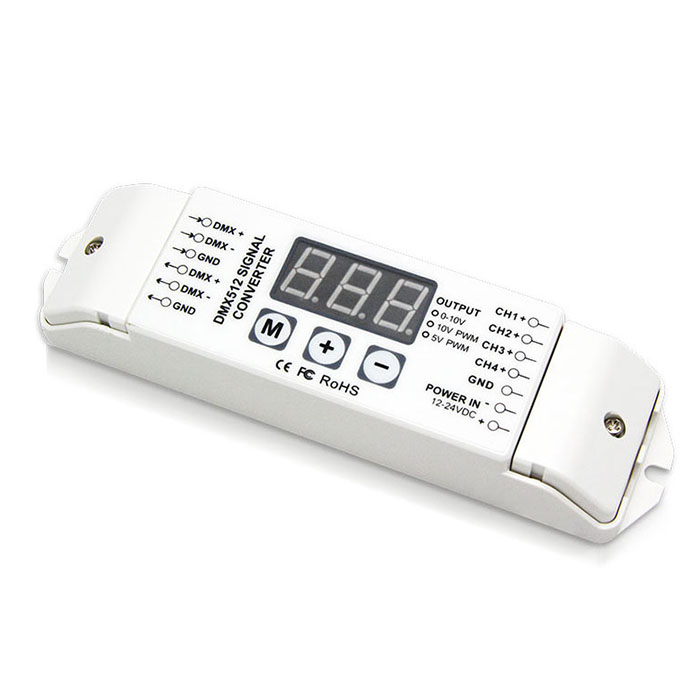
DMX512 to 0-10V Converter BC-834-010V - 4-Channel PWM Output
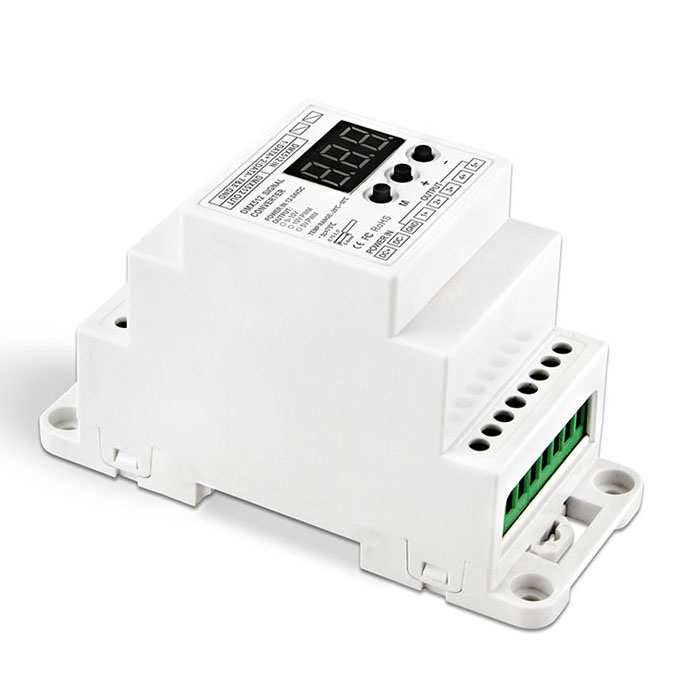
DMX512 to 0-10V Converter BC-835-010V-DIN-RJ45 - 5-Ch DMX DIN Rail
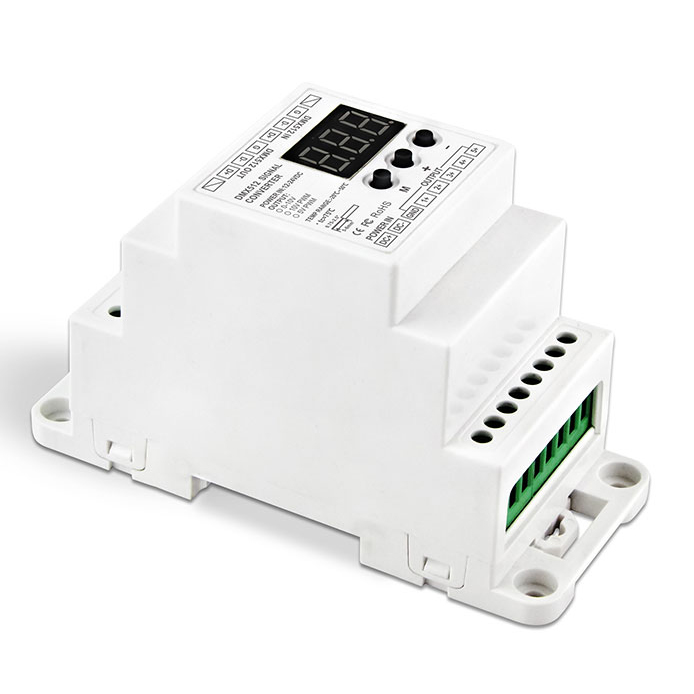
DMX512 to 0-10V LED Converter | DIN Rail Mount | DC12-24V
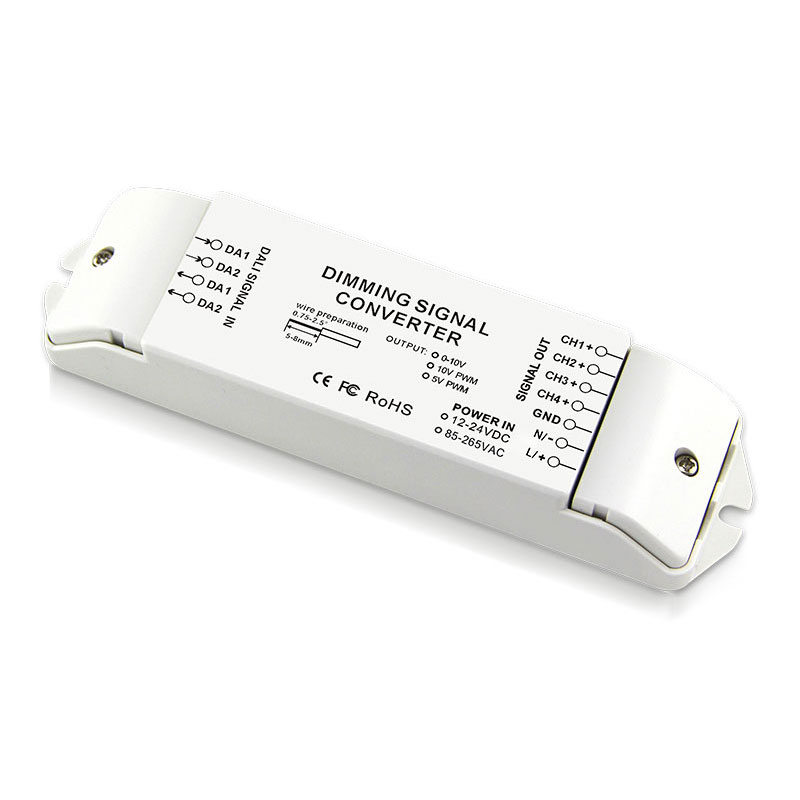
DALI Signal Converter BC-344-HV-PWM/010V - 0-10V Analog & PWM Output
DALI to 0-10V Converter DC12-24V - DIN Rail Mount | IEC62386
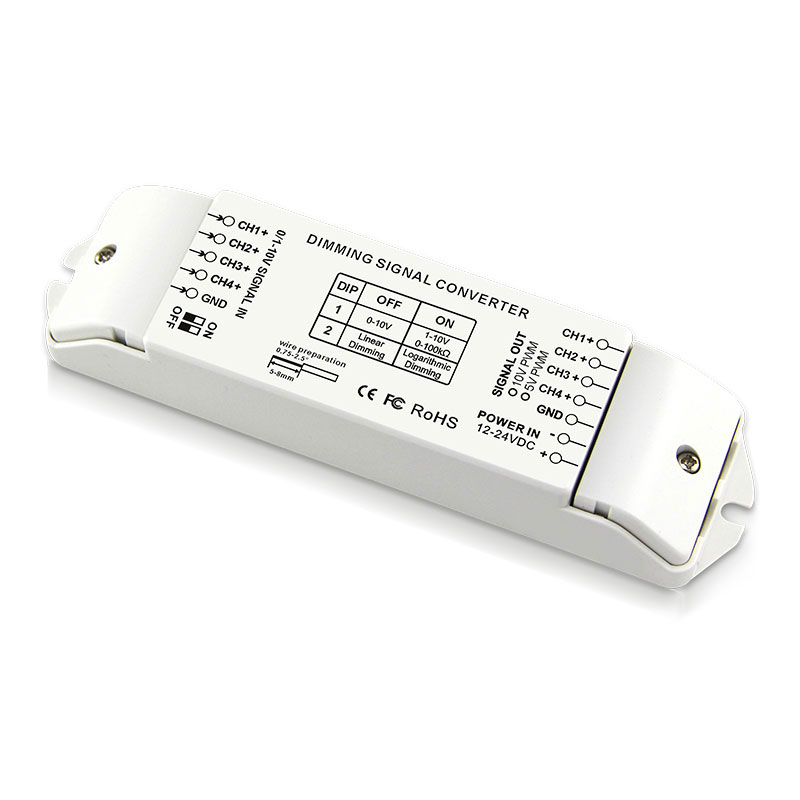
0-10V/1-10V to PWM Signal Converter - 5V/10V Output | BC-334-PWM
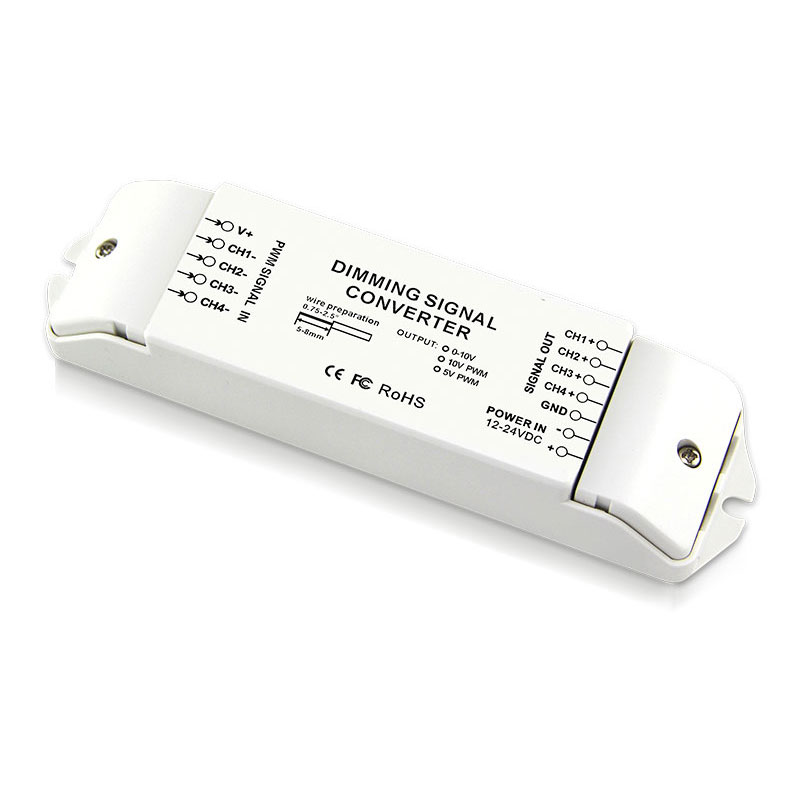
PWM to 0-10V Converter BC-964-PWM/010V - Optical Isolation Signal
FAQ About Dimming Signal Converters
Direct answers to technical wiring, protocol translation, and driver compatibility questions from our pre-sales engineering desk.
A dimming signal converter translates one lighting control protocol into a completely different format so incompatible devices can communicate. For example, if your architectural lighting board outputs digital DMX512 or DALI signals, but your commercial fixtures only accept 0-10V analog voltage or 10V PWM, this module converts the data in real time. It bridges protocol gaps without requiring you to tear out existing fixtures or buy new power supplies.
Selecting the right output on your dimming signal converter depends entirely on what your destination LED driver expects at its dimming terminals. Standard commercial drivers with purple and gray (or pink) wires generally expect a variable 0-10V DC voltage or current sinking. If your driver specifically lists 10V PWM logic input to combat low-end color shift on LED strip lights, set the onboard DIP switches to 10V PWM instead.
Yes, a DALI dimming signal converter like the BC-345 assigns independent DALI short addresses to each of its 4 or 5 output channels. On a single pair of DALI bus wires running IEC62386 protocol, the converter responds as distinct digital addresses, allowing you to dim multiple 0-10V architectural zones independently from one cabinet location. For a closer look at how DALI addresses and groupings work in practice, read through our guide to DALI control.
Every DC dimming signal converter in our range runs on standard DC12V to DC24V auxiliary power, requiring roughly 1W to 2W of idle power for its internal micro-controller. You can tap into the same 12V or 24V power supply driving your secondary lighting equipment, provided the voltage remains clean and stable. Do not feed AC line power into DC terminals; for high-voltage cabinets, select dedicated AC-input versions like the BC-344-HV.
You select linear or logarithmic output on a dimming signal converter using the onboard two-position DIP switches before powering up the unit. Human eyes perceive light logarithmically, meaning a 10% measured voltage drop appears like a 32% perceived drop in brightness. If you are dimming architectural LED strip lights for ambient coves, choose the logarithmic curve for smooth, natural dimming; if you are feeding industrial test equipment or automated machinery, choose the linear curve.