
PWM CV Power amplifier
12 productsIn led strip light applications, sometimes the output of the led controller may not be enough to drive all your led strips. In this case, you can use a constant voltage power amplifier to amplify the controller's output to ensure that enough power is delivered to all the led strips. And the led light strips are all under the same control system.
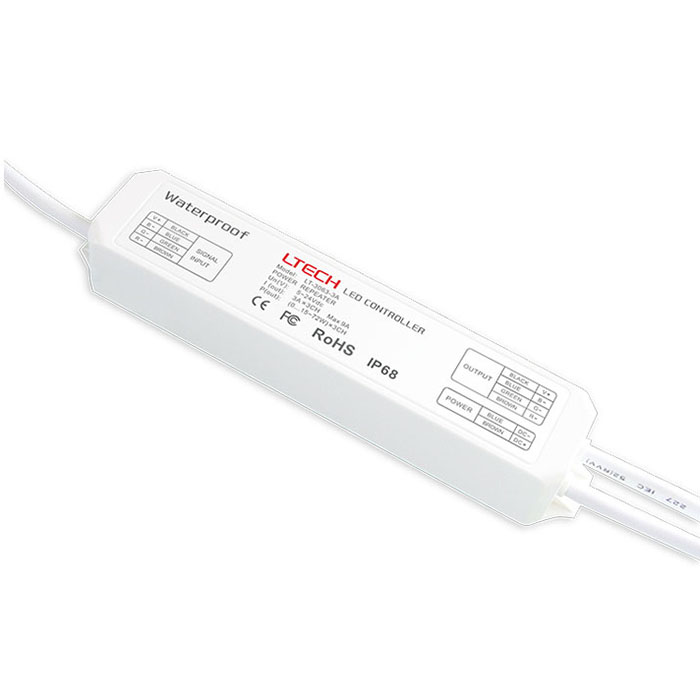
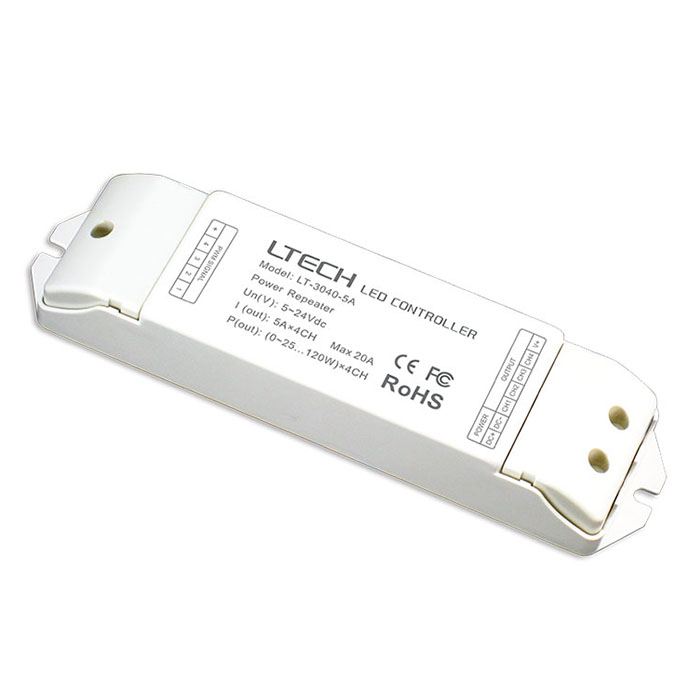
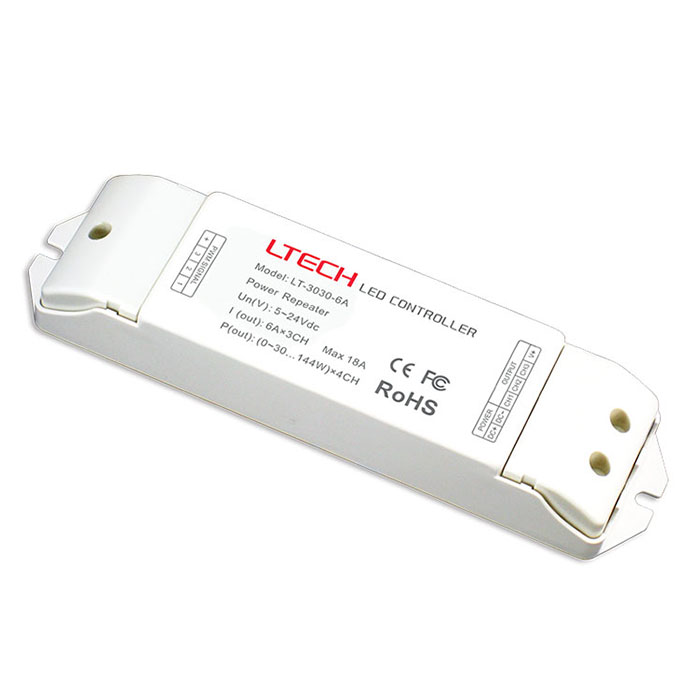
These Ltech PWM LED Strip Light Constant Voltage Power Amplifiers with 1CH, 3CH, or 4CH color output for different led types.




FAQ About PWM CV Power Amplifiers
Direct answers to real jobsite wiring, sizing, and compatibility questions from our technical support desk.
A PWM CV power amplifier monitors the pulse-width modulation duty cycle coming off your primary LED controller's output terminals. Instead of drawing substantial current from that master controller, the amplifier's optocoupler input samples the high-speed switching pulses with less than 20 mA of load, then replicates those exact on-off cycles using power from a secondary power supply. Because the signal is regenerated rather than merely split, your LED strip lights stay completely synchronized without dimming lag, no matter how many repeaters you deploy.
The load capacity of a PWM CV power amplifier depends on your operating voltage and the channel rating of the unit. For example, a 3-channel 5A model like our LT-3060S handles 15A total, delivering up to 180W at 12V or 360W at 24V across its terminals. If you need single-run brute force, a 12A single-channel unit delivers 288W at 24V. Always derate your connected LED strip lights by 20% against the repeater's maximum threshold to keep internal MOSFETs running cool during continuous duty.
Every standard PWM CV power amplifier in our lineup uses a common positive (anode) terminal topology. That means you connect the shared V+ line from your master controller to the signal input V+, while the channel switching occurs entirely on the negative (cathode) lines. If you wire a common-cathode fixture into these terminals, the LEDs will stay permanently energized at 100% or short out the amplifier's internal driver stage immediately.
PWM CV power amplifier flicker almost always stems from a loose signal reference wire or severe voltage drop on the DC input supply. If the power supply feeding the amplifier dips below its minimum operating voltage under heavy current draw, the internal optocouplers lose threshold sync and chatter. Check the output with a multimeter under load; if voltage sags by more than 1.5V, upgrade your feed cabling or move the DC power source closer to the amplifier terminals.
No, a PWM CV power amplifier with optically isolated signal inputs does not require a common DC ground connection between separate power supplies. In fact, keeping the power supply DC negatives isolated helps eliminate ground loops and line noise across sprawling commercial runs. All the amplifier requires is the direct positive and negative PWM output pair coming from the master controller's fixture terminals to trigger its input phototransistors.
This issue occurs when signal input polarity is reversed on the PWM CV power amplifier or if the master controller uses common-cathode switching. Because our repeaters operate on common anode (+), connecting the controller's positive rail to a channel negative terminal keeps the internal switching transistors permanently saturated. Verify that your controller V+ lands squarely on signal V+ and that each negative channel aligns precisely with CH1, CH2, or CH3.