
RGB Fiber Optic Engine
23 productsRGB fiber optic light illuminator sources display RGB color-changing light mode on fiber optic cables, suitable for atmosphere lighting or creating artwork with fiber optics, such as LED fiber optic tree lights, LED fiber optic star ceiling lights, LED fiber optic pool lighting, etc. Different types of RGB fiber optic light engines have different powers, heads, and control methods (button remote, touch remote, IR remote control, RF remote control, Bluetooth, Tuya WiFi APP control). You can browse and choose according to your actual needs.
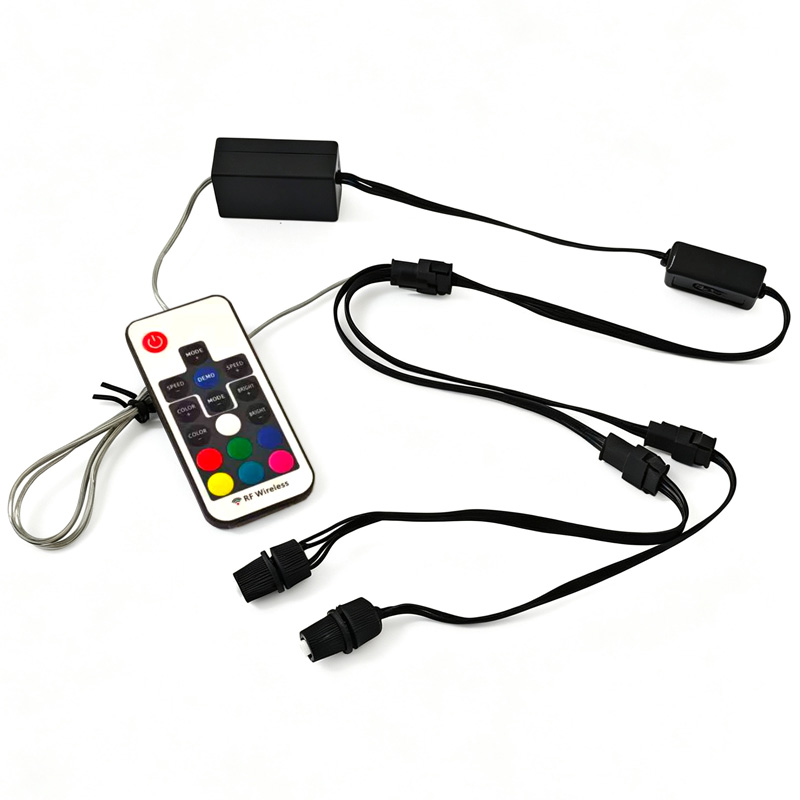
DC5/12V IR Remote RGB LED Fiber Optic Light Source Illuminator

DC12V 6 Heads Bluetooth RF RGB LED Fiber Optic Illuminator

Bluetooth RF RGB/White Shooting Star Fiber Optic Light Engine


16W Tuya WiFi RF Controlled RGB Fiber Optic Light Engine

Car & Bedroom Twinkle RGBW LED Fiber Optic Star Light Illuminator

DC12V Double Head 32W Tuya RF RGB Fiber Optic Light Source

45W RGB LED Fiber Optic Light Engine With 20 Keys Remote Control

Commercial 45W DMX Fibre Optic LED Starry Ceiling Light Machine

DMX-Controllable 45W RGB Optical Fibre LED Star Ceiling Projector

45W/90W Weatherproof RGB Fiber Optic Light Source Machine


High-Power 100W RGB LED Fiber Optic Light Engine Driver

FAQ About RGB Fiber Optic Engine
Kevin answers real jobsite questions on sizing, wiring, DMX integration, and optic coupling for our RGB fiber optic light engines.
An RGB fiber optic engine is a specialized illuminator that focuses red, green, and blue solid-state emitter output into an optical coupling port to inject color-mixed photons straight into optical fiber strands. Unlike standard rgb lighting fixtures, the engine stays in an equipment closet or ceiling void while the strands transmit cold illumination with zero electricity or thermal radiation to the star points. It gives you 3-channel primary color mixing for high-saturation dynamic effects across ceilings, displays, and sensory spaces.
RGB fiber optic engine units mix equal intensities of red, green, and blue diodes to render white, which yields a composite daylight white around 6000K to 6500K with a slight cool tint. If your project demands a dedicated, soft 3000K or 4000K natural white alongside rich color accents, step up to our RGBW fiber optic engines which incorporate a dedicated fourth phosphor-converted white emitter channel. Mixing RGB for white works reliably for starry sky backdrops, but dedicated white chips deliver a much higher color rendering index for high-end residential ceilings. We stock both formats so you can match the precise color balance your client expects.
The maximum capacity of an RGB fiber optic engine depends entirely on the cross-sectional area of the coupling head aperture compared to your fiber diameter. A 20mm coupling port provides 314 mm² of raw area, which comfortably holds up to 600 strands of 0.75mm fiber or 300 strands of 1.0mm fiber when allowing for standard mechanical packing friction. Step up to our 30mm coupling heads and your capacity jumps to roughly 1,350 strands of 0.75mm fiber or 700 strands of 1.0mm fiber. If you need massive fiber counts across wide rooms, choosing our dual head 32W illuminator doubles your termination capacity to 1,200 strands of 0.75mm line without stressing a single optical harness.
Yes, five of our RGB fiber optic engine models feature integrated 3-channel DMX512 decoding boards with native XLR or terminal block inputs. You assign the base DMX address using the onboard DIP switches or digital numeric display, letting your stage board, architectural touch panel, or building automation system command Red on Channel 1, Green on Channel 2, and Blue on Channel 3. If your project utilizes central architectural control networks, our DMX fiber optic engines interface directly with commercial desks to sync fiber starry ceilings with perimeter RGB flexible LED strip lights without requiring external signal converters.
Input voltage is strictly dictated by the engine driver board: 7 of our catalog models run on native 12V DC, while 2 high-output industrial models operate on 24V DC, with remaining units taking universal 85-265V AC. Compact 6W to 16W units run on 12V DC, making them ideal for mobile 12V vehicle cabins, marine consoles, or small residential bulkheads. Higher-wattage 75W to 90W commercial engines require 24V DC to handle the heavy current draw while keeping internal driver operating temperatures low. Always verify the chassis label before energizing; feeding 24V into a 12V engine burns out the internal step-down regulator within seconds.
Standard indoor models carry an IP20 rating and must stay dry, but our weatherproof 45W fiber optic light source is built specifically in an IP65 stainless steel enclosure for outdoor installations. The primary engineering benefit of fiber optics around water is safety: the light engine and AC mains remain completely dry inside an equipment closet or weatherproof enclosure, while non-conductive, unpowered fiber bundles route safely into wet soil, swimming pools, fountains, and wet spa zones. Just remember that IP65 enclosures must maintain an ambient airflow perimeter so heat sink fins can dissipate thermal energy freely.
An RGB fiber optic engine relies entirely on solid-state chip modulation to adjust colors, chase sequences, and dimming curves, while twinkle engines add an internal mechanical perforated wheel driven by a stepper motor. That mechanical wheel physically slices the light cone across adjacent fiber strands, generating a rapid, organic shimmer that mimics atmospheric stellar flicker. Our twinkle fiber optic engines are dominated by RGBW layouts built specifically for night sky ceilings, whereas standard RGB engines provide smooth, solid saturation and linear chasing that excel in architectural art, backlighting, and dynamic cove illumination.