
Triac Dimmer
6 productsLTECH TRIAC Leading-Edge or Trailing-Edge ELV Dimmers & Modules
Backed by a 5-year warranty, LTECH TRIAC dimmers and units are designed for dependable lighting control and long-term performance. With CE and RoHS certifications, along with additional certifications on applicable models, these products in SuperLightingLED offer a reliable choice for residential and commercial dimming applications.
From Traditional Wall Dimmers to Smart Wireless Control
LTECH offers a versatile range of TRIAC light dimmers, from conventional hardwired wall dimmer panels to modern wireless dimmer modules. Whether you prefer direct wall control, RF wireless remote operation, or Bluetooth 5.0 SIG Mesh smart lighting integration, you can choose a control solution that fits your installation and lifestyle.
Choose the right phase-cut dimming technology for your LED lighting and build lighting system. LTECH offers leading-edge TRIAC and trailing-edge ELV dimmers and modules, with selected models supporting both dimming methods for greater installation flexibility. Since compatibility varies by model, always check the specified dimming type and ensure it matches your dimmable LED lights, incandescent bulbs, and halogen lighting.


More TRIAC & ELV Dimming Solutions at SuperLightingLED
Looking for more TRIAC and ELV dimming options? MiBoxer / Mi-Light offers additional phase-cut dimmers, with Push-button dimming available on selected models, alongside RF wireless, Wi-Fi, and Zigbee control options.
If you haven't found the right dimmer in our LTECH range, explore the SkyDance TRIAC Dimming System for more choices. Check each model's leading-edge or trailing-edge compatibility and additional functions to find the right solution for your lighting project.
FAQ About Triac Dimmer Controls
Direct engineering answers on phase-cut dimming, wiring modules, leading vs trailing edge compatibility, and line-voltage loads.
A Triac dimmer is an AC line-voltage controller that dims lighting by chopping out portions of each alternating current half-cycle, a technique known as phase-cut dimming. By clipping the AC sine wave—either at the front edge (leading edge) or back edge (trailing edge/ELV)—it reduces the total RMS voltage reaching the downstream load. When paired with compatible mains-dimmable fixtures or triac CV dimmable drivers, this chopped waveform tells the driver circuitry to scale down DC output to the connected LED strip lights without perceptible flicker.
Most triac dimmers buzz or produce low-end flicker because an inductive leading-edge Triac switch was paired with an electronic capacitive driver, creating high inrush current spikes every half-cycle. Standard forward-phase Triacs were built for resistive incandescent filaments. When driving modern electronic LED power units, a trailing-edge (reverse-phase / ELV) dimmer shuts off smoothly at the end of the half-cycle without violent voltage step-ups. If your existing wall switch chatters or strobes below 20%, changing to a trailing-edge phase unit or inserting a synthetic minimum-load bypass typically resolves the problem.
Wiring a Triac dimmer directly to a 12V or 24V LED strip will destroy the LEDs within seconds because the dimmer outputs 100V to 240V AC mains electricity. Low-voltage tape requires direct-current (DC) power. The AC phase-cut dimmer switch must sit strictly on the line-voltage side ahead of a phase-dimmable power transformer, which steps down the chopped AC mains to smooth 12V or 24V DC.
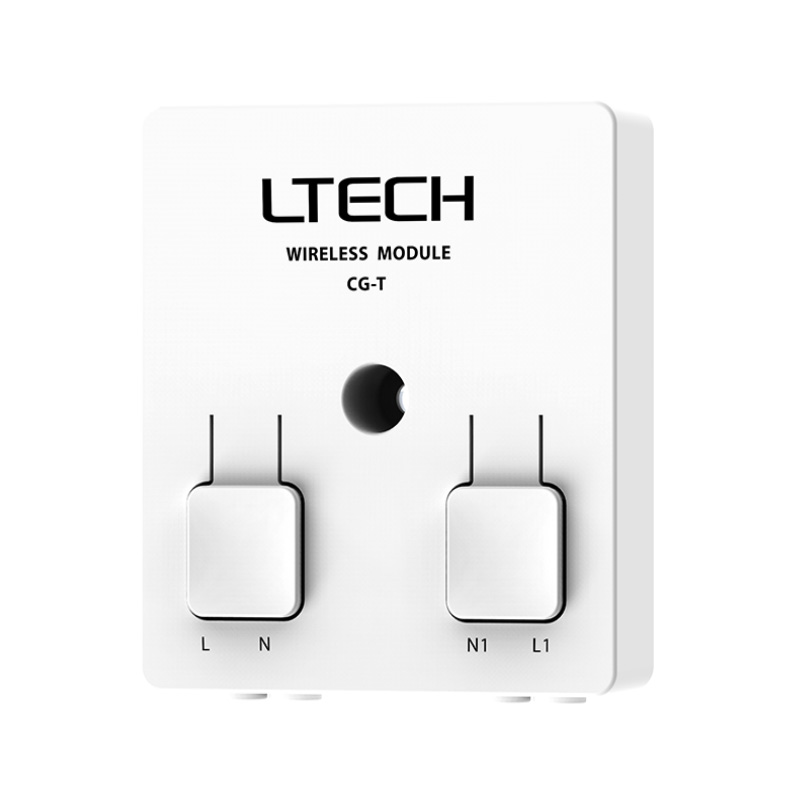
Select a trailing-edge (ELV / reverse-phase) Triac dimmer for almost all electronic solid-state transformers and DC LED tape power supplies. Leading-edge (forward-phase) units fire a switch midway through the AC sine wave rise, generating sharp di/dt electrical noise that causes electronic drivers to hum. Trailing-edge units turn on as the sine wave crosses zero and cut off gently at the back end. Units like our E1S-TD wall panel and CG-T wireless module output clean trailing-edge signals specifically engineered to keep electronic drivers quiet and stable down to 1%.
An electronic Triac dimmer typically requires 5W to 15W of active load on the circuit to keep its internal thyristor or MOSFET gate stably latched open. If you connect only a 3W accent fixture or a highly efficient light run that draws less than the dimmer holding current, the output drops out intermittently, causing random flashing or failure to turn off completely. When operating tiny loads below 10W, choose a MOSFET-based reverse-phase module like the CG-T or wire a dummy load resistor in parallel across the AC output to maintain reliable gate conduction.
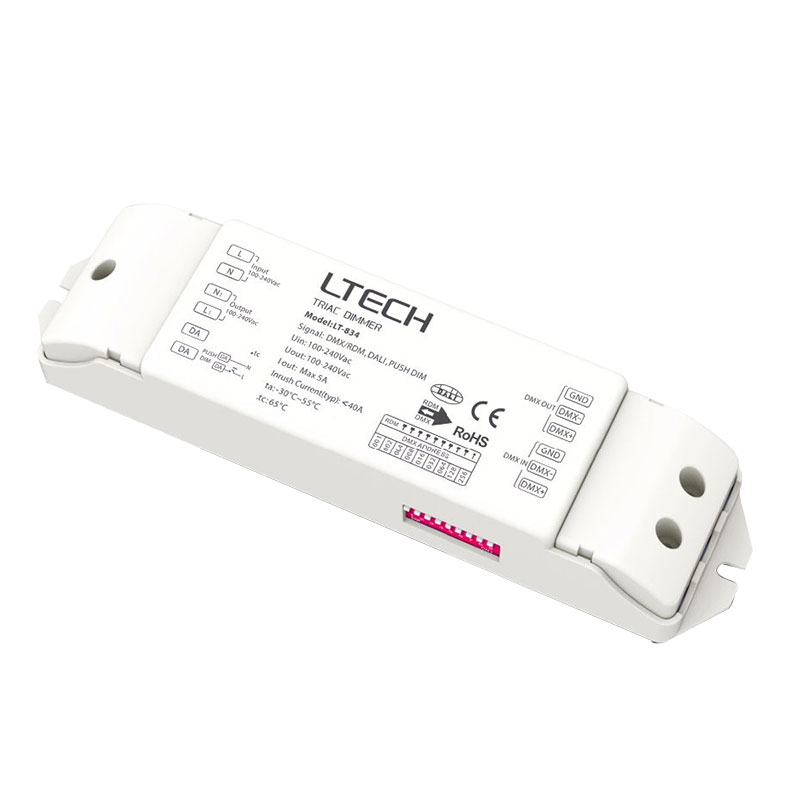
Calculate your total driver wattage and de-rate the Triac dimmer maximum rated capacity by at least 80% to allow for startup inrush current. Even though five 60W power units consume only 300W in steady state, their initial capacitor charging draws 30A to 60A for a few milliseconds, which can weld contacts on an unrated switch. For example, on a 5A-rated line unit like our LT-834 running on 120V AC (600W max theoretical), keep the sum of connected LED driver nameplates under 300W to protect the switching components against inrush fatigue.
Yes, a specialized Triac dimmer module like our LT-834 converts digital DMX512, RDM, or DALI bus signals into a smooth AC phase-cut output for legacy line-voltage fixtures. This allows architectural control desks to dim conventional mains-dimmable sconces, pendant downlights, and phase-cut drivers alongside theatrical stage rigs. The LT-834 handles 100-240V AC input at up to 5A, features an onboard numeric display for DMX channel addressing, and supports both leading-edge and trailing-edge phase selection directly through dip switches.
When your aggregate lighting load exceeds the dimmer wattage limit, install an AC phase-cut power repeater like the TT-550-W1T phase cut amplifier. The TT-550-W1T takes the chopped AC phase-cut output from your master dimmer as its control signal and outputs up to 550W of fresh, synchronized phase-cut mains power from a secondary feed. It supports both leading-edge and trailing-edge inputs and can convert a leading-edge wall signal into smooth trailing-edge output, letting you expand circuit capacity across large banquet halls or retail perimeters without installing multiple wall switches.
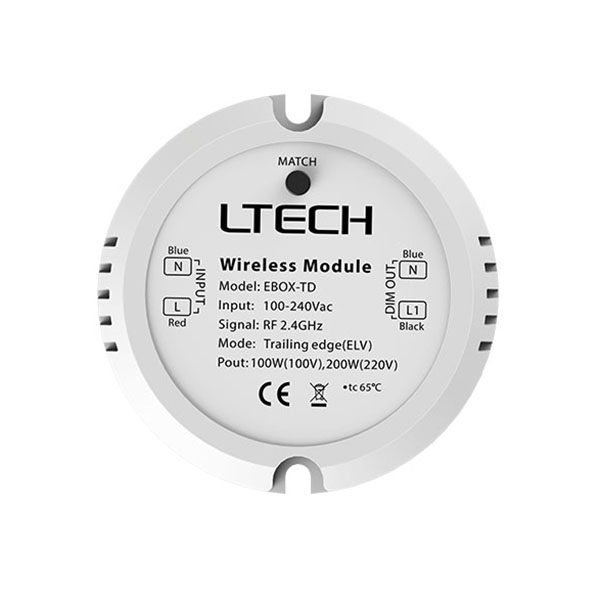
A wireless Triac dimmer module installs inside an electrical wall box or ceiling fixture canopy, wiring directly to incoming AC mains and the load wire while accepting wireless commands. Units like the EBOX-TD receive 2.4GHz RF signals from handheld or wall-mount remotes, while the CG-T module joins a Bluetooth 5.0 SIG Mesh network for smartphone and voice control. Both eliminate the need to run 0-10V or DALI low-voltage wiring through finished drywall, transforming standard AC line-voltage circuits into smart dimming zones without requiring new control cabling.
A Triac dimmer drops out prematurely when the downstream driver internal control chip lacks the dynamic range to decode very narrow AC phase pulses. Most standard wall dimmers bottom out around 10% to 15% voltage conduction, causing the driver circuit to lose operating power and snap off abruptly. Our rotary panels, such as the E6-TD1, feature an adjustable minimum brightness potentiometer under the trim plate. Dialing this trim screw sets the lowest stable conduction threshold, preventing drop-out while keeping the initial turn-on smooth from 0.1% upwards without 'pop-on' latency.