
ArtNet-DMX Lighting System
7 productsLTECH ArtNet-DMX & ArtNet-SPI Lighting System
ArtNet DMX controller or ArtNet SPI controller uses the ArtNet protocol (an Ethernet-based communication protocol that allows communication over a local area network or the Internet) to convert network data into DMX signals or SPI/TTL signals to control various DMX or SPI lighting devices such as addressable LED strips, pixel LED matrices, and other compatible lighting fixtures.
LTECH provides both ArtNet-to-DMX and ArtNet-to-SPI products, allowing the same Art-Net-based control architecture to be used with professional DMX512 fixtures as well as digitally addressable LED lighting. Mainly used in stage lighting, TV and broadcast studios, entertainment venues, conference rooms, exhibition halls, building façades, theme parks, and other places that require high-quality, diverse, and intelligent lighting control.
The system works with Art-Net-compatible lighting software on a computer to create and manage customized lighting effects, scenes, animations, timelines, and large-scale synchronized installations. Depending on the software and controller model, users can program dynamic pixel effects, architectural lighting scenes, stage effects, matrix displays, and multi-zone lighting systems through a standard Ethernet network.
Unlike a conventional single-universe DMX connection, an Art-Net network can carry multiple DMX universes over Ethernet, making it much more suitable for projects that require a large number of channels, pixels, fixtures, or independently controlled lighting zones.
Through the use of Ltech ArtNet-DMX/SPI Lighting System products, users can easily achieve multiple lighting combinations, multiple lighting scenes, remote control, linkage control, etc., to make the entire lighting system more efficient and convenient.
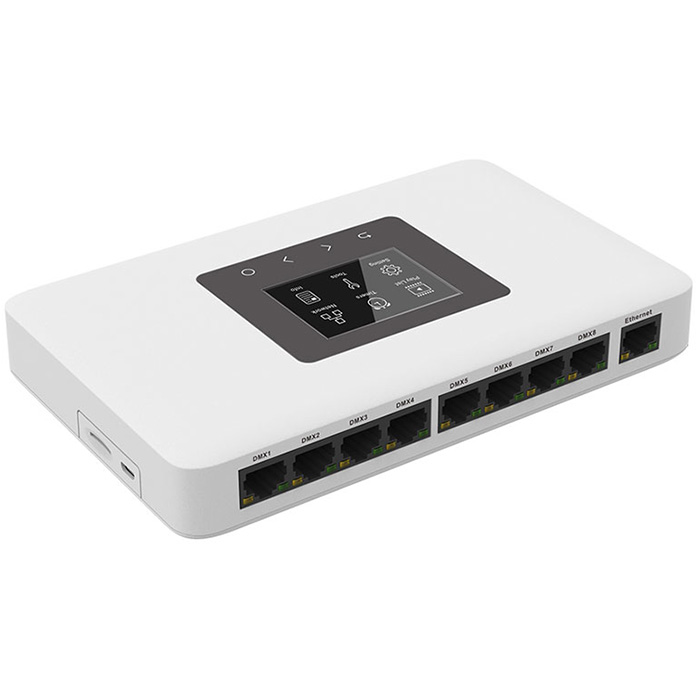
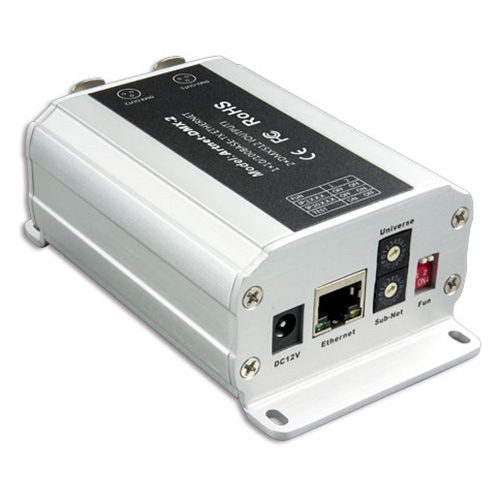
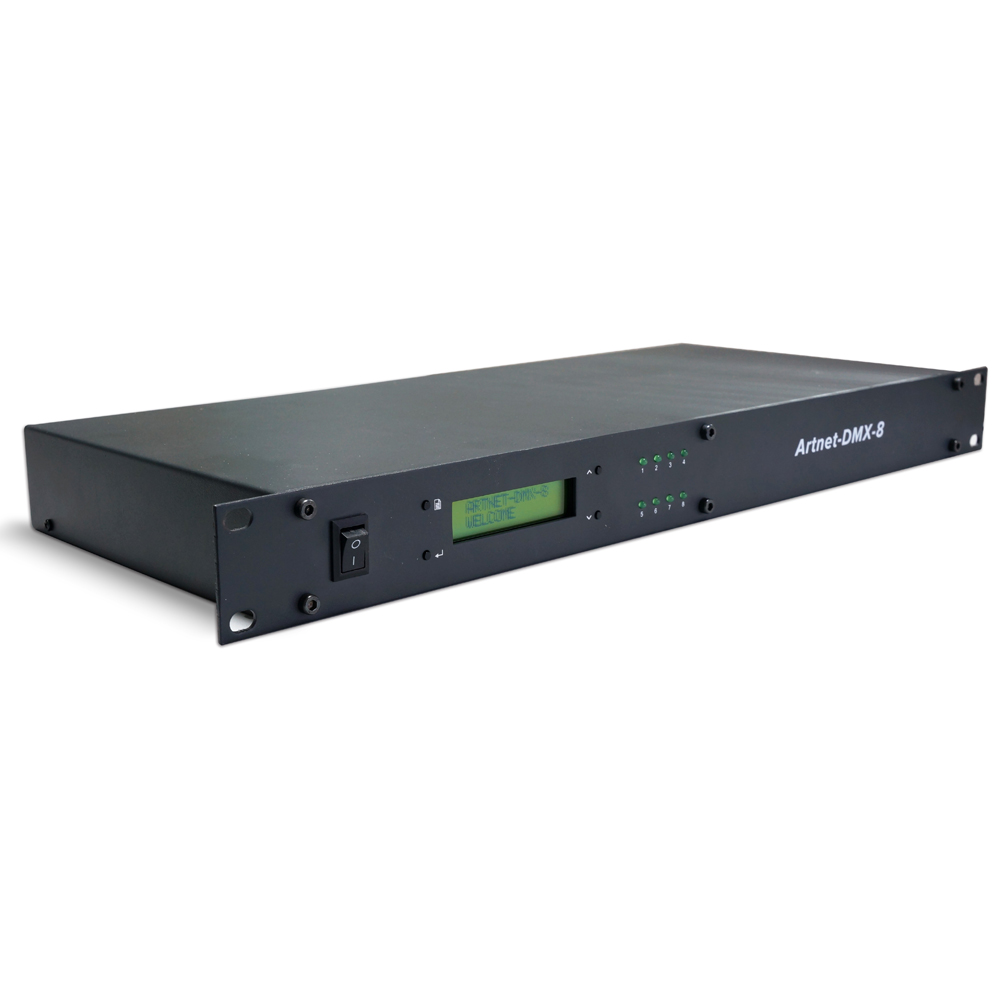
Artnet-DMX-8 Converter 8-Port - 4096 Channels for Stage & Matrix Lighting
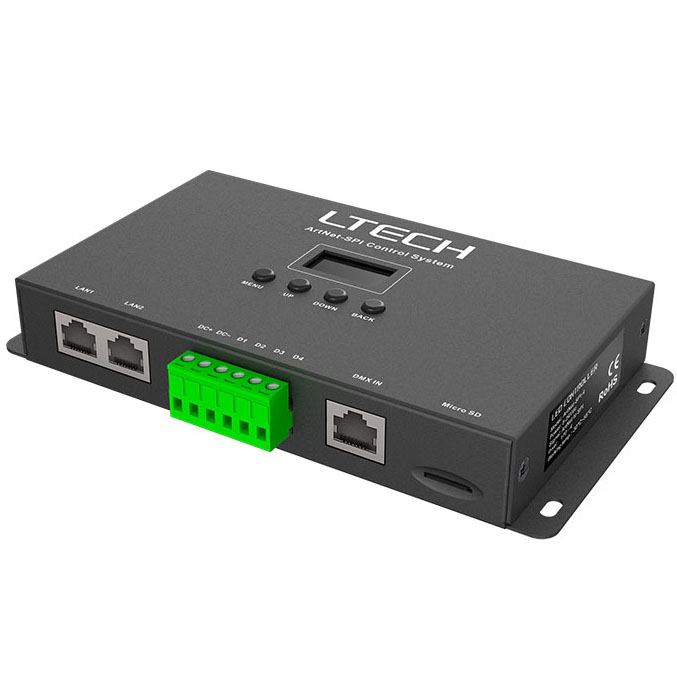
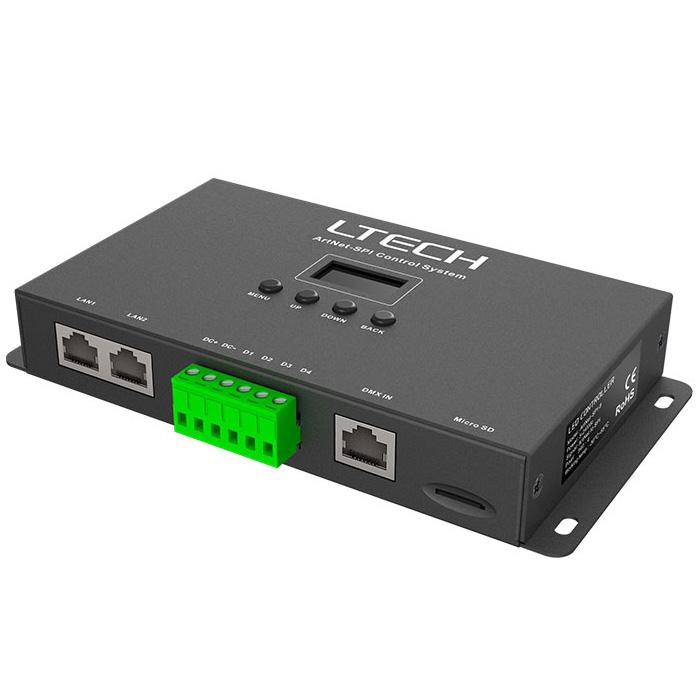
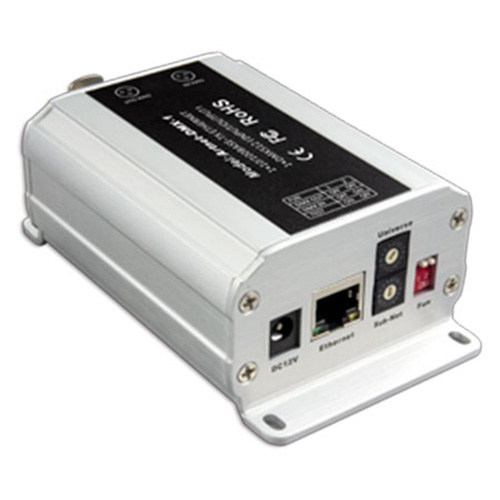
Why Choose Ltech ArtNet LED Pixel Lighting Controllers
High-Speed Processing & Multi-Universe Control
A major feature of the LTECH ArtNet series is that it is designed as a professional lighting-control system rather than only a basic network-to-DMX converter. LTECH models use high-speed ARM processors for stable data processing and provide multiple Art-Net / DMX universes for larger lighting installations.
For example, LTECH multi-port ArtNet-DMX models can provide multiple independent DMX512 outputs, while selected 8-universe models support up to 8 × 512 DMX channels. Professional rack-mount models are also available for installation in standard lighting-control cabinets.
On-Device Configuration & Offline Playback
Some LTECH controllers include LCD or OLED displays and physical control keys, allowing network addresses, operating modes, and other system settings to be configured directly on the controller without relying entirely on computer software.
Advanced LTECH models also provide additional professional functions such as program recording, SD-card storage, offline playback, timed playback, loop playback, firmware updating, static or dynamic IP configuration, broadcast or unicast Art-Net operation, and multi-controller synchronization, depending on the model.
Direct ArtNet-to-SPI Pixel Control
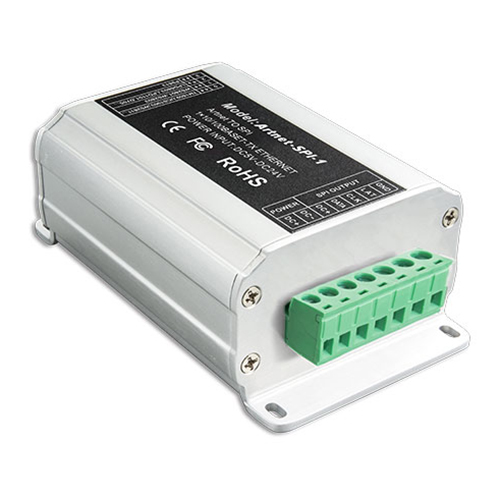
LTECH ArtNet-SPI controllers extend the same system directly to addressable LED lighting. Instead of outputting only conventional DMX512, they convert Art-Net data into SPI/TTL digital signals for compatible pixel-control ICs. Selected models support widely used IC families such as WS2811, WS2812, UCS1903, WS2801, LPD6803, P9813, and other compatible protocols, allowing software-controlled Art-Net systems to drive LED strips, pixel modules, matrices, and other digital lighting products directly.
Some LTECH ArtNet-SPI models also support multi-device offline synchronized playback without manually designating a master and slave, making them particularly useful for larger permanent installations that need synchronized effects without keeping a computer continuously connected.
Through LTECH ArtNet-DMX/SPI Lighting System products, users can build lighting systems with multiple universes, multiple fixtures, multiple pixel outputs, multiple scenes, synchronized playback, remote network control, and coordinated lighting effects. This makes the system especially suitable for projects where conventional standalone controllers or a single DMX512 universe do not provide enough channels, flexibility, or system scalability.
More Art-Net LED Controllers at SuperLightingLED
In addition to the LTECH ArtNet-DMX and ArtNet-SPI system, SuperLightingLED offers a broader selection of Art-Net DMX controllers, Art-Net SPI pixel controllers, Ethernet converters, and network lighting-control products for different project sizes and control requirements.
Our Art-Net controller collection includes compact network controllers, multi-port DMX nodes, ArtNet-to-SPI pixel controllers, MADRIX-compatible controllers, bidirectional ArtNet/DMX converters, Wi-Fi Art-Net devices, and models with SD-card offline playback and multi-controller synchronization.
Different products are available for projects ranging from a few Art-Net universes to larger pixel and matrix installations. Depending on the model, available functions include DMX512 output, SPI/TTL output, simultaneous DMX and pixel control, online software control, offline playback, network configuration, multiple universes, and support for different addressable LED IC protocols.
Frequently Asked Questions About ArtNet-DMX Lighting Systems
Your questions about bridging network-based lighting control with DMX and SPI fixtures, answered by our engineers.
Think of it like this: DMX is the local language spoken by the lights themselves, using special XLR or RJ45 cables in a daisy chain. ArtNet is the language spoken over a standard computer network (Ethernet/WiFi) to send many DMX signals at once. Our ArtNet-DMX converters are translators, taking commands from your lighting software on the network and speaking DMX to the fixtures.
You move to an ArtNet-DMX lighting system when you outgrow the limits of a single DMX universe or want to use powerful computer software. A basic controller is great for simpler scenes. But if you're running a complex show with pixel mapping or syncing lights to music from a laptop, ArtNet is how you get that massive amount of data from the PC to the lights without a ton of cables.
It depends entirely on your lights. If you're controlling standard stage lights or single-color architectural fixtures that use DMX addresses, you need an ArtNet-to-DMX converter. If you're using addressable pixel strips, like our WS2811 LED strips, you need an ArtNet-to-SPI converter.
Pretty much any professional or enthusiast lighting software that supports the ArtNet protocol will work. We see customers using Madrix, Resolume Arena, TouchDesigner, QLC+, and many others. As long as the software can output ArtNet data over the network, our converters will translate it into DMX or SPI signals for your fixtures. It's a standard protocol, so you're not locked into one software package.
It depends on the model you pick. We have units that output 2, 4, or 8 universes. A single ArtNet network can theoretically handle thousands of universes, so the bottleneck isn't the protocol, it's just how many physical output ports you need in one location. You can always add more converter boxes to the network to get more physical DMX outputs.
For ArtNet devices to talk, they must be in the same IP address range. Most ArtNet gear defaults to a 2.x.x.x or 10.x.x.x range. Check the converter's manual for its default IP, then set your computer's network adapter to a static IP in that same range (e.g., if the node is 2.0.0.1, set your PC to 2.0.0.2). If that doesn't fix it, check your firewall settings.
Yes, absolutely. That's one of the main strengths of an ArtNet-DMX lighting system. You can have converters spread all over a venue, each one plugged into the local network. In your software, you just assign different universes to each converter's output. For example, your stage right lights could be on Universe 1 from a converter over there, and your stage left lights on Universe 2 from a second converter.
The ArtNet converter is the brain; it still needs a DMX decoder to actually control the LED strips. The signal path is: PC (lighting software) -> Ethernet cable -> ArtNet-to-DMX Converter -> DMX cable -> CV DMX512 Decoder -> Low-voltage wiring -> LED Strip. The converter just translates the network signal to a DMX signal; the decoder is what interprets that DMX and sends the right power to the red, green, and blue channels on the strip.
They are very similar but not identical. Both ArtNet and sACN (Streaming ACN) are protocols for sending DMX data over an Ethernet network. ArtNet is generally more common in the DJ, VJ, and club scene, while sACN is often preferred in professional theater. Most of our L-tech ArtNet DMX system converters focus on ArtNet, but always check the datasheet of the specific model if you have a hard requirement for sACN.