
DALI Controller
14 productsSuperLightingLED offers a comprehensive range of LeyNew DALI Lighting Control System products designed to build, integrate, and expand professional digital lighting installations.
The product range includes DALI touchscreen master controllers, DALI bus power supplies, DALI signal repeaters, DALI-to-0/1-10V converters, bidirectional DALI-DMX512 signal converters, and compatible DALI LED strip control solutions.
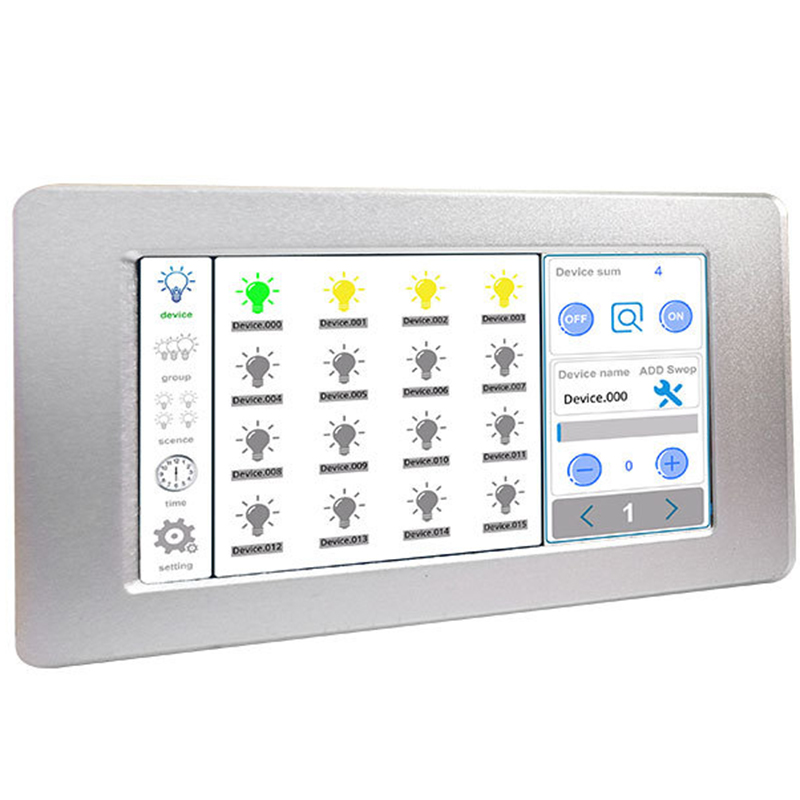
At the center of the system is the DL103B DALI Touch Screen Master, featuring two DALI bus outputs and the capacity to manage up to 128 DALI devices. Through its intuitive touchscreen interface, users can individually control connected devices, organize lighting fixtures into groups, create customized lighting scenes, and schedule automatic scene activation.
A DALI lighting network can combine compatible DALI LED drivers, dimmers, lighting controllers, and interface converters within an organized digital control architecture, making it suitable for residential, commercial, hospitality, and architectural lighting projects.
Whether you are building a new centralized lighting system or integrating different dimming technologies into an existing DALI network, LeyNew provides practical control and signal management solutions.

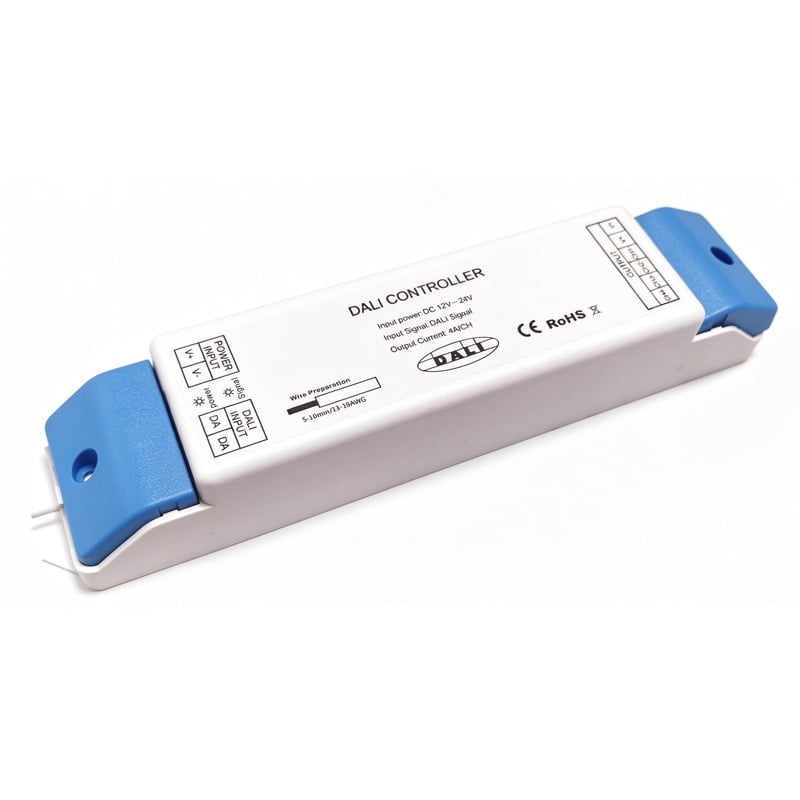
LN-DALIDIMMER-3CH-DCxV 3 Channel DALI Low Voltage RGB Dimmer, DALI Extension Controller


1 Channel DALI Low Voltage Dimmer, DALI Extension Controller LN-DALI-DIMMER-1CH-DCxV


How to Connect and Wire a LeyNew DALI Lighting Control System
A typical LeyNew DALI lighting installation uses the DL103B touchscreen master as the central controller, with the DALI bus power supply, compatible DALI devices, and optional signal interfaces connected according to the system design.
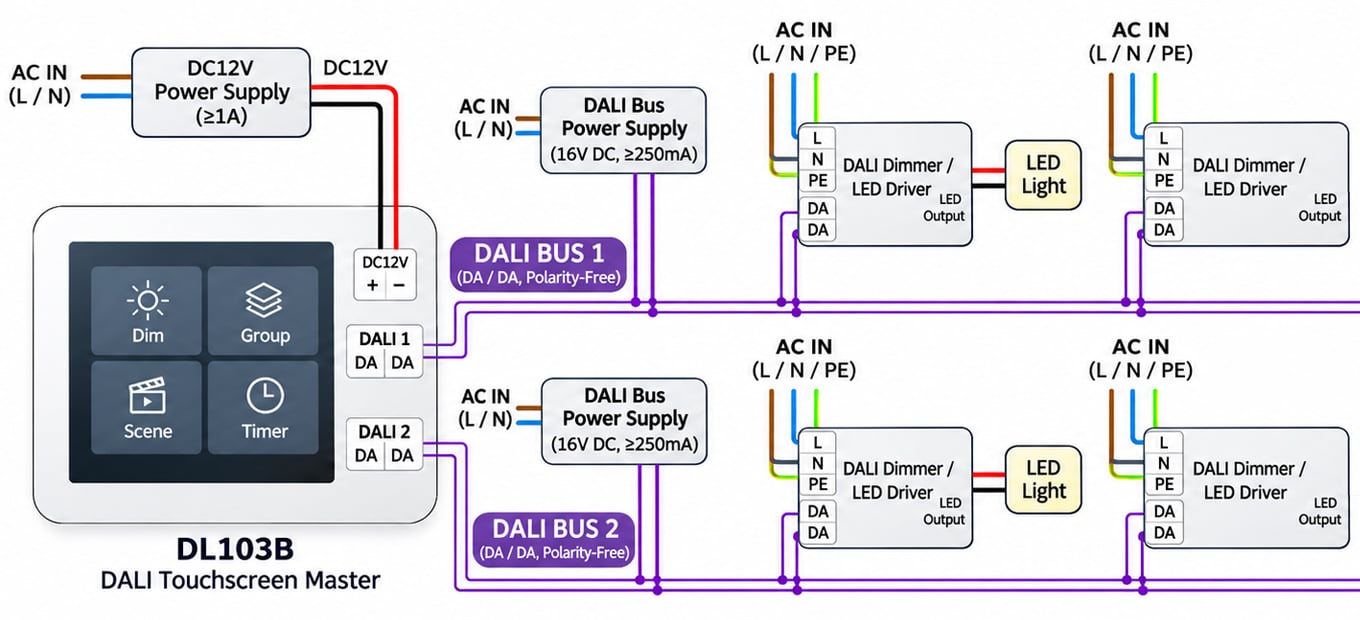
1. Power the DALI Master: Connect a DC12V, 1A power supply to the DL103B touchscreen master. Its two DALI output interfaces provide the control connections for the two DALI bus circuits.
2. Connect the DALI Bus Power Supply: Connect the DL810 DALI bus power supply to the appropriate DALI bus wiring. It receives AC100-240V mains power and supplies 16V DC communication power, up to 200mA, to the bus.
3. Connect DALI Devices: Connect compatible DALI dimmers, lighting controllers, and other DALI-compatible devices to the corresponding two-wire bus. The DALI bus carries communication signals and does not replace the separate power connections required by the lighting loads.
4. Add Signal Repeaters When Needed: For larger installations with extended cable runs, integrate the DL812 DALI signal repeater according to its input and output terminals and installation instructions.
5. Connect Other Dimming Systems: For 0/1-10V lighting, connect the DL108 to the DALI bus and wire its analog output to a compatible 0/1-10V dimmable driver. For DMX512 integration, connect the DL113 between the DALI interface and the corresponding DMX512 network according to the selected conversion direction.
6. Connect LED Lighting Loads: DALI LED strip controllers require their own compatible operating power supplies and load wiring. Connect the LED strips to the controller's output terminals, not directly to the DALI bus.
After completing the wiring and device addressing, use the DL103B touchscreen to configure individual devices, organize control groups, create lighting scenes, and set schedules. Always check the voltage, current, bus power budget, and wiring requirements of each component before energizing the system.
FAQ About DALI Controller Systems
Straight technical answers from our engineering desk on wiring, bus power, addressing limits, and integrating LeyNew DALI hardware into real-world installations.
Every DALI bus requires exactly one dedicated bus power supply delivering nominal 16V DC (between 9.5V and 22.5V DC) at a current capped at 250 mA, regardless of which DALI controller you install. A master interface or touch panel sends digital pulses by shorting the bus line; it does not power the communication line itself unless it has an internal bus supply built in. For example, our DL810 rail-mount unit supplies a regulated 16V DC up to 200 mA across the two control conductors, powering the communication transceivers on up to 64 connected slave devices. Connecting two unsynchronized bus power supplies on the same line will push current above the 250 mA IEC 62386 standard and damage slave transceivers.
A single-channel DALI lighting controller addresses up to 64 independent device addresses (short addresses 0 to 63), 16 lighting groups, and 16 preset scenes on one pair of wires. When an installation requires more endpoints, you move to a multi-channel master rather than overloading the bus. Our DL103B touchscreen master features two independent DALI bus output ports, allowing you to manage 128 individual devices and 32 separate groups from a single wall panel. If you need hundreds of fixtures controlled as a unified commercial grid, you deploy multiple DALI sub-loops managed through higher-level building management systems.
A low-voltage DALI controller built as a PWM receiver, like the LeyNew NL704, decodes digital bus commands and modulates 12V or 24V DC power directly to control RGBW LED strip lights. The DALI bus wiring only carries digital instructions, so your strip lights must be powered by an external auxiliary constant voltage driver sized to your strip's wattage. The NL704 takes 12V to 24V DC input from that auxiliary driver and uses four distinct DALI short addresses to provide 0% to 100% logarithmic PWM dimming across red, green, blue, and white channels.
The maximum permissible cable distance from a DALI lighting controller to the furthest slave device is 300 meters (984 feet) when using 1.5 mm² (15 AWG) twin-core wire. This limit guarantees that the total loop voltage drop across the signal wires does not exceed 2.0V DC. If your cable run between a master cabinet and an outbuilding or distant wing extends past 300 meters, you must install a signal repeater like the DL812. The DL812 opto-isolates and regenerates clean Manchester-coded data packets, extending your transmission range by another 300 meters while preserving complete signal integrity.
Yes, you can integrate legacy fixtures by pairing the DALI controller with a rail-type signal converter like our DL108, which translates incoming digital DALI commands into an analog 0-10V or 1-10V output. The converter claims a single short address on the digital bus, allowing commercial high-bays, architectural troffers, or 0-10V fluorescent ballasts to join DALI groups and recall stored scenes alongside native digital fixtures.
You bridge the two environments by wiring a dedicated bidirectional protocol converter, such as our DL113, between the DALI controller bus and the DMX network. Operating on 12V to 24V DC, the DL113 translates standard DMX512 slot levels directly into DALI short address dimming levels, or conversely takes DALI master commands and broadcasts them across DMX512 decoder controllers. This lets an architectural DALI wall keypad trigger stage wash lights, or allows a theatrical lighting desk to control architectural house luminaires without replacing drivers or pulling dual cable backbones.