
RF+Knob Dimmer Panel
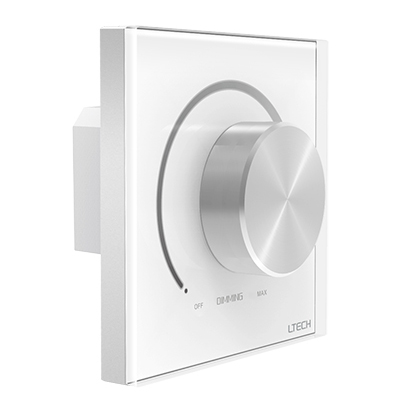
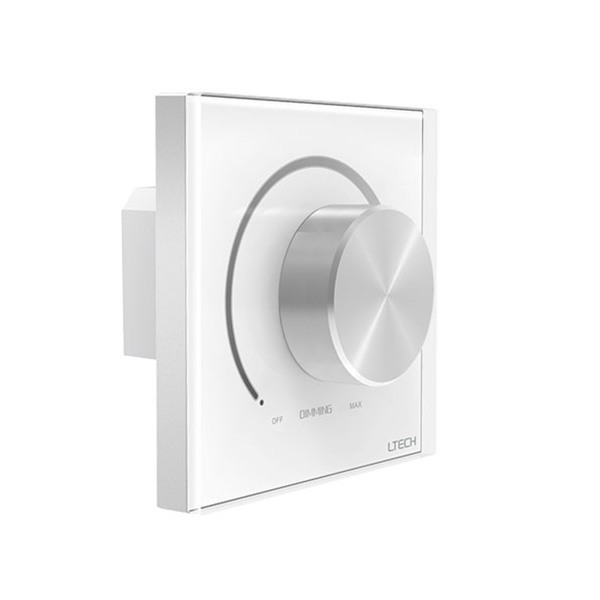
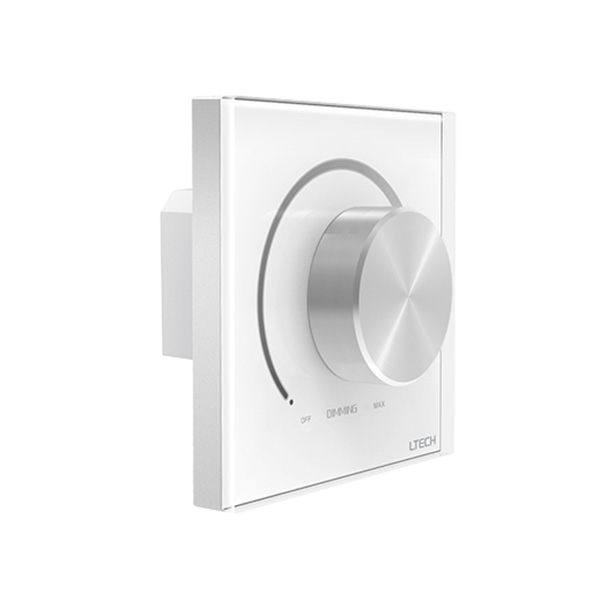
4 productsLTECH L-BUS RF rotary knob panels combine intuitive manual dimming with 2.4GHz RF wireless connectivity, making them a flexible control option for residential and commercial lighting systems. When paired with compatible LTECH L-BUS devices, these RF knob panels can extend lighting control beyond the wall. Depending on the configuration, the system can combine with WiFi-106 app control, F Series or Q Series RF remotes.
Different models provide different output interfaces to match the lighting system:
- Constant-voltage LED strips: Control compatible 12V or 24V single-color LED strips.
- 0–10V dimmable lighting: Connect to constant-voltage or constant-current 0-10V LED drivers and lights.
- DMX512 lighting: Provide wired DMX512 output for compatible DMX decoders or DMX-enabled LED drivers.
Before purchasing, confirm the panel's output type, supported RF devices, input voltage, load requirements, and wiring method. A 0–10V panel requires a compatible 0–10V dimmable driver; a DMX panel requires a compatible DMX input; and a DC/PWM panel must match the LED strip's voltage and channel configuration.

FAQ About RF+Knob Dimmer Panel
Direct engineering answers on wiring, load limits, 0–10V compatibility, and wireless range for our rotary wall controls.
An RF knob dimmer panel combines a physical rotary knob with a 2.4GHz wireless transmitter to dim and switch LED strip lights. Turning the knob adjusts brightness smoothly from 0.1% to 100%, and pressing it toggles power. Unlike standard mechanical wall dimmers, an RF rotary panel either sends wireless L-BUS control signals directly to matching receiver modules up to 30 m away or outputs a control signal like PWM, 0–10V, or wired DMX512 to your driver.
Choose by matching the panel output interface to your driver or LED strip lights. The E61 is a 12–24V DC unit with built-in PWM power output that connects straight to single-color LED strip lines up to 6A. The E610P-RF runs on 100–240V AC and provides a wired 0–10V analog signal for commercial dimmable drivers. The EX61 operates on 12–24V DC and outputs wired DMX512 data while transmitting 2.4GHz RF.
An L-BUS wireless knob dimmer panel like the E610P-RF controls any standard 0–10V or 1–10V dimmable driver from brands like Mean Well, Advance, or Fulham. The unit provides both an active/passive 0–10V dimming output (sink or source up to 20mA) and an internal 5A AC relay switch (90–250V AC) that cuts mains power to the driver when you click the knob off. That physical relay prevents the phantom glow that plagues cheap 0–10V dimmers. For a complete signal breakdown, check our 0-10V dimming guide.
It depends strictly on the model you select. The E610P-RF wires directly to 100–240V AC mains power because it contains an internal switching transformer and line relay. The E61 and EX61 are strictly low-voltage devices requiring a 12V or 24V DC power supply; connecting 120V AC directly to their terminal blocks will instantly destroy their logic boards. Always check the terminal label on the back casing before landing your line wires.
Yes, an L-BUS wireless knob dimmer panel can link to dozens of wireless receivers simultaneously within its 30 m radio range (Only the EX Series can achieve this). By putting compatible wireless receivers into learning mode and tapping the knob, all receivers bind to the same radio frequency address. When you turn or click the knob, every linked receiver updates in sync, allowing you to control cove lighting, under-cabinet fixtures, and toe-kick runs without running control cabling between walls.
The E61 features a built-in PWM output rated for 6A maximum continuous load across 12V to 24V DC. On a 24V DC line, that equals a theoretical maximum of 144W, or about 115W if you maintain an 80% safety margin. If you are powering a standard 9.6 W/m 24V LED strip light, you can wire up to 12 m directly to the panel screw terminals. For larger jobs exceeding 6A, land the panel output on a PWM power repeater rather than overloading the internal MOSFETs.
The EX61 knob panel outputs standard DMX512 serial data on its screw terminals while simultaneously transmitting 2.4GHz RF signals over the air. You can hardwire the panel via shielded twisted-pair cable to local DMX decoders inside a nearby electrical closet, while simultaneously controlling cordless L-BUS wireless receivers installed across the ceiling. Both channels mirror the rotary knob adjustments with zero operational lag.