
SPI LED Controllers
2 sub-categoriesSuperLightingLED offers a comprehensive selection of SPI/TTL addressable LED strip lights and compatible control systems for projects requiring dynamic lighting effects, precise pixel control, and synchronized color animations. We help lighting professionals find the right combination of programmable LED strips, controllers, and control accessories for architectural lighting, digital signage, media displays, and custom lighting installations.
LTECH SPI Master Controllers – Reliable Control for Professional Projects
Designed for demanding pixel LED applications, LTECH SPI master controllers combine flexible control options with dependable performance. The LTECH SPI master controller range features a 5-year warranty, with CE, FCC, and RoHS certifications documented.
With broad compatibility across popular LED driver ICs, including WS2811, WS2812B, WS2801, UCS-series, and TM-series chips, these controllers provide versatile solutions for professional addressable LED strip installations. Always verify driver IC compatibility and signal wiring before selecting a controller.

SPI Master controller
An SPI master controller generates or translates the clocked serial data stream that tells individual digital ICs along an addressable LED strip light exactly when to light, dim, and shift color. SuperLightingLED provides a complete range of pixel hardware within our SPI control systems, bridging standard network protocols to bare chip inputs across DC 5V, 12V, 24V installations.
Standard building automation and stage consoles communicate via balanced DMX512 or wireless networks, yet digital LED strips require single-ended TTL signals with microsecond timing. Deploying dedicated master controllers eliminates signal degradation across long runs by providing direct protocol conversion, localized timing generation, and onboard amplification right at the strip header.
What protocols does an SPI master controller translate?
A dedicated SPI master controller acts as a hardware bridge between standard lighting networks and raw pixel data lines, converting DMX512/RDM, RF, or Bluetooth signals into high-speed TTL serial data. Rather than relying on software-emulated timing from a computer, each hardware unit features dedicated microprocessors designed to handle specific digital signaling without timing jitter.
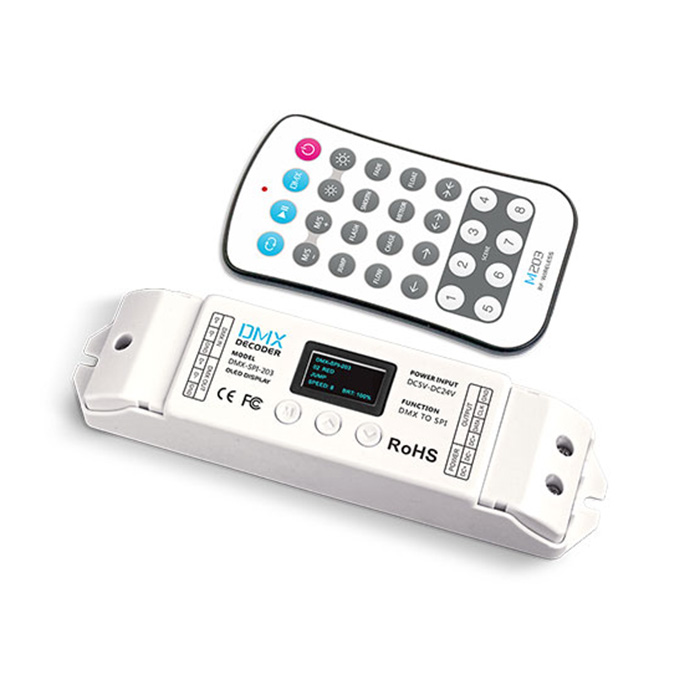
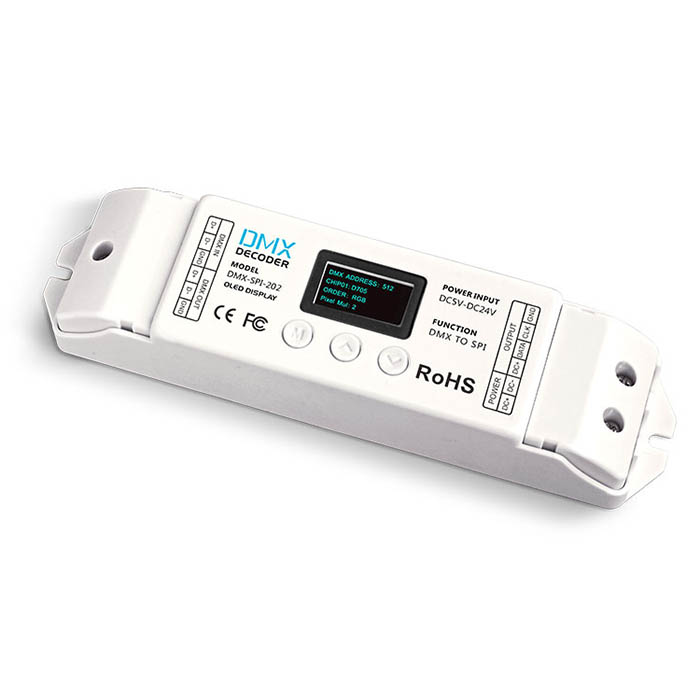
- DMX512 and RDM conversion: Decoders like the DMX-SPI-202 and DMX-SPI-203 take standard DMX512 console data and output SPI data to control up to 1,024 virtual pixels, with RDM parameter configuration supported over the line.
- RF and standalone playback: Units such as the SPI-16S work with handheld remotes (powered by a 3V CR2032 battery) to run pre-programmed chases and dynamic scene modes across DC 5V to 24V circuits.
- Wireless mesh control: Compact units like the CG-SPI (135×30×20mm) integrate Bluetooth 5.0 SIG Mesh to manage RGBIC pixel tape up to 10A directly from a mobile device without running external data wire.
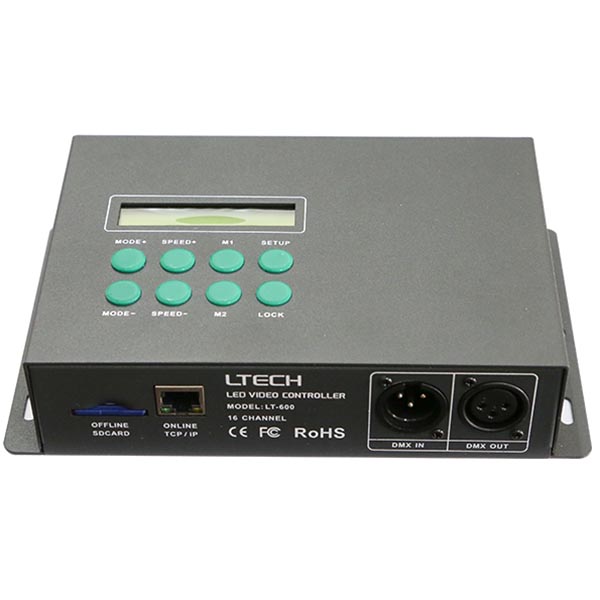
- Networked video playback: Systems like the LT-600 offer direct WiFi wireless transmission alongside standard DMX512 and SPI outputs for video synchronization.

LED Control System
Out pixel controller almost able to control all IC-driven LED lights. Compact and powerful, various built-in changing effects and customized scene modes can bring you fantastic color!
By RF remote control, you can select from a variety of dynamic lighting effects, set controlled pixels quantity, adjust the changing speed and brightness, change the lighting moving direction, adjust RGB sequence, select the IC type, store and play customized scene etc.
Best-selling SPI LED Controllers
1–11 of 11 products



FAQ About SPI LED Controllers
Engineering answers to common wiring, protocol, and hardware questions for SPI pixel control systems.
An SPI LED controller sends serial digital data directly to individual integrated circuits on an addressable LED strip, rather than chopping DC voltage across the entire line like a PWM dimmer. Standard PWM dimmers adjust the brightness of every diode on the circuit simultaneously. In contrast, an SPI controller transmits timed binary packets containing separate 8-bit or 16-bit brightness values for red, green, and blue diodes on every individual pixel IC. This lets you generate chase sequences, colour gradients, and media mapping across individual segments of an addressable LED strip while the DC supply voltage stays constant.
An spi led strip addressable controller reads and generates specific serial timing protocols for single-wire and dual-wire ICs, including WS2811, WS2812B, WS2801, UCS1903, TM1804, and TM1812. Because SPI (Serial Peripheral Interface) timing tolerances vary between 400 kHz and 800 kHz, the controller must match the microsecond pulse widths expected by the driver chip.
Most SPI LED controllers manage between 512 and 2,048 pixels per output port at a fluid 30 frames per second before transmission delay causes visible frame rate stutter. Single-wire protocols like WS2811 transmit data at roughly 800 kbps, which takes approximately 30 microseconds per 24-bit RGB pixel. When you push past 1,024 pixels on a single SPI data line at full 30 Hz refresh rates, the serial transmission time approaches 31 milliseconds, leaving zero frame margin.
On a standard SPI LED controller, keep the unshielded TTL data wire between the controller output and the first pixel under 5 metres. TTL logic signals operate at 5V single-ended signalling, which degrades rapidly over cable capacitance, picking up ambient electromagnetic noise. If your control cabinet sits 10 to 50 metres away from the start of the LED strip, run shielded twisted-pair wire, or place an SPI signal amplifier like the LT-122 near the controller to convert and boost the serial pulse without data corruption.
A commercial led spi light controller bridges standard stage or architectural control boards by taking standard USITT DMX512 or RDM signals and translating them into SPI serial packets. Decoders such as our DMX-SPI-202 and DMX-SPI-203 take incoming DMX channels from theatrical consoles and assign them sequentially to pixel ICs on 5V, 12V, or 24V LED strip systems. When an installation requires integration with wider theatrical consoles or architectural desks, our DMX512 series decoders provide full RDM addressing and universe routing across multi-channel layouts.
Every SPI LED controller features an internal RGB sequence setting because different chip manufacturers arrange internal PWM registers in differing orders, such as RGB, BGR, GRB, or RBG. If your controller outputs pure red but the LED strip illuminates green, the chip uses a GRB bit pattern instead of standard RGB. You can toggle the data order via the controller onboard display, DIP switches, or paired remote (like the M16S on our SPI-16S) to remap the colour stream to the physical emitter dies.
You can synchronise multiple pixel runs by pairing Bluetooth Mesh master units, such as the CG-SPI 10A, or by distributing synchronized DMX broadcast streams across local sub-controllers. The CG-SPI controller uses Bluetooth 5.0 to synchronize multiple pixel zones wirelessly within 30 metres, triggering matching chasing, fading, and static dynamic scenes without inter-controller data cabling. For multi-channel sync requiring physical distribution, hardware repeaters like the 2-channel LT-122 split and isolate a single master SPI signal across multiple isolated output lines.