
RF+Touch Power Panel
11 productsLTECH L-BUS RF touch panels combine intuitive wall-mounted touch control with 2.4GHz RF wireless connectivity for system control. With different models supporting different output types, these panels can control compatible low-voltage LED strip lights directly or operate with suitable dimmable 0-10V LED drivers for a wider range of lighting applications.
Choose the panel according to your LED lighting type and control requirements:
- 12–24V DC LED strip panels: Provide built-in PWM power output for compatible single-color, tunable white (CCT), RGB, RGBW, or RGBCCT LED strips. The LED strips can connect directly to the panel, provided the voltage and current requirements are within the model's ratings.
- 0–10V dimming panels: Send a 0–10V / 10V PWM control signal to a matching constant-voltage or constant-current 0–10V LED driver. The driver then supplies the required power to the connected LED fixture.
- TRIAC dimming panels: Control compatible phase-cut CV drivers or CC drivers or lighting loads. Check the supported dimming mode and load requirements before installation.
As part of the LTECH L-BUS ecosystem, these RF touch panels can work with supported wireless receivers, F Series and Q Series RF remotes, and WiFi master. This provides flexible control options, from convenient local wall-panel operation to remote lighting adjustment and coordinated multi-zone control.
Depending on the panel and connected equipment, users can adjust brightness, tune white color temperature, select RGB colors, and recall preset lighting scenes.
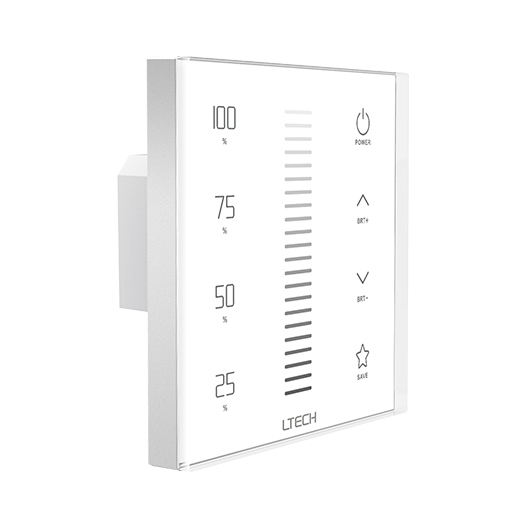
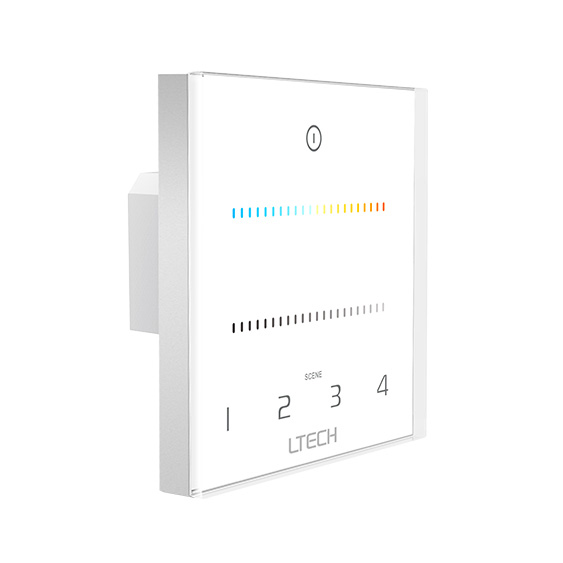


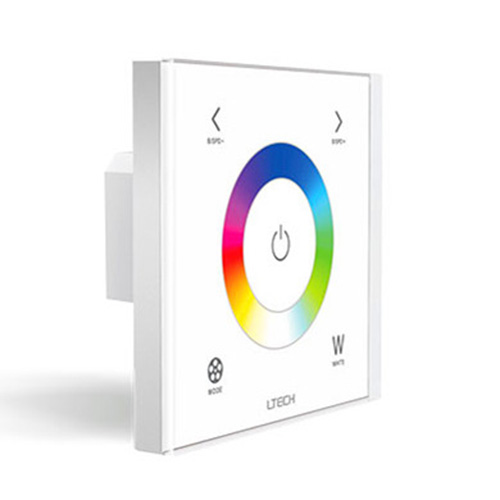


FAQ About RF+Touch Power Panel
Direct technical answers on wiring, load limits, backbox sizing, and wireless syncing for LTECH L-BUS touch wall controllers.
You can power up to 288W of 24V LED strip lights (or 144W at 12V) directly from an RF touch power panel like the E4. The physical limit is current: 3A per channel across 4 channels, totaling 12A max. If you are running our standard 14.4W/m RGBW LED strip lights on 24V, that works out to exactly 20 meters (65.6 feet) of total tape before overloading the internal MOSFETs. If you are uncertain about sizing your run length against your power feed, check our practical guide to calculating LED strip wattage to keep your setup well within thermal limits.
No, you do not pull 120V or 230V mains to an L-BUS wireless led strip panel controller that has direct DC PWM outputs. Models like the E1, E2, E4, and E5S run strictly on 12V or 24V DC power supplied from a remote constant-voltage LED driver. Wiring 120V AC into their DC terminals will instantly destroy the board. However, signal-only variants like the E1S-AD 0–10V panel or E1S-TD phase-cut dimmer are built specifically with internal AC power supplies and require incoming 100–240V AC line power. Always verify the input voltage label on the back housing before landing your conductors.
To link a handheld remote with an L-BUS wireless led strip panel controller, power on the panel and verify the power button indicator glow is white. Long-press the ON/OFF button on the touch panel for about 3 seconds until all LED indicator keys begin flashing rapidly. While they are flashing, immediately press the ON/OFF button on a single-zone remote (such as an F1 or F4), or press the specific zone ON/OFF keys simultaneously on a multi-zone remote like the F8. The touch panel lights will stop flashing and beep once, confirming the wireless 2.4GHz RF address has paired.
An L-BUS wireless 0-10V wall panel sends an analog 0–10V or 10V PWM control signal to a dimmable LED driver, whereas a PWM touch power panel connects directly to the LED strip lights and handles the DC amperage itself. Use a 0–10V panel like the E1S-AD when your fixtures use dedicated commercial 0–10V dimmable drivers, high-bay power supplies, or constant-current architectural fixtures. Choose a PWM power panel when you are running 12V or 24V low-voltage LED strip lights right off the wall box and want an all-in-one controller without hiding an extra driver module between the switch and the tape.
One RF touch power panel can broadcast wireless 2.4GHz commands to an unlimited number of matching L-BUS wireless receivers within a 30-meter line-of-sight radius. While the panel is physically powering the local LED strip lights wired to its screw terminals, it simultaneously acts as an RF master transmitter. Any compatible receiver coded to the same zone—such as an R4-5A or R4-CC module in an adjacent cove or closet—will mimic the wall panel's brightness, color changes, and scene recall in sync. Walls and metal studs will attenuate the range, so plan on 15 to 20 meters through drywall.