
EBOX Signal Converter
5 productsLTECH EBOX wireless modules are part of the L-BUS lighting control system, designed to connect compatible 2.4GHz RF wireless controls with lighting equipment that uses different control interfaces. By converting wireless RF commands into DMX512, 0–10V, or TRIAC signals, the EBOX series helps integrate compatible lighting loads into a coordinated wireless lighting system without requiring a separate wired control connection from each wall panel to the control module.
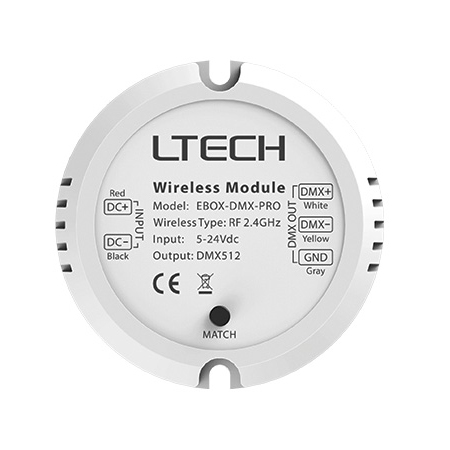
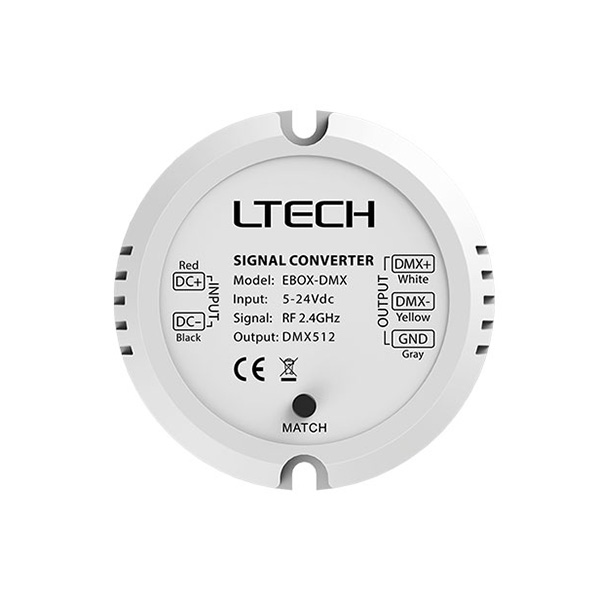
RF-to-DMX512 Module — Receive compatible L-BUS RF commands and output DMX512 signals for compatible DMX decoders and DMX-enabled LED drivers. Can be wirelessly paired with compatible EX Series RF+DMX512 wall panels and F Series or Q Series RF remotes, allowing users to control DMX lighting from wall-mounted or handheld controls. A wired DMX connection is still required between the EBOX module and the downstream DMX equipment.
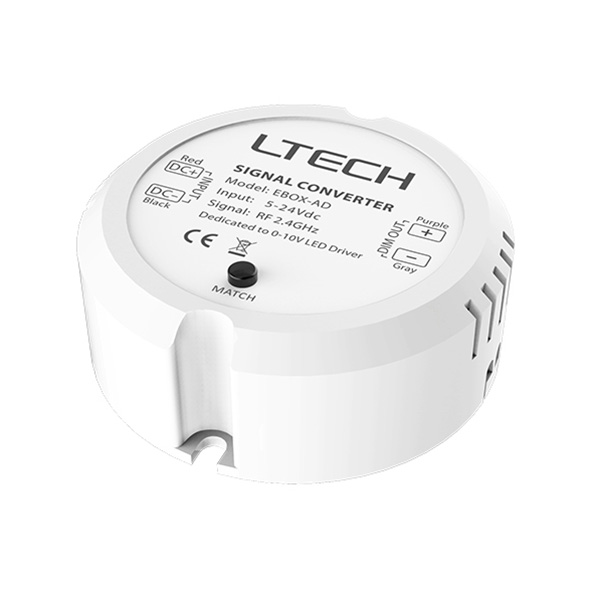
RF-to-0–10V Module — Converts compatible L-BUS RF commands into a 0–10V control signal for compatible 0–10V dimmable CV or CC LED drivers. It can be paired with single-zone EX1 panels, multi-zone EX5 panels, and F Series or Q Series RF remotes for wireless control.
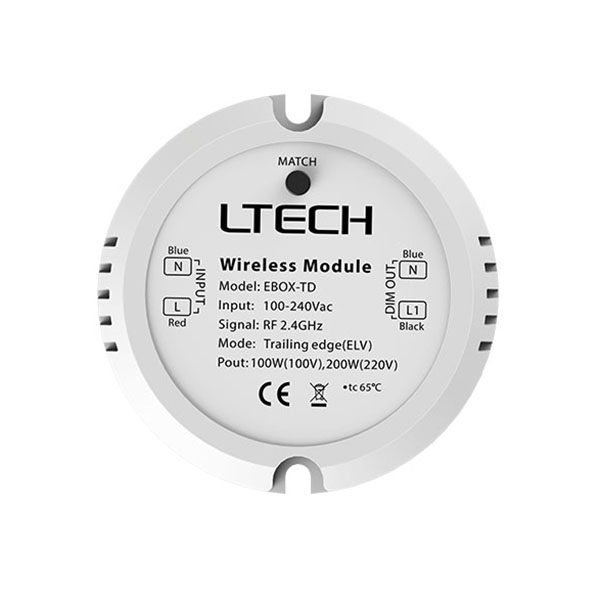
RF-to-TRIAC Module — Receives compatible L-BUS RF commands and provides wireless control for supported TRIAC dimmable lighting systems. It can wirelessly work with single-zone EX1S or multi-zone EX5 panels and F Series or Q Series handheld remotes.
Before purchasing, confirm the module's input power requirements, output interface, supported RF devices, and compatibility with the connected driver or lighting load.

Frequently Asked Questions About EBOX Signal Converters
Direct engineering answers on wiring, protocol bridging, and RF integration for LTECH EBOX wireless signal converters.
An EBOX signal converter translates 2.4GHz wireless LT-BUS radio commands into hardwired protocol signals like DMX512, 0-10V, or AC Triac phase-cut. Instead of driving LED strip lights directly with internal power transistors, these modules act as signal translators. You mount them near your third-party power supplies or decoders so a wireless wall panel or handheld remote can regulate lights across rooms without pulling low-voltage control lines through finished walls.
An EBOX signal converter outputs an industry control signal rather than direct dimmable DC power to your LED strip. In our LT-BUS control system shelf, touch power panels usually drive 12V or 24V loads straight from their internal terminals, but EBOX models run on DC5-24V specifically to generate isolated protocol outputs for downstream equipment. While sibling panels act as combined interfaces and power drivers, an EBOX acts purely as a wireless-to-wired bridge.
The EBOX-AD RF wireless module receives LT-BUS commands and outputs a 10V PWM dimming signal capable of managing up to 50 0-10V dimmable drivers on a single control run. That gives you synchronized control over commercial architectural fixtures or commercial LED strip power supplies across 30 m of line-of-sight range. It takes a DC5-24V auxiliary feed, draws under 1W quiescent power, and eliminates the need to run 0-10V control copper back to the handheld transmitter.
The EBOX-TD wireless module accepts an AC100-240V mains input and outputs trailing-edge Triac phase control rated up to 1.5A to dim compatible AC phase-cut drivers. Unlike low-voltage converter blocks, it requires no separate DC power supply. You tuck it inside a ceiling junction box near your line-voltage light fixtures, pair it to any LT-BUS wireless panel, and dim 120V or 230V LED power supplies smoothly without pulling switch-leg wiring back to the entrance.
Plan for 15 m to 20 m through residential drywall and timber studs, or up to 30 m in an open, unobstructed hall. Standard 2.4GHz RF signals drop rapidly when routed through concrete elevator cores, metal conduit, or commercial foil-faced duct insulation.