
LED Light Dimmer
13 productsSuperLightingLED's LeyNew LED Light Dimmer Series offers convenient brightness adjustment and lighting control solutions for single-color LED strip lights and compatible low-voltage dimmable LED fixtures such as module string lights.
Designed for residential and commercial low-voltage lighting applications, including rooms, open areas, corridors, and display or accent lighting, this series offers four practical control options to accommodate different installation requirements and user preferences.
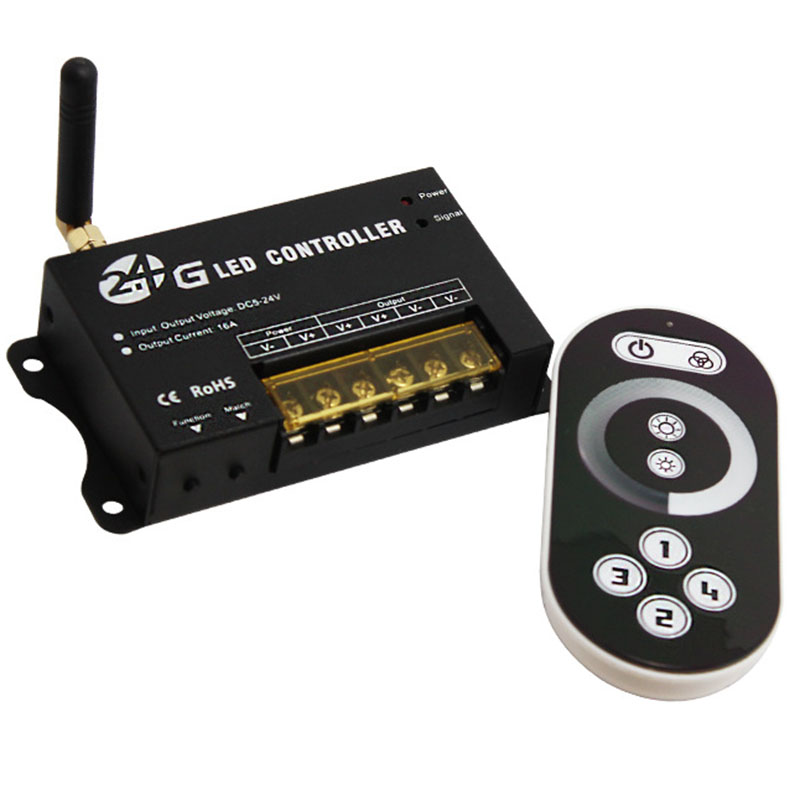
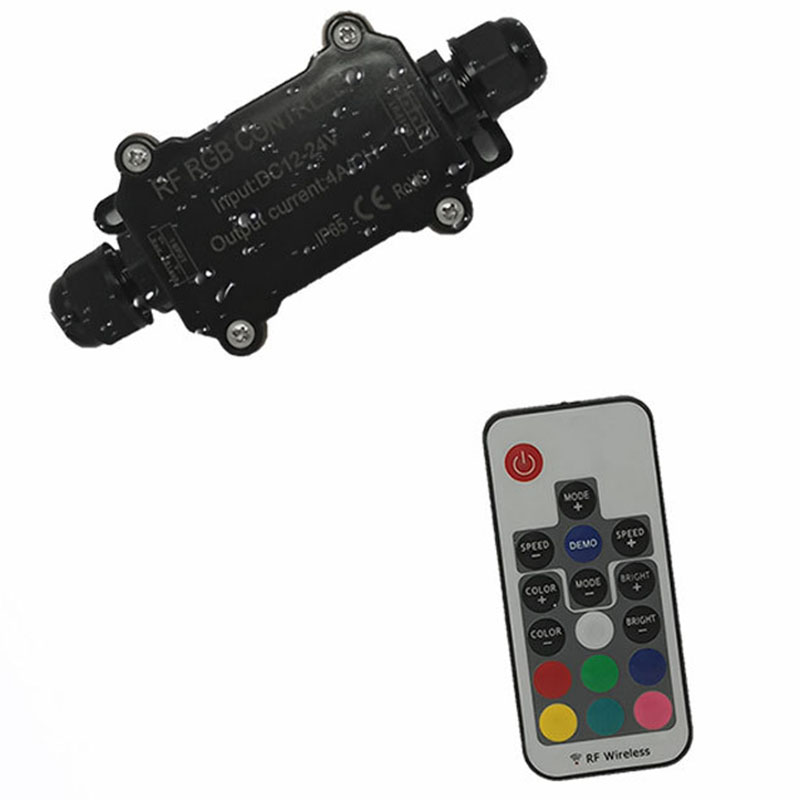
- RF wireless remote dimmers provide simple handheld brightness adjustment.
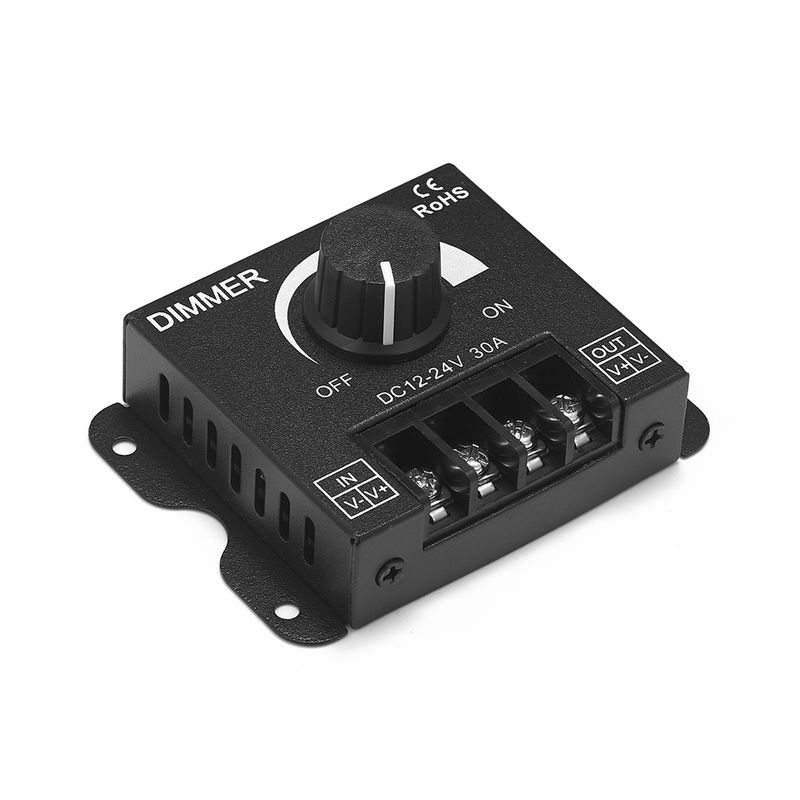
- Manual rotary knob and touch-panel dimmers offer direct, intuitive operation for convenient on-site lighting adjustment.
- PIR motion sensor switches automatically activate connected LED lights when movement is detected, inline sensor controller can be conveniently accommodated as part of the lighting installation.
- Programmable timer controllers allow users to preset lighting schedules and automate lighting operation according to specific time requirements.
From straightforward wireless dimming and manual brightness adjustment to motion-activated switching and scheduled lighting control, LeyNew provides versatile and easy-to-use solutions for everyday low-voltage LED lighting installations.
Different models support different input voltages, output channels, and load capacities, making it easy to select a suitable dimmer for your LED lighting setup.
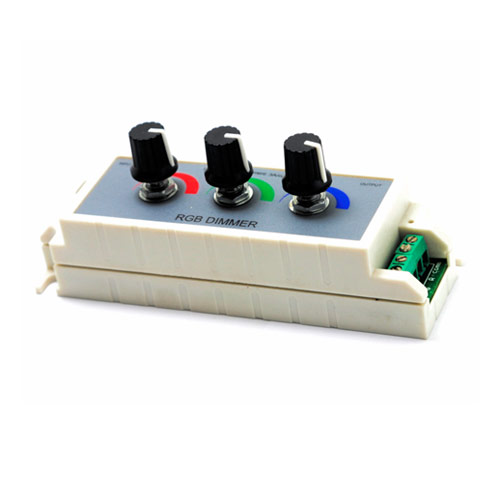
12/24V RGB LED Dimmer 3A/CH - Knob Control for Strip Lights | Max 108W




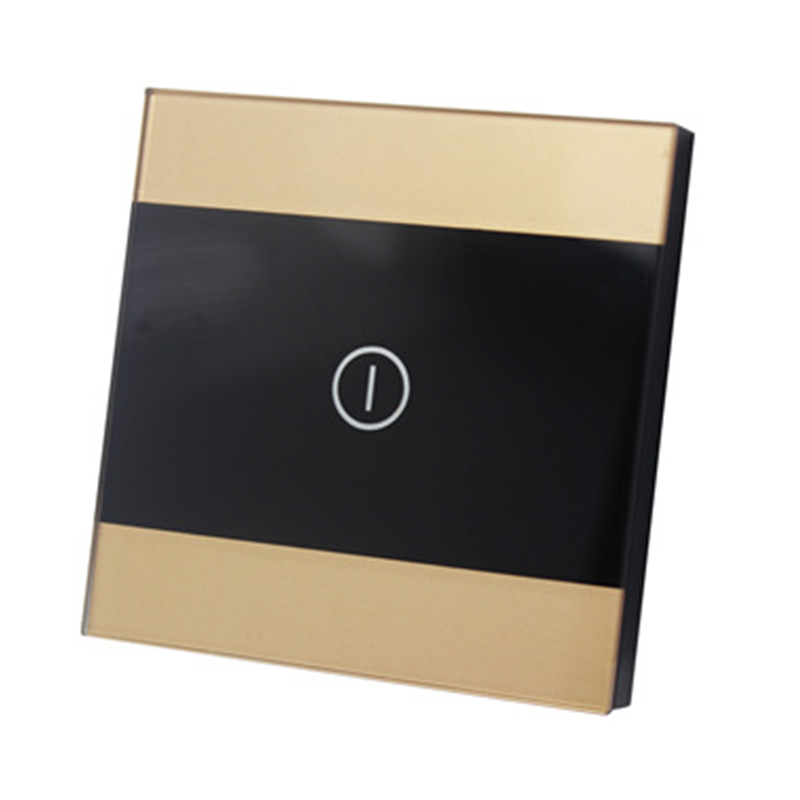
TM06 Wall Touch Dimmer | DC12/24V 8A Glass Panel LED Controller


FAQ About LED Light Dimmer
Direct answers to common wiring, voltage compatibility, and control questions on low-voltage DC dimmers from our technical support desk.
The best dimmer for led lights depends on whether your setup controls power before or after the LED driver. If you want a traditional wall switch on the 120V mains feed, you need a phase-cut wall dimmer paired with a dimmable driver. If you run a standard constant-voltage power supply, a secondary-side 12V or 24V DC inline controller is the best dimmer for led lights because it controls brightness smoothly down to 0.1% via pulse-width modulation without line interference. For standalone single-color LED tape, a 24V DC dimmer eliminates minimum-load hum entirely.
An inline DC LED light dimmer controls output on the secondary 12V or 24V side using pulse-width modulation (PWM), unlike AC wall dimmers that chop 120V mains voltage. In our catalogue, 56% of models in this category are dedicated 24V units, compared to an 8% average across our sibling categories. Sibling units like trailing-edge dimmers wire ahead of the power supply to regulate line current, requiring an ELV-compatible transformer. A DC dimmer sits between a standard non-dimmable driver and the strip, switching the ground rail thousands of times per second to vary brightness without driver compatibility headaches.
A low-voltage LED light dimmer must always be installed between the constant-voltage DC power supply and your LED strip, never directly into 120V mains power. Connect your AC line voltage into the driver input terminals (Live, Neutral, Ground). Run the positive and negative 12V or 24V output wires from the driver directly into the Power + and Power - terminals on the dimmer. Finally, connect your LED strip leads to the dimmer output terminals. Wiring an AC mains line directly into a low-voltage DC dimmer burns out the control IC instantly.
Running a dual dimmer and dimmer configuration requires matching channels or linking synchronized RF controllers. If you install two independent dimmers wired to the same power supply, their ground return paths stay separate, meaning each dimmer can drive its own run of LED strip lights independently up to its rated amperage. However, you cannot wire the outputs of two dimmers in parallel to the same single LED strip; the two PWM timing circuits will fight each other, causing erratic flashing and thermal shutdown. For multi-zone control from a single interface, use a multi-channel unit.
To calculate capacity on an 8A LED light dimmer, multiply rated amperage by working voltage and apply an 80% continuous safety margin. For a 12V system, 8A yields 96W nominal, but derating to 80% leaves a safe continuous ceiling of 76.8W (roughly 5 meters of 14.4W/m tape). On a 24V system, 8A yields 192W nominal, giving you 153.6W of continuous running headroom. Running any DC controller continuously at 100% of its nameplate amperage generates internal junction heat exceeding 70°C, drastically shortening terminal and MOSFET lifespan.
The right outdoor dimmer for led lights must have an IP67 or IP68 ingress rating and an RF wireless remote to operate from inside an enclosure. Standard touch-glass wall panels and rotary dials are IP20 indoor rated and short-circuit when exposed to morning condensation. In our catalog, models like the RF161 feature a sealed waterproof chassis designed specifically for wet-location 12V and 24V exterior tape, garden spotlights, and perimeter facade fixtures. Pairing a sealed controller with waterproof cable glands ensures zero moisture tracking into the terminal contacts.
A programmable 5-channel LED light dimmer like the TC420 lets you schedule 24-hour sunrise, daylight, sunset, and moonlight dimming curves over time. Using the PC software or mobile app, you define specific time nodes (for example, ramping channel 1 from 0% at 06:00 to 100% by 07:30) and download the profile via USB or Wi-Fi. The controller operates stand-alone using an internal clock battery, running five independent 12V-24V DC channels up to 4A each, which makes it ideal for aquariums, vivariums, and automated architectural circadian lighting.