
LED Strip Amplifier
3 productsLow voltage LED strip lights are often affected by voltage drop and signal attenuation, especially when the LED strip length is long. This normally leads to signal weakening, making the LED lighting effect uneven or out of control. In this case, we need to use LED strip light amplifiers.
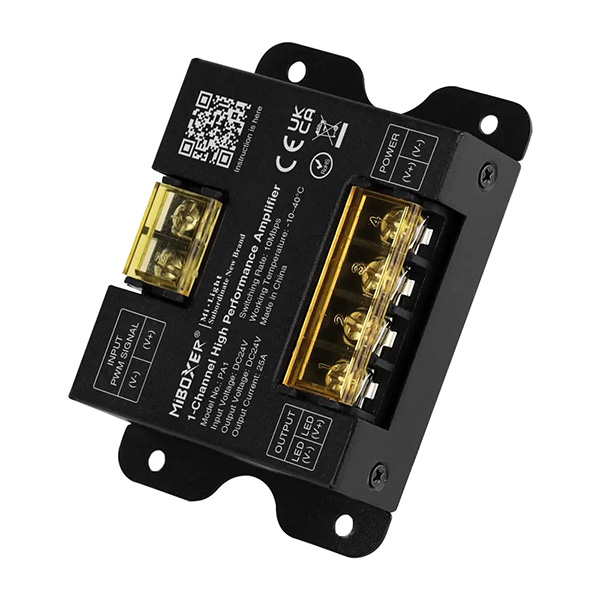
MiBoxer Mi-Light led light strip amplifier adopts a high-speed optical coupler with a 10Mbps output rate; it can output the signal of the main controller completely and synchronously. These high-performance led strip amplifiers work on all PWM series LED controllers in the market.
Made from the big current MOSFET to assure the high rate output. Every time you add one more led strip amplifier, you can connect twice as many as LEDs. Theoretically, it can connect countless amplifiers, input and output are with optoelectronic isolation. Working with the main controller can satisfy the application requiring large power, wide range, and synchronization area.


FAQ About LED Strip Amplifiers
Direct engineering answers on sizing, wiring, and troubleshooting low-voltage LED strip amplifiers for long-distance lighting runs.
An LED strip amplifier acts as a signal repeater and power booster that samples the dimming or color signal from your primary controller and replicates it onto a fresh section of tape. Controllers have fixed current limits—often 6A to 15A total across all channels. When your load exceeds that threshold, or when voltage drop dulls the end of a run, the LED amplifier takes the weak PWM output, isolates it with a high-speed optical coupler running at up to 10Mbps, and drives the next length using dedicated current from a fresh power supply.
To wire an LED strip amplifier correctly, connect the tail end of your first tape run—or direct leads from the master controller—into the amplifier's input terminals, then wire the subsequent tape run to the output terminals. Never connect the output of an amplifier back into the output of another device.
You choose an LED strip amplifier based on the number of independent negative color channels on your tape. A 4-channel model like the PA4 manages standard RGBW or dual-zone white runs, carrying up to 6A per channel. If you run 6-wire RGB+CCT tape (red, green, blue, warm white, and daylight white sharing one positive terminal), step up to our 5-channel PA5 amplifier, which handles all 5 channels simultaneously with a 15A combined ceiling.
A color mismatch downstream from an LED strip amplifier is almost always caused by swapped negative channel legs on the terminal block. Because the amplifier electrically isolates inputs and outputs, mixing up the green and blue leads on the output will produce purple when the controller calls for cyan. Turn on one primary color at a time at 10% brightness to isolate which wire is crossed, and confirm the common anode wire sits firmly seated in the positive terminal.
Theoretically, you can daisy-chain an unlimited number of LED strip amplifiers because each optical coupler regenerates the PWM wave without drawing downstream operational load from upstream units. In practice, long commercial installations routinely run 10 to 15 repeaters across several hundred meters. You must feed each repeater with its own properly sized DC power feed so the cumulative current does not attempt to pull through earlier circuit segments.
A high-spec LED amplifier will not create any human-perceptible delay during color shifts or dimming fades. MiBoxer units use optical couplers rated for 10Mbps transmission speeds, processing PWM frequency shifts within nanoseconds. Even chained through 8 successive repeaters down a 100-meter hotel atrium, the entire strip array turns on, dims, and cycles colors in exact frame synchronization with the primary master controller.
An LED strip amplifier overheats when the continuous load current exceeds 80% of its rated MOSFET capacity or when ambient heat cannot escape the enclosure. If a 4-channel unit is rated for 24A total (6A per channel), running it continuously at 5.8A per channel inside an unventilated ceiling void will build thermal stress quickly. Keep continuous working loads around 70% to 75% of maximum capacity, mount the metal casing against a heat-dissipating surface, and verify wire terminals are torqued tightly to eliminate contact resistance.
Premature MOSFET failure in an LED strip amplifier almost always stems from dead shorts during installation or reverse-polarity input wiring. When a technician clips tape powered live, conductors cross for a millisecond, driving instantaneous amperage past 100A and vaporizing the silicon gate. Always disconnect AC mains before trimming tape or securing terminal screws, and verify wire polarity with a digital multimeter before powering on.