
RF & Tuya Bluetooth LED Controllers
6 productsBluetooth and RF are currently the most common and widely used wireless communication technologies. By supporting all three protocols at the same time, LED controllers can meet a wider range of user needs, allowing users to control LED lighting systems with the devices and networks they are used to, providing a more convenient and easy-to-use user experience.
The SkyDance RF & Tuya Bluetooth Series combines Bluetooth app control with 2.4GHz RF remote operation, providing flexible wireless control for different LED lighting systems. Rather than requiring users to rely exclusively on a smartphone or a handheld remote, compatible controllers offer both control methods in one device. Bluetooth enables app-based lighting adjustments, while RF provides convenient direct control with a compatible SkyDance remote.
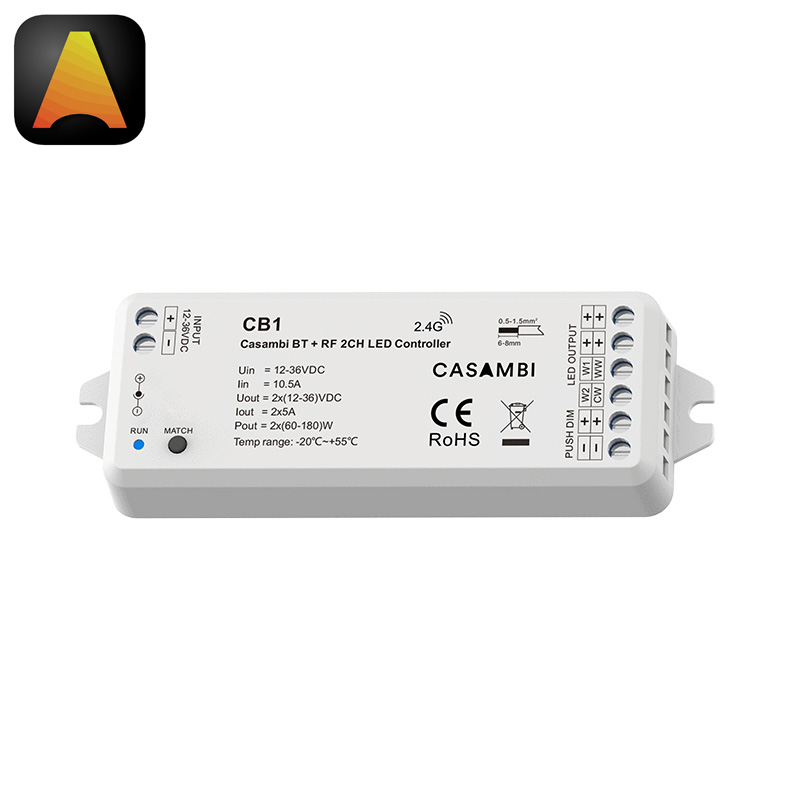

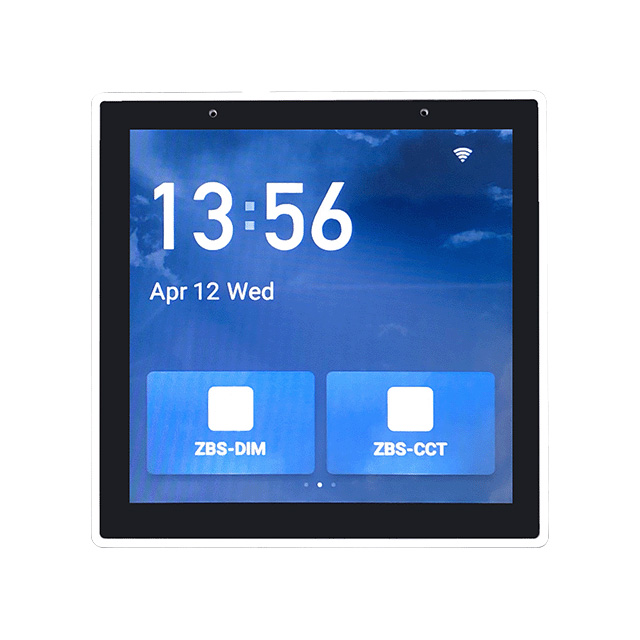


Smart LED Strip Controllers for Single-Color, CCT, RGB, RGBW, and RGBCCT Lighting
SkyDance Bluetooth + RF LED controllers support different constant-voltage LED strip configurations, including single-color dimming, tunable white (CCT), RGB, RGBW, and five-channel RGBCCT lighting, support DC 12–24V, 12–36V, or 12–48V LED strips.
Smart AC TRIAC Dimmers and Smart 0/1–10V Dimming Modules are also available.
Why Choose RF & Tuya Bluetooth Control?
The key advantage of the SkyDance RF & Tuya Bluetooth Series is the combination of app-based Bluetooth operation and dedicated RF remote control in one lighting control solution. Users can choose smartphone control for convenient adjustments or RF remote control for quick, direct operation.
Bluetooth-based app control can be particularly useful for straightforward local installations, while RF remotes provide a familiar control option for everyday use. Additional gateway or network equipment may be required for remote access or other connected features.
FAQ About RF & Tuya Bluetooth LED Controllers
Direct answers on wiring, protocol differences, RF remote pairing, and load limits for Bluetooth LED controllers from our bench engineers.
A Bluetooth LED controller operates entirely locally without internet access, a Wi-Fi router, or cloud servers. Your smartphone establishes a direct point-to-point Bluetooth Low Energy connection to the hardware, giving you instant color and brightness adjustment within 10 to 15 m. At the same time, the 2.4GHz RF receiver listens for paired hand remotes or wall panels up to 30 m away through drywall. While tuya wifi controllers requires an active 2.4GHz wireless network for app discovery, these Bluetooth units work reliably in remote cabins, camper vans, or job sites before broadband is activated.
A Bluetooth LED controller pairs directly to your mobile device in seconds without entering network passwords or configuring IP subnets. Wi-Fi controllers connect directly to home routers for native away-from-home access but can congest consumer wireless access points. Zigbee units require a dedicated coordinator hub like Philips Hue or Tuya. Bluetooth provides the simplest standalone setup, with RF remotes giving family members tactile wall control without a phone.
The WB5 5-channel Bluetooth LED controller handles up to 3A per channel, with a maximum combined rating of 15A across all 5 channels. On a 12V DC system, that caps your total continuous draw at 180W; on 24V DC, the ceiling rises to 360W. To maintain a safe thermal operating margin and avoid continuous terminal block stress, calculate your total strip wattage and apply an 80% continuous-load headroom rule. If your architectural run pulls 400W of 24V RGBW tape, do not overload the primary controller; route the PWM control channels into led power repeaters powered by a secondary driver.
To pair an RF remote to your Bluetooth LED controller, quickly short-press the physical 'Match' button on the controller case, then immediately tap any zone on or off key on your handheld remote. The connected LED strip will flash slowly 3 times to confirm the radio frequency link is locked. If your controller is concealed behind drywall or inside an aluminium cove where you cannot reach the match key, turn off AC line power to the driver for 10 seconds. Restore power, and within 5 seconds of the strip illuminating, press the remote's power button 3 times. The tape will flash 3 times, confirming pairing.
A bluetooth light controller relies on 2.4GHz Bluetooth Low Energy signals, which face clear signal limits of roughly 10 to 15 m in free air and degrade when passing through solid masonry, concrete, or metal studs. When your phone walks out of direct range, the point-to-point data link drops automatically. Adding our wg-b bluetooth mesh gateway bridges your local controllers onto your home Wi-Fi network, giving you continuous out-of-room and cloud control. Alternatively, keep an RF remote mounted on the entry wall; 2.4GHz RF penetrates residential interior partitions much more effectively than unmeshed phone Bluetooth signals.
A bluetooth light controller works reliably for under-cabinet kitchen task lighting, especially when paired with an auxiliary RF wireless wall switch mounted beside standard switch plates. You can calibrate 2700K warm white for dinner prep and shift to 5000K daylight for cleaning directly through the smartphone interface. Because under-cabinet drivers and receivers are often tucked inside lower baseboards or upper false cabinets, Bluetooth avoids the weak Wi-Fi dead zones common behind granite backsplashes.
Tuya Bluetooth controllers are designed around consumer smart homes, offering straightforward smartphone pairing, Tuya app automation, and cross-compatibility with household voice platforms through an optional bridge. Casambi Bluetooth models, such as our CB1 and CB5, run on an industrial-grade self-healing Bluetooth Low Energy mesh protocol engineered for commercial architectural installations. Casambi controllers talk device-to-device with sub-millisecond sync, handle complex time-based circadian lighting curves without hubs, and offer deeper multi-user permission hierarchies. We currently list 6 models in this category, giving buyers a direct choice between commercial Casambi nodes and residential Tuya Bluetooth hardware.
Every Bluetooth LED controller in this category is a constant-voltage PWM pass-through unit that accepts DC 12V to 24V, with select hardware tolerating up to DC 36V. The output voltage matches your input voltage exactly. If you plug a 24V DC driver into the DC input terminal, the controller outputs a 24V PWM signal to the LED strip lights. Connecting a 12V LED strip while feeding 24V into the terminal block will burn out the tape's diodes within seconds. You cannot mix different voltage tapes on one controller; all channels share a single positive common terminal.
You must install an active Bluetooth mesh gateway to bridge your Bluetooth LED controller to Amazon Alexa, Google Assistant, or out-of-home cloud servers. Smart speakers cannot talk directly to standard Bluetooth Low Energy lighting accessories without an intermediary network node. The gateway stays plugged into a central 5V USB port or wall outlet, listening for local Bluetooth beacons while maintaining a persistent Wi-Fi connection to your router. Once paired through the Smart Life app, voice dimming commands route over Wi-Fi to the bridge, which translates and transmits them instantly via local Bluetooth to your LED controller.