
DALI Constant Current Dimmer
9 productsSuperLightingLED offers a full range of genuine SkyDance DALI Constant Current Dimmers, they are DALI signal-controlled LED dimming controllers designed to provide digital lighting control for compatible constant-current LED modules, COB light sources, and constant-current lighting fixtures.
Similar to DALI constant-voltage LED dimmers, these controllers receive digital dimming commands from a DALI master controller through the DALI bus, but instead of producing constant-voltage PWM outputs for LED strips, they deliver regulated multi-channel constant-current outputs to drive and dim connected constant-current LED loads.
Powered by an external DC12–48V constant-voltage power supply, they convert DALI control commands into corresponding output current adjustments, allowing constant-current lighting fixtures to be integrated into centralized DALI lighting control systems.
These DALI Constant Current LED Dimmers/Controllers are suitable for commercial lighting, architectural lighting, hotel projects, retail displays, office lighting, and other installations using multi-channel constant-current LED light sources.


FAQ About DALI Constant Current Dimmer
Direct answers to real jobsite questions about wiring, configuring, and troubleshooting DALI constant current dimmers and drivers.
A DALI constant current dimmer regulates electrical current in milliamps rather than voltage, delivering a fixed current such as 350mA or 700mA while letting DC voltage float within an operating window. Unlike constant voltage units that supply a flat 12V or 24V rail to standard LED strip lights with onboard resistors, constant current units connect directly to raw LED emitters, downlights, or dedicated constant current LED strips. Dimming commands from the digital bus modulate this output using high-speed PWM or linear amplitude reduction, maintaining stable color point and forward current across every diode without thermal runaway.
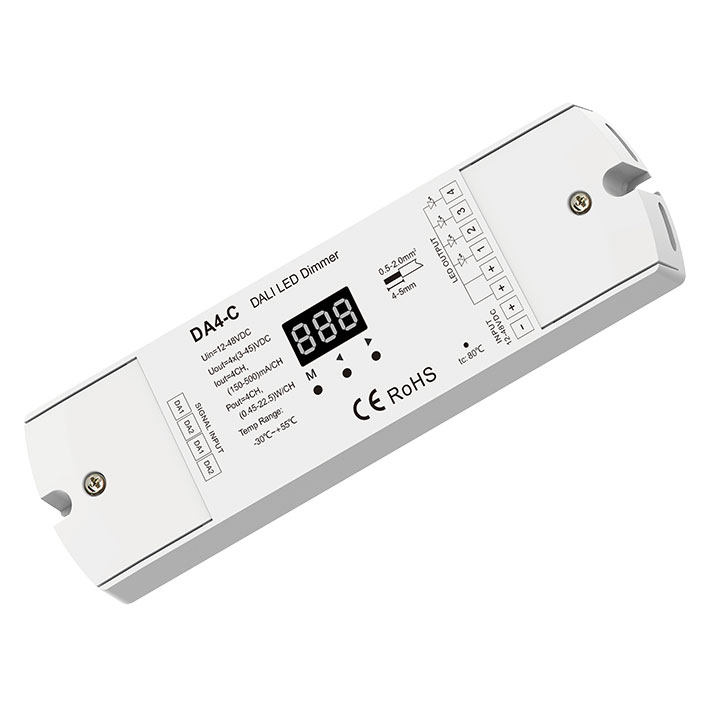
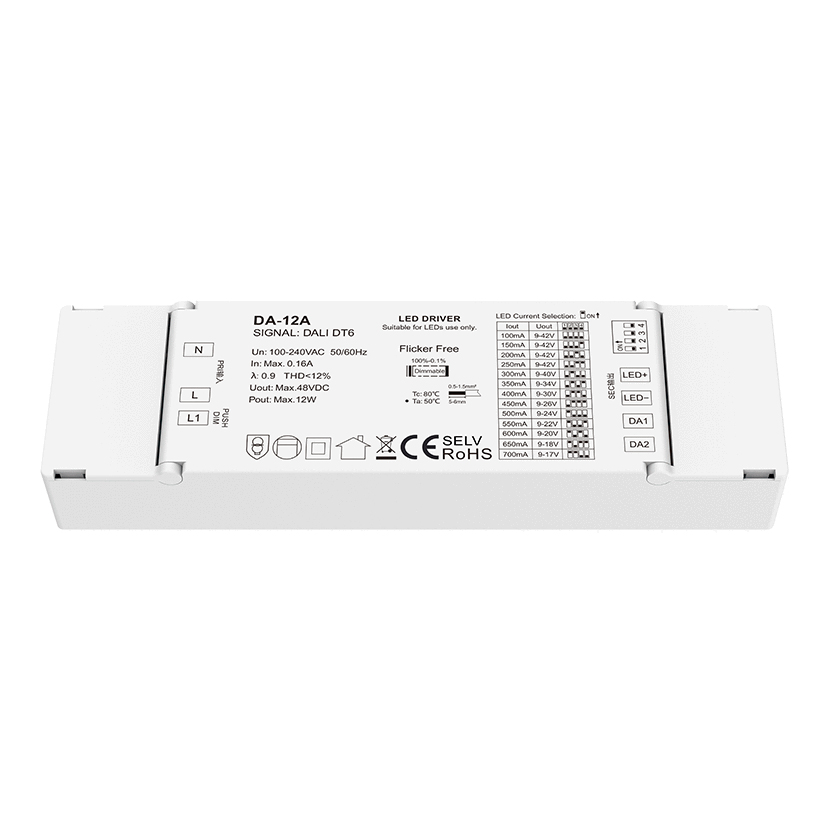
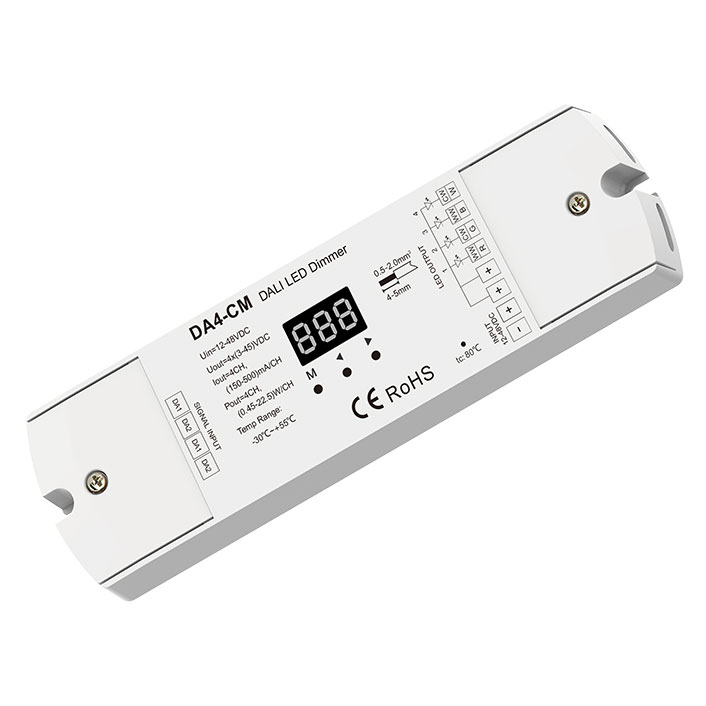
You set the output current on a DALI constant current dimmer using either onboard DIP switches, rotary dials, or digital buttons before applying power. On multi-range models like the DA4-C constant current dimmer, you choose between 150-500mA or 350-1200mA hardware ranges, then fine-tune the exact milliamp rating to match your fixture label. Never change DIP switch settings while the driver is energized. A mismatch here is destructive: setting 700mA on a downlight rated strictly for 350mA over-drives the junction, creating immediate heat discoloration and failing the diode array within hours.
LED strobing on a DALI constant current dimmer happens when the combined forward voltage (Vf) of your series LED string falls outside the driver's output compliance window. If your dimmer specifies a 10V to 45V output range and you connect only two 3V white LEDs in series (6V total), the internal buck converter drops below its minimum regulation threshold, enters auto-protection, and cycles on and off repeatedly. Measure your total series Vf with a multimeter under load; if total forward voltage is under 10V, you must add diodes to the series string or change driver models.
Select 4000Hz or 8000Hz on a DALI constant current dimmer whenever lighting broadcast studios, conference rooms, or spaces filmed on high-speed video cameras. Units like our DA4-C let you choose between 1000Hz, 2000Hz, 4000Hz, and 8000Hz via front display buttons. While a 1000Hz frequency is silent and completely invisible to human eyes, rolling camera shutters capture dark banding bands across video frames below 2000Hz. Switching the PWM output to 8000Hz eliminates camera flicker up to high frame rates, though it slightly reduces the lowest sub-1% dimming resolution.
Address allocation on a 4-channel DALI constant current dimmer depends on whether you set it to DT6 multi-address mode or DT8 single-address mode. In DT6 mode, you can assign 4 independent DALI addresses to control four separate single-color zones from one physical box. In DT8 mode for RGBW or tunable white fixtures, the device accepts all channel balance commands under 1 single DALI address. You can assign these addresses manually using the onboard numeric display and push buttons, or let a DALI master controller assign them sequentially via software commissioning.
A DALI constant current LED driver will not respond if the two-wire control line lacks bus power or suffers from crossed polarity on older non-compliant masters. Standard DALI requires an active 16V DC nominal bus power supply delivering between 12V and 20.5V at up to 250mA. Check your DA+/DA- terminals with a DC voltmeter; if you read 0V, the bus power supply is either missing or tripped. Also use the driver's manual self-test feature: press the test button to cycle local outputs, which tells you instantly if the issue is master-side or wiring-side.
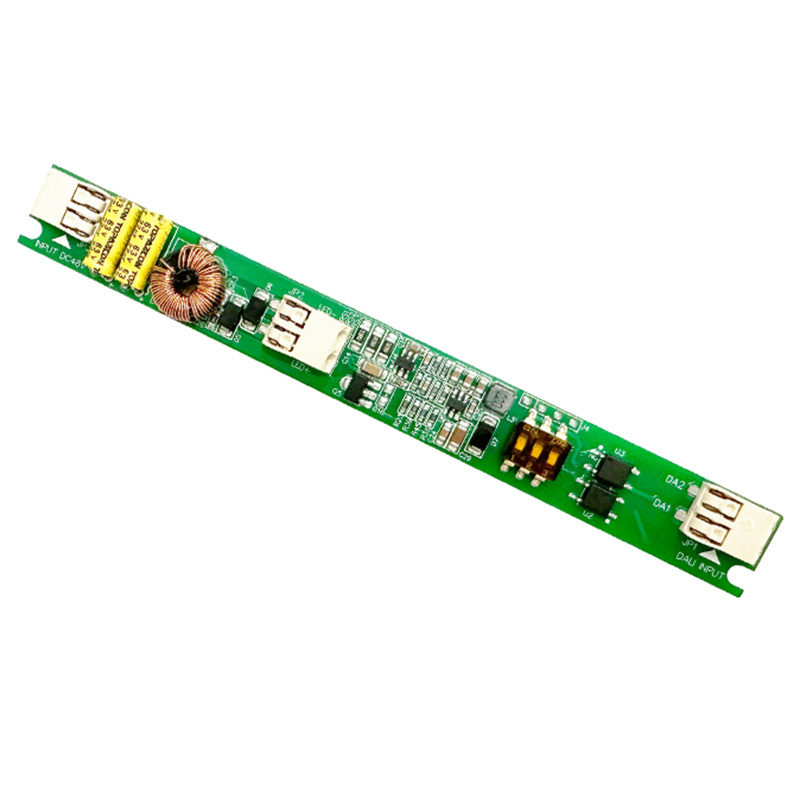
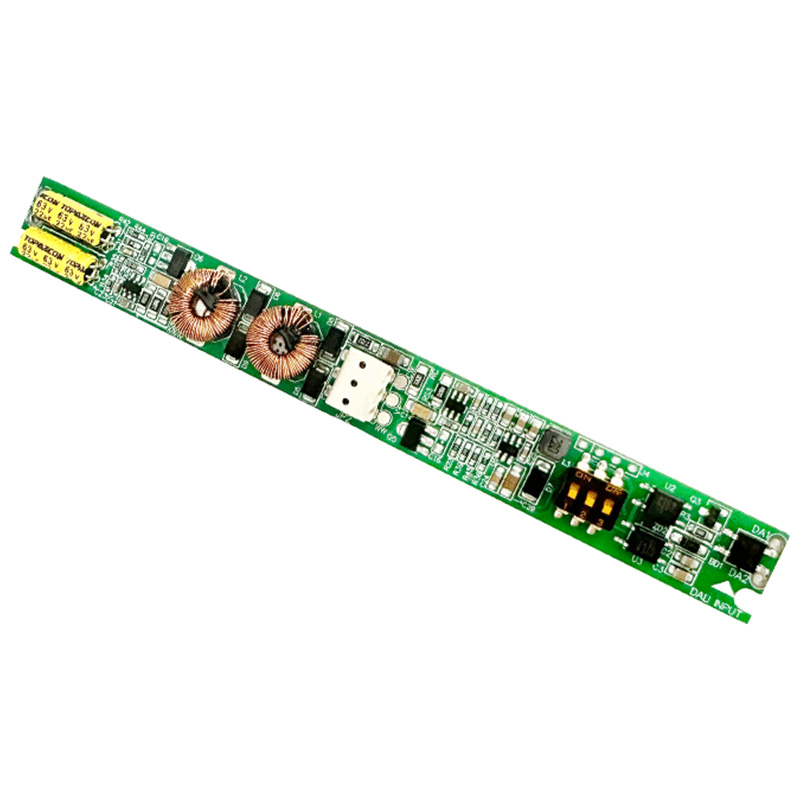
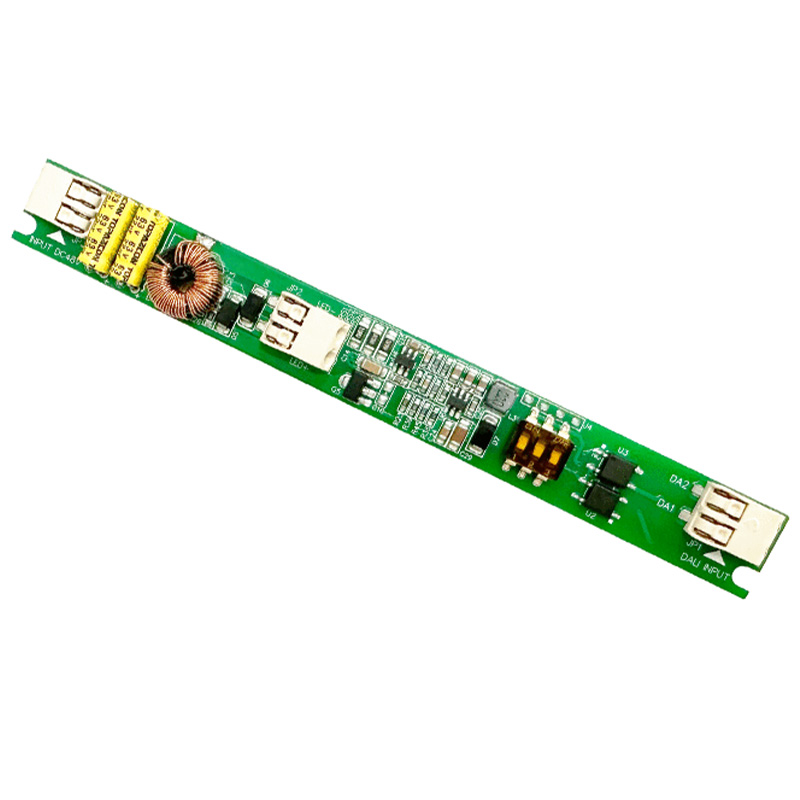
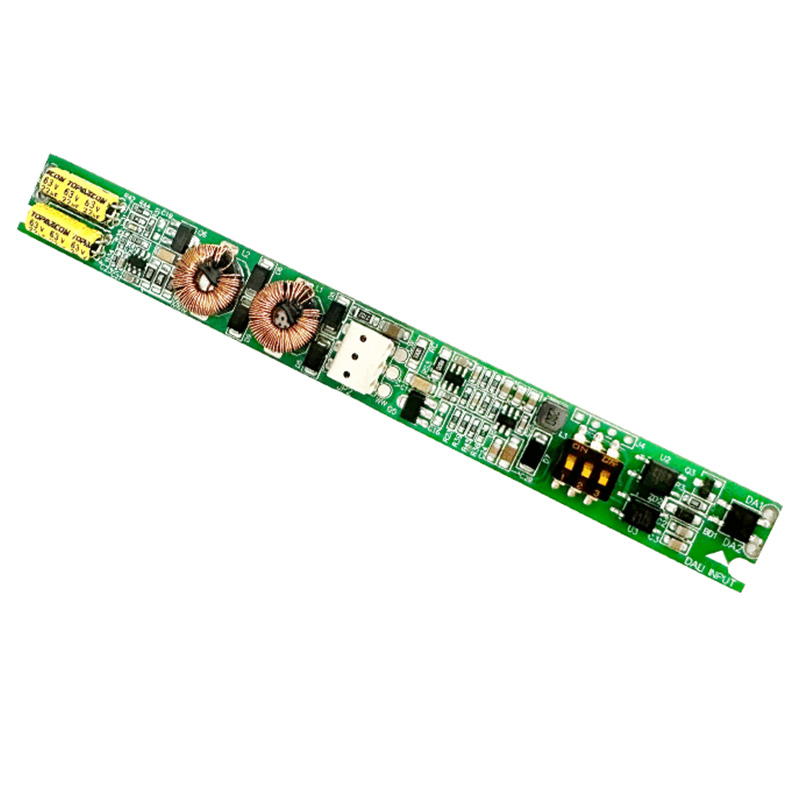
A DC-to-DC DALI constant current dimmer requires a separate DC power supply (typically 12V to 48V DC) on its input, whereas an AC driver wires straight to 120V-277V mains. Compact DC-input drivers like the CXD-21A and CXD-28A series are specifically designed for low-voltage magnetic track lighting and remote power enclosures. They fit inside tight 15mm-wide track channels where mains-voltage clearances are impossible. A single centralized bulk 48V supply feeds the track rail, and each miniature DC-to-DC constant current unit manages fixture dimming locally on the bus.
If an LED fixture opens while running, a DALI constant current dimmer detects zero load and caps its output voltage at its rated maximum (such as 48V) without damaging the internal switching circuitry. If a diode fails short-circuit, the driver automatically reduces its output voltage to maintain the programmed milliamp setpoint across the remaining working diodes. Built-in thermal and short-circuit protections recover automatically once wiring faults clear, protecting both your luminaires and the driver from catastrophic burnout on the jobsite.