
DMX Triac Dimmable
4 productsSkyDance DMX Triac Dimmer Series is specially designed to bring professional DMX512 lighting control to conventional AC-powered, phase-cut dimmable LED lighting systems. It converts standard DMX512 digital control signals into 1-channel or 2-channel AC phase-cut outputs, enabling centralized dimming and on/off control of compatible Triac-dimmable LED drivers, LED lamps, incandescent lights, and high-voltage halogen fixtures.
Operating with a universal AC 100–240V input, these dimmers are installed between the AC power supply and compatible lighting loads, allowing DMX lighting consoles to control multiple lighting zones independently.
- Forward-Phase & Reverse-Phase Dimming: Selectable leading-edge or trailing-edge phase-cut control provides better compatibility with different Triac-dimmable LED drivers and lighting fixtures.
- Adjustable Minimum Brightness: Configurable minimum brightness helps optimize low-level dimming performance and reduce flickering or unstable operation with compatible lighting loads.
- Reliable Quality & Protection: Stable phase-cut dimming performance, automatic over-temperature protection, and additional overload protection. With CE compliance and a 5-year manufacturer's warranty, they provide a dependable solution for integrating conventional AC dimmable lighting into modern DMX512 control systems.


How DMX to Triac Dimmer Works & Where to Use
Connect the DMX Triac dimmer to a DMX512 master controller, supply it with AC mains power, and connect its AC phase-cut outputs to compatible dimmable LED drivers or AC lighting fixtures.
Each output channel can be assigned a DMX address for independent brightness control. This makes it especially useful for integrating conventional dimmable lighting into professional DMX-controlled systems without replacing every existing luminaire or LED driver.
Ideal for hotels, restaurants, retail stores, offices, galleries, museums, architectural lighting, and other projects requiring centralized dimming of AC-powered lighting. It is particularly valued by lighting designers, DMX system integrators, electrical contractors, and professional lighting installers working on new installations or upgrading existing phase-cut dimming systems.
DMX AC Switch & Triac Dimmer Wiring: On/Off Control vs. Phase-Cut Dimming
SkyDance DMX AC Switches and DMX Triac Dimmers both operate with AC 100–240V lighting systems, but they serve different control purposes.
A DMX AC switch provides simple power ON/OFF control for an AC lighting circuit, while a DMX Triac dimmer regulates brightness by controlling the AC phase waveform.
Understanding their wiring configurations and load compatibility is essential for choosing the right solution for your lighting project.
1. DMX AC Switch Wiring – Centralized AC Power ON/OFF Control
A DMX AC Light Switch is designed to switch AC power on or off through DMX512 commands. It does not provide brightness dimming or phase-cut output. Instead, it supplies full AC mains power when switched ON and disconnects the controlled output when switched OFF.
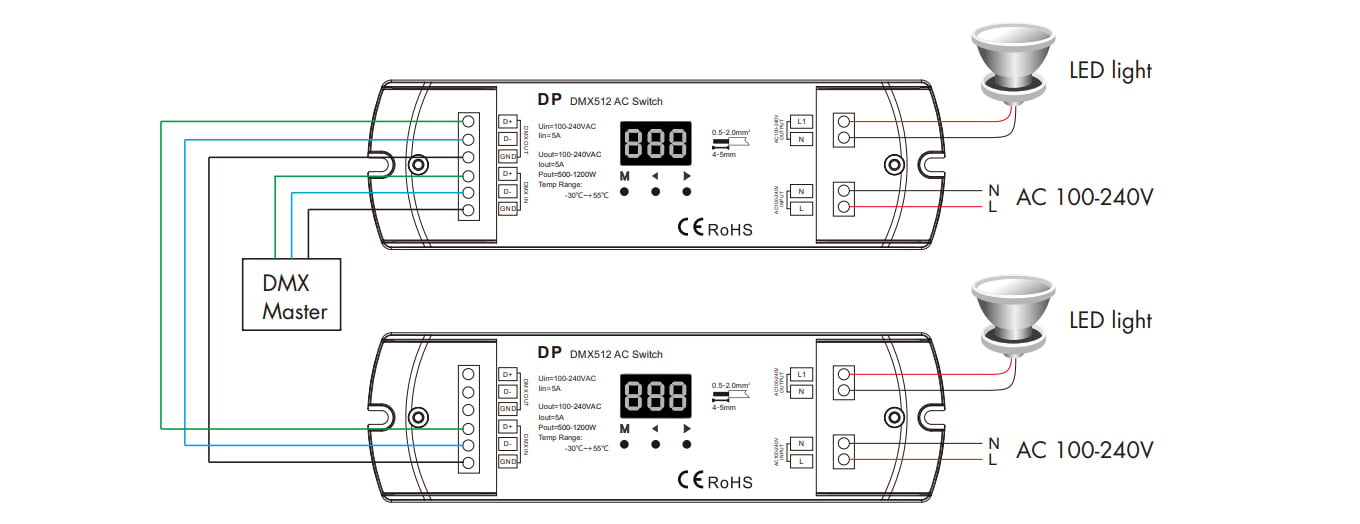
The switch can be installed in the AC supply line of a single lighting fixture, a group of AC-powered lights, or an entire downstream lighting branch circuit. This makes it suitable for centralized switching of non-dimmable LED fixtures, LED drivers, architectural lighting groups, decorative lighting, and other compatible AC-powered equipment.
- One DMX AC light switch controls one independently addressable AC output group.
- Multiple compatible lighting fixtures or drivers can be connected downstream, provided their combined load and startup current remain within the switch's rated capacity.
- Do not connect the AC switch output to a phase-cut dimming circuit or use it to regulate brightness.
2. DMX Triac Dimmer Wiring – AC Phase-Cut Brightness Control
Unlike a standard AC switch, a DMX Triac Dimmer does not simply turn the power supply on or off. It modifies the AC waveform through leading-edge (forward-phase) or trailing-edge (reverse-phase) control to regulate the brightness of connected lighting loads.
The dimmer is installed between the AC mains supply and the phase-cut dimmable LED driver or lighting fixture. For low-voltage LED strip applications, a compatible phase-cut dimmable AC-to-DC LED driver must be connected between the Triac dimmer and the DC LED strip.
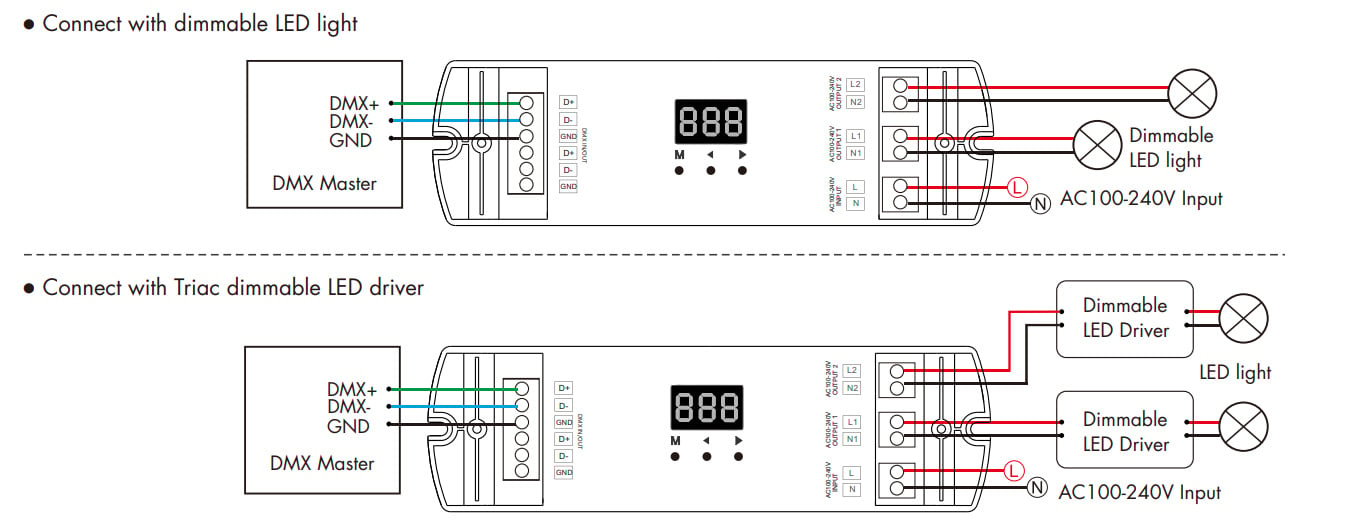
- Only use LED drivers and lighting fixtures explicitly rated for Triac or phase-cut dimming.
- Select leading-edge or trailing-edge dimming according to the connected driver's compatibility requirements.
- Check the driver's minimum load, maximum load, power factor, and startup inrush current when calculating the connected lighting load.
- Do not connect non-dimmable LED drivers, ordinary non-dimmable electronic power supplies, or low-voltage DC LED strips directly to a Triac dimmer.
- For multi-zone installations, select a suitable single-channel or dual-channel DMX Triac dimmer according to the required independent lighting circuits.
Choosing between a DMX AC light switch and a DMX Triac dimmer depends on whether your project requires simple AC power switching or continuous brightness adjustment. Both solutions allow conventional AC-powered lighting to be integrated into professional DMX512 control systems without requiring every lighting fixture to have a built-in DMX interface.
FAQ About DMX Triac Dimmable
Direct engineering answers on phase-cut control, load ratings, and DMX addressing for high-voltage Triac dimming.
A DMX controller for LED lights operating on Triac control is an AC phase-cut decoder that converts standard digital DMX512 or RDM network packets into 100-240V AC forward-phase (leading edge) or reverse-phase (trailing edge) power. Instead of outputting low-voltage PWM directly to tape, it mounts on the line-voltage side ahead of dimmable AC-to-DC power supplies or direct-mains dimmable bulbs. This allows architectural theatrical consoles or building automation processors to regulate standard phase-cut drivers smoothly across 256 digital steps from 0% to 100% brightness.
No, you cannot connect low-voltage DC LED strip lights directly to a DMX Triac dimmer without immediately destroying the strip. A DMX Triac unit outputs line-voltage 100-240V AC phase-cut mains, whereas low-voltage LED tape requires steady 12V or 24V DC. You must install a phase-dimmable AC-to-DC driver between the dimmer's AC output terminals and your LED strip. If you prefer to bypass phase drivers entirely and drive low-voltage tape straight from the control card, use a constant voltage DMX decoder instead.
Leading edge (forward phase) chops off the front of each AC half-wave cycle using traditional Triac silicon, which works well with resistive incandescent filaments and magnetic transformers. Trailing edge (reverse phase) chops off the falling edge using MOSFET semiconductors, eliminating voltage spikes and inductive ringing. Modern dimmable electronic drivers running LED strip installations run significantly cooler, produce zero coil chatter, and resist flickering far better on trailing edge. In our DMX Triac units, you can toggle between forward (leading) and reverse (trailing) mode directly on the digital display keys.
Calculate your driver load at a maximum of 20% to 30% of the dimmer's nominal resistive rating to handle capacitive inrush current safely. For instance, a 2A model like the S1-D1 delivers 240W to 480W on paper across 120V to 240V mains, but when driving capacitive electronic power supplies, cap your total connected load at 100W on 110V or 200W on 230V. If your architectural zone exceeds 400W of dimmable drivers, specify the heavy-duty SK1 phase-cut DMX dimmer, which handles up to 6A continuous output.
You can assign the starting DMX address manually using the onboard 3-digit numeric display and push buttons, or discover and address the device remotely over the signal line using RDM (Remote Device Management). In manual mode, hold the front buttons down for 2 seconds until the readout flashes, cycle to your target channel (001 to 512), and let it lock in. On networked installations where units sit tucked into inaccessible ceiling junction boxes, an RDM-compliant lighting console can query the device ID, read its status, and rewrite the decode address remotely.
An AC DMX Triac dimmer delivers variable phase-cut sinusoidal AC power intended to feed external dimmable drivers or line-voltage fixtures. By contrast, an AC high voltage DMX decoder contains onboard rectification stages that output high-voltage pulsed direct current (110V-240V DC) across multiple color channels designed specifically for long runs of driverless driverless-rectified AC strip. If your project uses standard single-color LED tape behind a phase-dimmable driver, you must use a Triac unit, not a direct high-voltage tape decoder.
No, you should never run non-dimmable drivers or electronic transformers through a phase-dimming circuit, because chopping the AC waveform destroys their internal rectifier stages. Instead, split your DMX signal out to the DP 1-channel DMX AC relay switch, which uses a 5A internal mechanical contactor. It interprets the DMX channel value (switching on at DMX values above 127 and off below) to cut or provide 100% full mains sine-wave power cleanly without phase distortion.