
LED Remote Control
2 productsWireless Remotes for the LTECH DX Lighting Control System
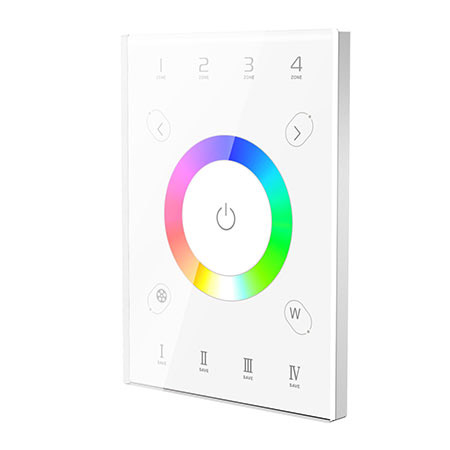
LTECH DX wireless remotes provide convenient wall panel control for compatible LED lighting and wireless control devices within the LTECH DX system. Designed for use with specified LTECH R4 Series receivers, these remotes allow users to adjust lighting without needing to access the controller or LED strip directly. A compatible remote can complement wall-panel operation and provide convenient handheld control for residential and commercial lighting.

FAQ About LED Remote Control Systems
Direct engineering answers on pairing, range, multi-zone setup, and wiring for LTECH DX series handheld and touch panel LED remote controls.
An RF LED remote control does not wire directly into your tape; it broadcasts 2.4 GHz wireless radio signals to a paired receiver like the R4-5A, which regulates the low-voltage PWM output to the LED strip lights. For homeowners setting up lighting with remote transmitters, line-of-sight is not required. The radio signal penetrates drywall, cabinet carpentry, and acoustic ceilings up to a practical limit of 20 to 30 meters indoors. Once the receiver picks up the signal, it adjusts the constant voltage feed from your DC12V or DC24V power supply without dropping frame rates or color data.
Multi-zone lighting with remote control operates by assigning distinct receivers or receiver groups to dedicated numeric zone keys on a 4-zone transmitter. The LTECH V7 LED remote allows you to bind separate R4-5A units to Zone 1, Zone 2, Zone 3, and Zone 4 across kitchen, cove, and bar areas. Each zone toggles independently or synchronizes globally using the master key. Because each receiver acts as an independent PWM terminal, you can run separate 10-meter DC24V runs per zone without cross-talk or lag between adjoining architectural areas.
The reliable indoor reach for an RF light for remote control transmission is 30 meters in open interior spaces, decreasing to 15 to 20 meters through double-layer sheetrock and framing studs. Metal enclosures act as a Faraday cage; if you house a wireless receiver inside a steel electrical panel or deep aluminum junction box, signal range drops below 5 meters. Keep the receiver antenna exposed or housed in standard ABS trim boxes so your handheld LED remote control delivers instantaneous scene transitions from across the room.
Accurate remote light control depends on your color channel assignment, which is why our 2 live LED remote control models are dedicated 50% to RGB and 50% to RGBW configurations. A 3-channel RGB remote like the V7 manages red, green, and blue diodes on common-anode tape, but it lacks the dedicated fourth slider required for clean white balance. If you install 5-wire tape, pair a 4-channel transmitter like the UX8 touch panel with an R4-5A receiver so the phosphor-converted white diodes operate independently of the chromatic mix.
Yes, one LED light with remote transmitter can synchronize an unlimited number of R4 receivers within its 30-meter broadcast radius. When pairing, trigger the match key on each receiver one after another and press the identical zone button on your LED remote control. All matched receivers will respond to color wheel selections, dynamic chases, and dimming curves simultaneously. For runs stretching past 30 meters through concrete partitions, each sub-zone should receive its own receiver powered by local 12V or 24V power supplies.
To operate an RF remote light setup safely, wire a dedicated constant-voltage AC-to-DC power supply into the DC input of the receiver, matching the voltage of your LED strip lights. A 12V strip requires a 12V supply; a 24V strip requires a 24V supply. Never route line-voltage 120V AC into an R4 receiver terminal. For runs exceeding 5 meters on 12V or 10 meters on 24V, inject supplementary DC power along the line according to our RGBW wiring tutorial to stop voltage drop from making the end diodes appear red or dull.