
DALI AC Light Switch Controller
5 productsAt SuperLightingLED, we offer SkyDance DALI AC Light Switch Controllers designed to bring conventional AC-powered lighting and electrical loads into centralized DALI lighting control systems. Available in different output channel configurations, these controllers support independent or synchronized switching of one, two, four, or eight AC lighting circuits.
Unlike DALI dimmers, SkyDance DALI AC Light Switch Controllers provide simple ON/OFF switching rather than brightness adjustment. They receive digital switching commands from a DALI master and use built-in AC-rated relays to open or close the connected AC power circuits, allowing standard non-dimmable LED lights, lamps, and other compatible AC electrical loads to be switched through the DALI network without requiring dimmable drivers or specialized lighting fixtures.


Centralized DALI AC Lighting Switch Control
SuperLightingLED's SkyDance DALI AC switching solutions are suitable for hotels, offices, commercial buildings, conference rooms, retail stores, residential properties, warehouses, and other projects where conventional AC lighting needs to be integrated into a centralized building lighting management system.
They are particularly useful for electrical contractors, lighting designers, and building automation integrators who want to control non-dimmable lighting circuits through DALI, schedule lighting operation, switch multiple areas independently, and reduce the need for separate manual switching systems.
By adding DALI-controlled relay switching, existing AC lighting installations can become part of a coordinated smart lighting infrastructure without replacing their existing non-dimmable light fixtures.
Connecting AC Lighting Circuits to a DALI Switch System
To integrate conventional AC lighting circuits into a DALI lighting control system, connect the DALI master and a compatible DALI bus power supply to the DALI input terminals of the DALI AC Light Switch Controller.
The controller also requires an AC100–240V power supply. Connect the incoming AC Line (L) and Neutral (N) wires to the designated power input terminals, then connect the relay-controlled output terminals to the corresponding AC lighting circuits.
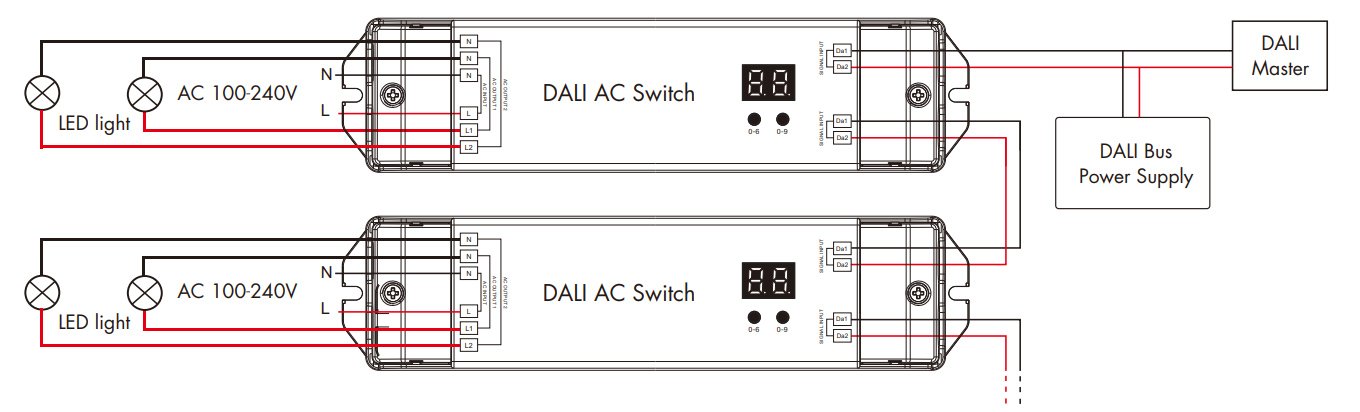
When the DALI master sends an ON command, the internal relay closes to allow AC power to reach the connected lighting load. When an OFF command is received, the relay opens and interrupts the power supply, switching the connected lights off.
Before installation, verify the controller's input voltage, relay contact rating, maximum load current, and supported load type. LED drivers and other electronic loads can produce high inrush currents when switched on, so the number of connected drivers must be calculated according to their input current and inrush characteristics rather than their rated output wattage alone.
FAQ About DALI AC Light Switch Controller
Direct answers to technical, wiring, and load-capacity questions on DALI AC relay switch units.
A DALI AC light switch controller converts incoming digital DALI commands into physical mechanical relay actions to switch 100-240V AC line power on and off. Unlike electronic dimmers that chop the AC sine wave, this unit uses physical relay contacts to completely open or close the AC circuit. That lets your DALI bus command non-dimmable LED drivers, fluorescent ballasts, high-bay lights, and standard socket circuits without needing a separate building automation panel.
Choose a DALI AC light switch controller whenever your fixtures use non-dimmable power supplies or draw high capacitive inrush current that burns out solid-state switches. Sibling products like DALI Triac dimmers are designed for phase-cut dimmable lamps, but feeding chopped sine waves into non-dimmable drivers causes buzzing, rapid component overheating, and driver failure within months. The relay controller provides a clean, full-voltage AC sine wave with zero leakage current.
Zero-cross switching inside the DALI AC light switch controller monitors the AC sine wave and closes the relay contacts precisely when the voltage passes through 0V. Switched-mode LED power supplies contain large filter capacitors that draw brief inrush currents reaching 50A to 80A for 2 to 5 milliseconds if switched on at the AC voltage peak. Closing at zero volts keeps inrush minimal, preventing relay contact welding and extending the switch service life.
You can switch non-lighting inductive and resistive AC loads as long as their operational and start-up currents stay within the channel relay rating. Contractors frequently wire exhaust fans, projection screens, display cabinet extractors, and recirculating pumps into these units so the lighting control system handles ventilation alongside scene presets. Just ensure any motor load does not exceed one-third of the nominal contact rating to account for inductive kickback.
The maximum load per channel depends on your model: units like the DH1 provide 10A dry contacts handling up to 1200W on 120V AC or 2300W on 230V AC resistive load, while the DH4 4-channel relay switch provides 16A per channel. For capacitive loads like LED power supplies, limit your connected driver capacity to approximately 600W on a 10A relay and 1000W on a 16A relay to absorb the initial switch-on surge.
DALI DT7 refers to the Device Type 7 standard (IEC 62386-208) governing switching relays that act strictly as binary on/off controls rather than dimmers. A DALI AC light switch controller consumes one individual short address per physical relay channel on your 64-address DALI loop. An 8-channel unit like the DH8 registers 8 consecutive addresses, which you can assign automatically through bus commissioning or set manually using the onboard buttons.
A DALI AC light switch controller cuts the mains AC line feeding the primary side of the drivers, dropping phantom power to zero across the entire lighting run. Even when dimmed to 0%, typical 24V or 48V LED drivers draw between 0.5W and 2W of standby idle power continuously. In an office or hotel with 200 drivers, an AC relay switch bank prevents 2,000 to 3,500 kilowatt-hours of wasted idle power each year.
Units like the DH1 and DH4 feature galvanically isolated, normally-open dry contacts, meaning the switch terminals carry no voltage until you supply it. This isolation lets you switch different phase lines (L1, L2, or L3) or entirely separate circuits (such as 12V DC, 24V DC, 120V AC, or 230V AC) through separate channels on the same controller. Models labeled with dedicated AC output route the incoming AC line directly through the relay contacts to the output terminals.