
IR CV Controller
8 productsOur IR infrared LED controllers support a wide working voltage range of DC 5-24V or DC 12-24V, offering dual-mode operations for maximum flexibility. You can easily perform basic adjustments using the physical buttons directly on the controller or connect it seamlessly to your smartphone via the Tuya Smart App for advanced smart automation and global remote control.
For Single Color LED Strips
-
Power Controls: On/Off master switch.
-
Stepless Dimming: Manual brightness adjustment buttons for precise fine-tuning.
-
Quick Brightness Presets: 4 dedicated buttons for fixed brightness levels (e.g., 25%, 50%, 75%, 100% for rapid setting).
-
0.5s & 3s On/Off Fade: You can choose a quick 0.5-second fade for instant yet soft illumination, or a 3-second slow fade for a premium, cinema-style lighting transition that prevents sudden eye strain.
-
Night Light Mode: One-click activation for a soft, ultra-low brightness ambient glow—perfect for bedtime or night walks.
For RGB/RGBW Multi-Color LED Strips
-
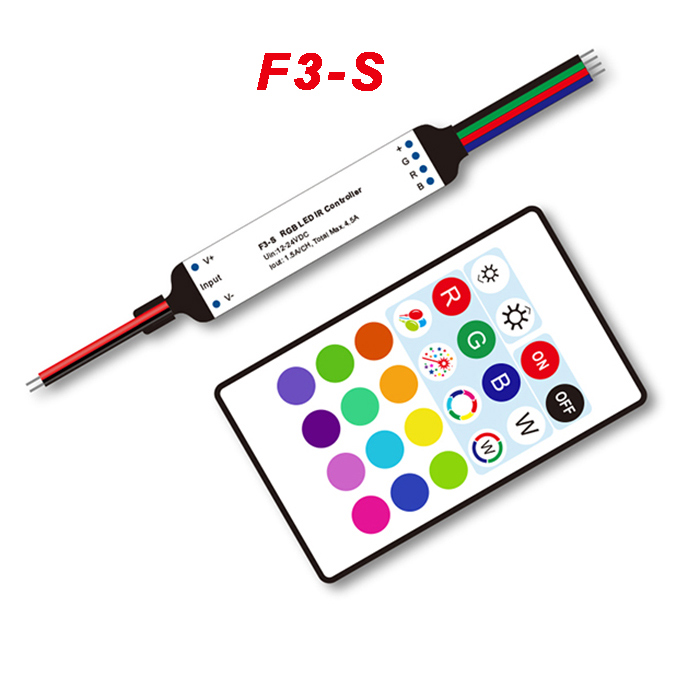
Static Colors Choice: Multiple shortcut keys for instantly switching to solid target colors.
-
Dynamic Modes: Built-in transition effects including fade, jump, and flash with speed control adjustments.




FAQ About IR CV Controllers
Practical answers from our engineering desk on wiring, load limits, sensor placement, and app control for constant voltage infrared LED controllers.
Overloading an IR CV controller beyond its rated amperage—such as pulling 7A on a 5A rated channel—causes the internal switching MOSFETs to overheat and trigger thermal shutdown or permanent failure. When the controller runs beyond its continuous current limit, you will often notice erratic flickering, dropped remote signals, or a warm plastic enclosure. If your total run wattage requires more current than the unit allows, split the run and wire a dedicated led strip amplifier downstream to carry the additional load safely without straining the primary receiver.
An IR CV controller works smoothly with 5V analog LED strip lights provided your power supply delivers a regulated 5V DC rail, but it cannot drive digital addressable strips. Units such as our F4-M(WT) accept a wide 5V to 24V DC input and pass common-anode PWM dimming cleanly across all channels. However, addressable digital LED strip lights need clock and data lines that standard constant voltage terminals do not provide. For standard 5V accent strips, verify your power supply amp rating covers the strip draw.
Yes, an IR CV controller with built-in casing buttons—such as our F1-D or F3-D models—provides direct manual control over power, brightness, and color modes without needing the handheld remote. The top-mounted buttons handle full on/off switching, step dimming, and cycling through pre-programmed static colors or dynamic transitions. Additionally, on WiFi-enabled models, you can pair the unit to the Tuya Smart Life mobile app, giving you a full digital touch interface and automated scheduling directly from your smartphone.
Wiring an RGBW LED tape light to a 4-channel IR CV controller requires connecting the shared positive lead to the V+ terminal and each individual negative color trace to the R, G, B, and W output channels. Models like our F4-M(WT)+RC3 handle 1.5A per channel across four outputs, allowing you to run vibrant color transitions alongside clean, dedicated 3000K or 4000K white task lighting. Pair the receiver with matching rgbw led strip lights to ensure independent channel control without white washout.
Under continuous 100% duty cycle, the surface casing of an IR CV controller should comfortably stay below 55°C (131°F) when loaded within 80% of its rated current capacity. Because constant voltage controllers regulate current using solid-state MOSFETs, heat generation increases proportionally to the total amperage passing through the terminal blocks. Always leave a few centimeters of open air space around the receiver body, avoid wrapping it in insulation, and never stack the controller directly on top of a hot power supply.
An IR CV controller cannot receive handheld remote commands through solid wood, drywall, or opaque cabinet doors because infrared light cannot penetrate non-transparent materials. If you mount the controller box inside a cabinet, you must route the small wired sensor diode through a 5mm hole so its tip faces into the room. Alternatively, on our hybrid WiFi models, you can completely ignore line of sight and control the LED strip lights through local wireless network commands or voice assistants.