
Car Use Fiber Optic Kit
19 productsFiber Optic Car Lights couple LED light source and fiber optics cables to make interior car decorations. These tiny through-illuminated and end-illuminated car fiber optic lights cables are soft and easy to hide, can be easily installed in a variety of confined spaces inside the vehicle to create a unique ambient experience for drivers and passengers.
What can you do with our Car Fiber Optic Lighting Kit?
Installing Fiber Optic Lights In Car:
Step 1. Plan the fiber optic light layout and select the appropriate fiber optic light kit; Step 2. Route the fiber optic cable through the holes or gaps in the vehicle interior according to your design requirements; Step 3. Connect the fiber optic to the LED light source, and connect the light source to the vehicle's power system; Step 4. Turn on the light source, check the fiber optic light effect and make adjustments. Elevate your car's interior ambiance with our captivating Car Fiber Optic Lighting.


Bluetooth 20W RGBW Dual Color LED Twinkling Starlight Fiber Optic Lights Illuminator

2/3mm Side Emitting Fiber Optic Lights Car Cable Spool 50m/164ft

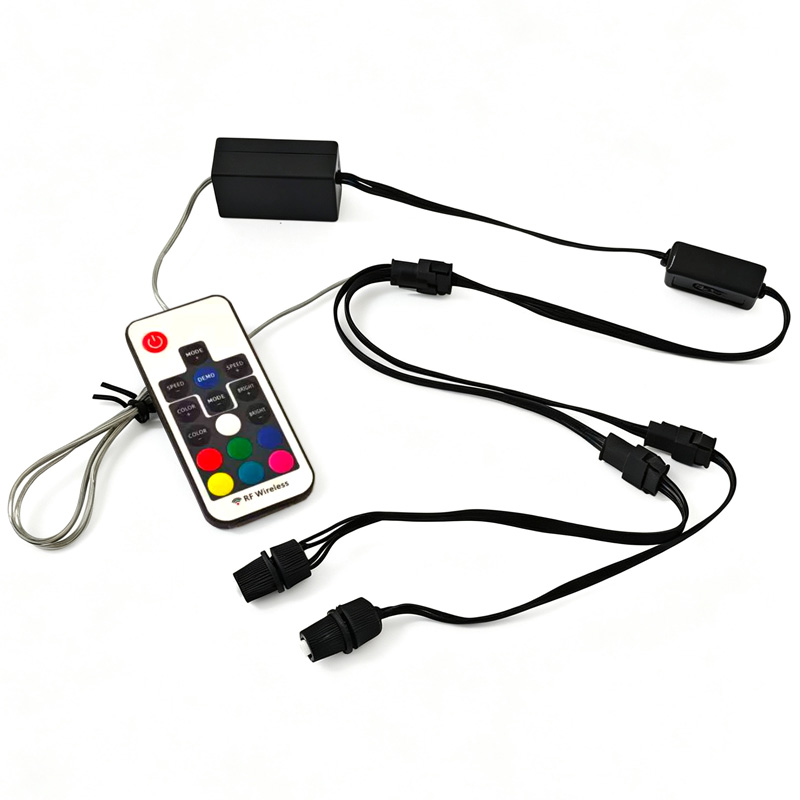
DC5/12V IR Remote RGB LED Fiber Optic Light Source Illuminator

DC12V 6 Heads Bluetooth RF RGB LED Fiber Optic Illuminator

Bluetooth RF RGB/White Shooting Star Fiber Optic Light Engine


10W Bluetooth+RF Music Twinkle RGBW LED Fiber Optic Light Engine


16W Bluetooth APP & RF Twinkle RGBW LED Star Fiber Optic Light Source


32W Bluetooth APP & RF Music Twinkle RGBW LED Fiber Optic Light Source

Car & Bedroom Twinkle RGBW LED Fiber Optic Star Light Illuminator

DC12V Double Head 32W Tuya RF RGB Fiber Optic Light Source
Frequently Asked Questions About Car Use Fiber Optic Kits
Direct engineering answers on vehicle wiring, headliner starlight bundle sizing, heat management, and fiber routing.
Fiber optic lighting transmits light from a remote illuminator through flexible PMMA optical strands using total internal reflection. The light source sits hidden behind vehicle trim or under a seat, focusing an LED beam directly into the polished collar of the fiber bundle. The fibers themselves carry no electricity and generate zero heat along the run, which makes routing hundreds of points through roof foam and fabric safe. At the cut strand tip, photons exit into the cabin, simulating pinpoint stars without placing hot electrical components overhead.
You can cut fiber optic lights at any point along each strand using a hot knife or sharp wire nippers. In a car headliner, you push 25 to 50 mm of strand through each pinhole drilled in the backing, lock the back with hot glue, and snip the cabin side flush against the fabric. A clean 90-degree cut gives a round, sharp star point, whereas an angled cut widens the light spread. We stock replacement fiber optic strands on 50 m spools if you ever cut a run too short during rough-in.
The fiber strands never get warm, but the fiber optic led light engine generates heat at its aluminum enclosure and needs open airflow. A 16W engine draws roughly 1.33A at 12V DC, which an automotive alternator handles without measurable drop while driving. If you run the system with the engine switched off, a standard 60Ah car battery drops below crank threshold in roughly 18 to 24 hours. We recommend wiring the 12V feed to an accessory-switched circuit rather than a constant battery rail.
A native 12v fiber optic lighting kit connects directly to vehicle DC power without an inverter humming under your trim. Automotive models handle alternator voltage swings from 11.5V up to 14.4V without burning out emitter diodes. Residential light engines adapted with cheap step-down buck modules frequently introduce alternator whine into your audio system.
The optical fibers never burn out because PMMA acrylic does not degrade under visible LED light. The solid-state LED emitter inside our illuminators is rated for 50,000 operating hours, meaning daily driving will not wear it out. What causes early failure in vehicles is engine compartment heat or trapping the metal illuminator inside unventilated pillar cavities where ambient heat climbs past 60°C. Mount the box under a passenger seat or behind a vented trunk trim panel and the led fiber light lasts the life of the car.
A Bluetooth car led illuminator connects point-to-point to your phone without requiring a local wireless router. In a moving vehicle, a WiFi-only light engine loses pairing whenever your phone switches between cellular data and mobile hotspot. Our Bluetooth modules let you tweak RGBW hues, twinkle motor speed, and music response directly from the front seat without relying on cell service or vehicle Wi-Fi networks.
Capacity depends entirely on the engine coupling diameter and strand thickness. A 20 mm coupling port holds roughly 600 pieces of 0.75 mm fiber, 300 pieces of 1.0 mm fiber, or 130 pieces of 1.5 mm fiber. In small coupes, 300 to 450 mixed strands provide realistic density; full-size SUVs often take 800 to 1,200 points. If you need more points than a single port allows, our dual-head 20W and 32W fiber optic light engines split the bundle between two ports to keep light transfer balanced.
Standard end-glow optical fibers stay completely dark along their run, carrying illumination strictly to the tip. If you want illuminated dashboard outlines or door card seams, you need a side-emitting led light fiber made with an MMA polymer core that bleeds light laterally. We stock 2 mm to 8 mm side-glow cables with integrated mounting flanges that press directly into interior dashboard gaps. For starlight headliners, using side-emitting cable is a mistake because light leaks behind the roof liner and dims your ceiling stars.
Uneven star brightness happens when the fiber strand bundle is cut unevenly inside the coupling head or optical grease contaminates the face. The fiber bundle ends must be trimmed flush, bundled tight with heat-shrink tubing, and polished flat before locking into the light port. If some strands sit recessed even 1 mm back from the LED condensing lens, they collect significantly less light. Loosen the set screw, inspect the fiber face with a flashlight, re-trim flush with a fresh razor, and re-seat the collar.
The twinkle effect comes from a motorized perforated disc spinning between the internal LED diode and the fiber bundle coupling head. As the wheel rotates, uneven cutouts intermittently block and pass light across different fiber bundles, creating an organic shimmering starry effect. You can adjust the rotation speed or halt the motor entirely via RF remote or mobile app when you prefer steady cabin ambiance. Our RGBW twinkle engines include independent white chips so the stars shimmer pure white while background accents glow colored.
Yes, using an add-a-circuit piggyback fuse tap in the interior fuse panel is the cleanest wiring method. Tap an accessory circuit that powers down with the ignition—such as the 12V cigarette lighter socket or radio accessory line—and fit a 3A or 5A inline blade fuse for the light engine. Never tap high-priority circuits like airbags or fuel systems. Ground the black wire directly to a bare unpainted chassis bolt under the dash to avoid ground loops and control signal interference.
We regularly build custom harness assemblies tailored to specific vehicle wheelbases and roof dimensions. You can specify exact strand counts, mixed diameters (0.5 mm, 0.75 mm, 1.0 mm, 1.5 mm), split bundle lengths (e.g., 2 m front, 4 m rear), and pre-terminated aluminum collar sizes. Send us your vehicle model or ceiling dimension sketch; an engineer returns a harness layout and price within 12 hours with no consultation fee or obligation. Many custom automotive harnesses we ship travel to trim shops and never appear in the standard catalogue.