
DALI 0/1-10V Dimmer
3 productsAt SuperLightingLED, we offer SkyDance DALI 0/1-10V Dimmers designed to integrate conventional 0-10V and 1-10V dimmable LED drivers and lighting fixtures into centralized DALI lighting control systems.
These dimmers receive digital dimming commands from a DALI master and convert them into corresponding analog 0-10V or 1-10V DC control signals, allowing compatible analog-dimmable drivers to adjust the brightness of connected LED lighting. This provides a practical way to bring existing 0/1-10V lighting equipment into a DALI-controlled environment without replacing every driver with a dedicated DALI model.
When connected to compatible 0/1-10V dimmable constant-voltage or constant-current LED drivers, these DALI to 0/1-10V converters can control a wide range of low-voltage lighting, including single-color LED strips, COB LED strips, linear LED fixtures, LED panels, downlights, and other analog-dimmable luminaires.
SuperLightingLED's SkyDance DALI 0/1-10V Dimmers are particularly valuable for retrofit installations and projects that already use 0-10V or 1-10V dimmable drivers but require centralized DALI scheduling, grouping, scene control, and brightness management.


How to Control 0/1-10V Lighting Using a DALI System
To integrate 0-10V and 1-10V LED lighting into a DALI system, the DALI 0/1-10V Dimmer is connected between the DALI communication bus and the analog dimming terminals of a compatible 0/1-10V LED driver.
First, connect the DALI input terminals of the dimmer to the DALI master controller's bus. A suitable DALI bus power supply must also be provided where required by the system.
Next, connect the AC Line (L) and Neutral (N) wires from the mains supply to the AC input terminals of the 0/1-10V dimmable LED driver. Connect the dimmer's analog signal output terminals to the driver's corresponding DIM+ and DIM- terminals. The driver's DC output terminals are then connected to the low-voltage LED strips or fixtures.
For luminaires with an integrated 0/1-10V dimmable driver, connect the analog control wires to the fixture's designated dimming terminals and provide its AC power according to the manufacturer's wiring diagram.
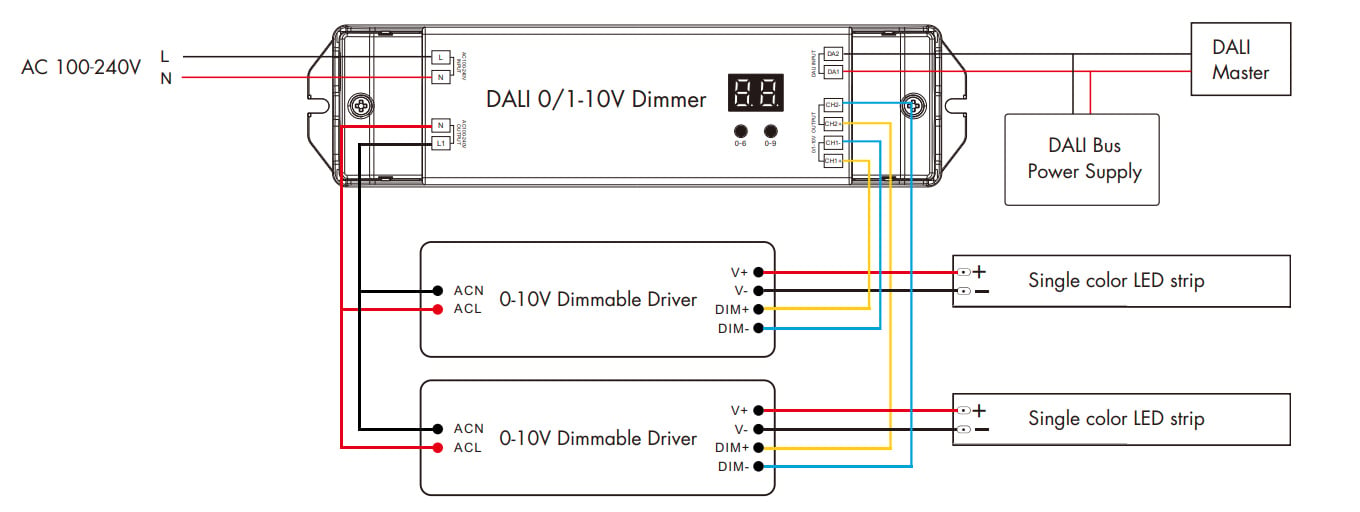
When the DALI master sends a brightness command, the dimmer converts it into an analog voltage signal that regulates the connected driver's output. Always match the output signal mode to the driver's dimming requirements and verify the relay rating, driver quantity, and control-wire distance before installation.
FAQ About DALI 0/1-10V Dimmers
Direct engineering answers on wiring, protocol conversions, channel capacities, and relay isolation for DALI to 0-10V and 1-10V installations.
A DALI 0/1-10V dimmer translates digital commands from a DALI network into an analog 0-10V or 1-10V DC control signal for third-party LED drivers. It functions as a DALI to 0-10V converter operating under IEC 62386-206 (Device Type 5 / DT5). Instead of replacing existing 0-10V commercial troffers, high bays, or LED drivers with costly native DALI gear, this dimmer sits between the digital DALI bus and the driver's analog control terminals, assigning each analog fixture its own distinct DALI short address.
Selecting between DALI 0-10V and DALI 1-10V modes determines whether the analog control voltage drops to 0V or stops at 1V. A 0-10V curve regulates output from 0V to 10V, allowing compatible drivers to dim completely down to dark. A 1-10V curve stops dimming at 1.0V (roughly 1% to 10% minimum brightness) and requires a physical relay to disconnect line power for full switch-off. Our units feature a selector switch so you can align the output voltage range with your driver's specific dimming curve.
No, this unit is a DALI to 0-10V converter, not an input 0-10V to DALI converter or 1-10V to DALI converter. Customers often search for a 0 10V to DALI converter wanting to use an analog wall knob to broadcast commands onto a DALI bus. These dimmers do the exact opposite: they receive digital DALI frames from the bus and generate an analog 0-10V or 1-10V output. If you feed an analog voltage into these signal ports, you will damage the output stage.
The integrated 10A AC relay physically cuts line voltage to the LED power supply when converting DALI to 0 10V off commands. Standard 0-10V drivers draw 0.5W to 3W in standby even when dimmed to 0V, which causes LED glow and wasted electricity in large commercial installations. When the DALI bus transmits an off level (DALI step 0), the internal relay contacts open within 10 ms, isolating the driver mains feed completely and dropping standby draw to zero.
DALI DT5 refers to Device Type 5 under IEC 62386-206, which defines the communication standard for DALI to DC voltage converters. Compliance ensures that any central DALI master recognises the dimmer as an analog output interface rather than a fluorescent ballast or relay unit. When an integrator configures dimming curves (linear vs logarithmic) or sets minimum and maximum analog voltage cutoffs, the DT5 profile translates those digital hex values accurately. You can read more about standard commands in our DALI protocol guide.
Hold the front programming button for 2 seconds until the 2-digit LED display begins flashing. Once flashing, short press the button to advance the address sequentially from 00 to 63. When the desired address appears, stop pressing and wait 5 seconds; the display stops flashing and saves the setting to non-volatile memory. To reset the unit back to factory broadcast mode ('FF'), hold the button down for 10 seconds until the display shows 'FF'.
Yes, our Skydance DALI DT5 units support both active current-sourcing and passive current-sinking analog driver interfaces up to 20mA. Most North American commercial LED drivers source current (roughly 0.5mA to 1mA at 10V) from their dimming leads, requiring the dimmer to sink it. Conversely, certain European electronic ballasts require an active 0-10V source. These units automatically balance both topologies across the signal terminals, ensuring consistent dimming down to the selected 0V or 1V threshold.